Distortion, Excuses, and the Erosion of Credibility in Thailand’s Military Narrative
 Distortion, Excuses, and the Erosion of Credibility in Thailand’s Military Narrative
In times of armed conflict, truth becomes the first casualty. Yet it is precisely during such moments that governments and militaries bear the greatest responsibility to uphold factual integrity, humanitarian principles, and international law. Recent statements by the Thai army’s spokesperson accusing Cambodia of “distorting facts” reveal not clarity, but contradiction—raising serious questions about credibility, intent, and accountability.
The Thai military has asserted that Cambodia fabricated claims of civilian casualties on the grounds that Cambodian authorities had announced the evacuation of civilians within 24 hours. This argument collapses under even minimal scrutiny. Evacuation orders do not instantly empty villages, nor do they negate civilian presence. In reality, Thai artillery fire and F-16 airstrikes were conducted in populated areas. Elderly residents, persons with disabilities, and those with limited mobility were unable—or unwilling—to leave. Others chose to remain behind to safeguard homes, livestock, crops, and pets, believing the fighting would be brief. These are not unusual choices in rural conflict zones; they are human ones. To deny their existence is to erase civilian life from the battlefield narrative.
More troubling is Thailand’s repeated allegation that Cambodia recently planted landmines that killed and injured Thai soldiers during patrols. This claim has been used to justify a disproportionate military response, including heavy artillery barrages and airstrikes penetrating 80 to 90 kilometers inside Cambodian territory. Yet Cambodia has consistently explained that the landmines in question date back decades, planted by multiple sides during previous wars. These remnants of conflict are a tragic legacy shared across the region. Notably, Thailand has never raised the landmine issue formally at any level of bilateral dialogue, nor presented verifiable evidence acknowledged by international experts to substantiate claims of new emplacement.
Even more revealing is the timeline. During the second phase of fighting from 7 to 12 December, no landmine incidents were reported at all. If landmines were truly a present and deliberate threat, such incidents would not have abruptly disappeared. This absence strongly suggests that the landmine narrative is being instrumentalized—not as a matter of humanitarian concern, but as a pretext to legitimize cross-border military operations.
The destruction of Khmer ancient temples marks another deeply troubling chapter. Thai forces have admitted to demolishing temples while claiming that Cambodian troops had converted them into military bases. This argument disregards both law and logic. Cambodian forces have the sovereign right to position themselves anywhere within their internationally recognized territory, particularly to protect cultural heritage sites that sit squarely inside Cambodia’s lawful borders. If Thailand truly believed these temples lay within its own territory—as it claims using unilaterally drawn maps—then obliterating them with heavy artillery and airstrikes would amount to destroying what it purports to be its own heritage.
Equally implausible is the assertion that heavy bombardment was the only military option available. Precision measures, surveillance, or diplomatic engagement were conspicuously absent. Instead, ancient temples were subjected to overwhelming force, contradicting Thailand’s professed commitment to cultural preservation and international humanitarian norms.
The case of the crane near Preah Vihear Temple further exposes the fragility of Thailand’s justifications. Thai officials claimed that the crane was used by Cambodian forces to counter Thai drones, and that its destruction inadvertently damaged the temple. This raises a more fundamental question: why were Thai drones operating over Cambodian sovereign territory in the first place? No evidence has been presented to substantiate the claim that the crane was weaponized. Rather than a credible military explanation, the story appears constructed after the fact to rationalize an unlawful incursion and the resulting destruction.
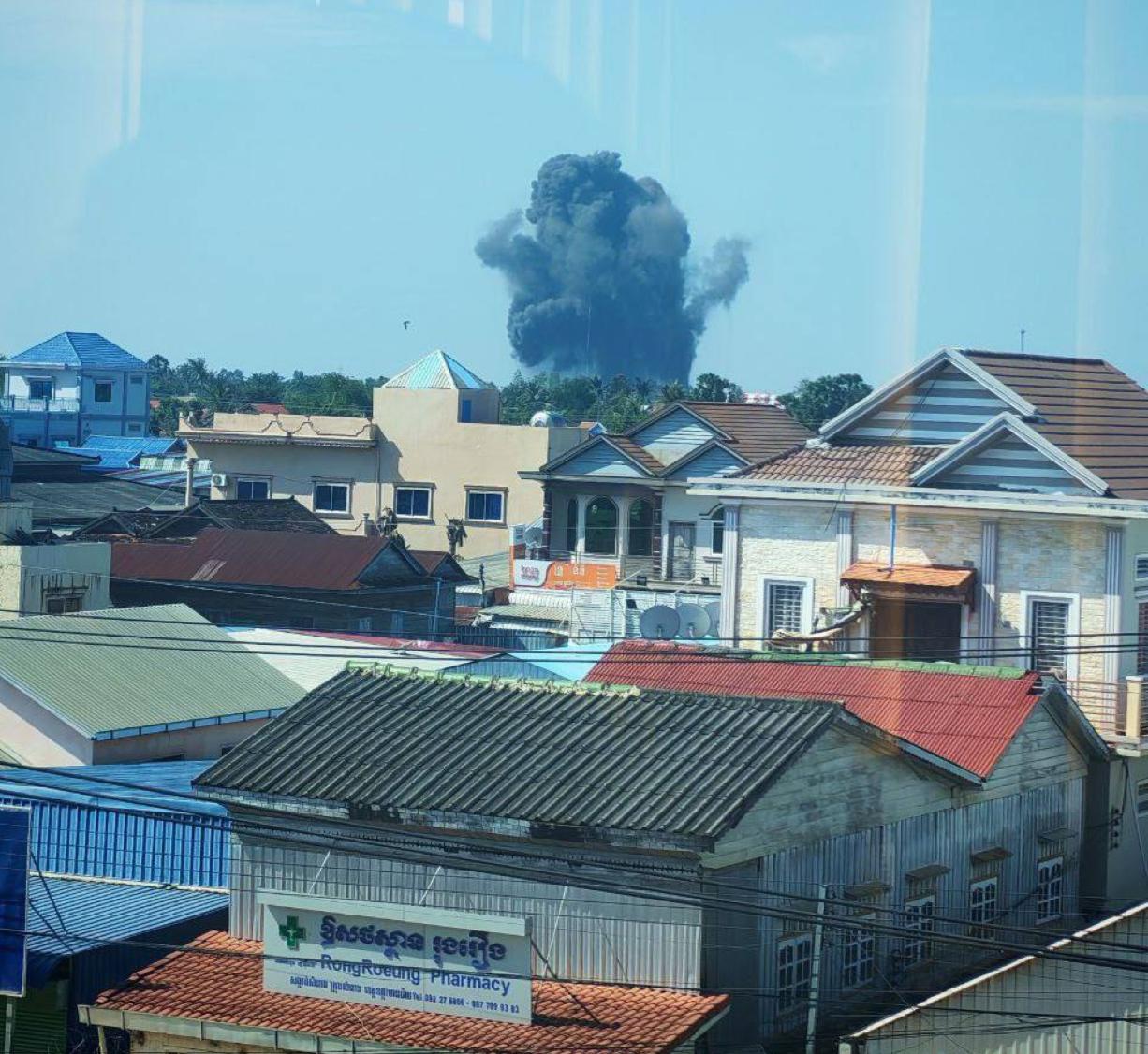
Perhaps the most damning contradiction lies in Thailand’s actions after diplomacy had ostensibly prevailed. Even after U.S. President Donald J. Trump publicly announced that both Cambodian and Thai leaders had agreed to a ceasefire, Thai forces continued firing heavy artillery, deploying toxic gas, and conducting F-16 bombardments into Cambodian towns near the border, including Preah Vihear Temple, Ta Krabei, Tamoan Thom, Ta Moan Touch Prey Chan, Chouk Chey, O’Bei Choan, Beung Trokoun, O’Smach, Thmar Da. These are not isolated incidents or misunderstandings; they are sustained operations conducted in defiance of declared political commitments.
This pattern forces an uncomfortable question into the open. If political leaders agree to a ceasefire and military actions continue unabated, where does authority truly lie? Is the Thai army acting independently of civilian oversight, or is it deliberately undermining diplomatic efforts? Either possibility points to a dangerous erosion of command responsibility.
War is not defined only by gunfire; it is defined by intent, proportionality, and respect for civilian life. The repeated use of heavy weaponry against populated areas, the destruction of irreplaceable cultural heritage, the reliance on unsubstantiated allegations, and the disregard for ceasefire commitments collectively undermine Thailand’s claim to moral or legal high ground.
Peace is not sustained by narratives crafted to excuse escalation. It is sustained by restraint, accountability, and truth. Until Thailand reconciles its words with its actions, its military narrative will remain less a defense of national security than a case study in how contradictions weaken credibility—and how the misuse of force ultimately damages the very legitimacy it seeks to preserve.
Keo Chesda, Affiliated Researcher at University of Cambodia