Thai military leverages the border crisis to reassert its political influence
 Thai military leverages the border crisis to reassert its political influence
By the end of 2025, Thailand was moving towards a February 2026 election, with the military — an enduring agent of the monarchy in the country — resurgent amid renewed conflict with Cambodia.
At the start of the year, the centrist Pheu Thai party (PT), dominated by former prime minister Thaksin Shinawatra, led the government in a coalition which included a reluctant conservative Bhumjaithai Party (BJT), with Thaksin’s daughter, Paetongtarn Shinawatra, as prime minister. The progressive People’s Party (PP) — which had won a plurality of seats in the 2023 election — led the opposition.
Tensions on the Thailand–Cambodia border had steadily escalated in late 2024 and early 2025, in part because of a breakdown in relations between Thaksin and Cambodian strongman and former prime minister Hun Sen, before deteriorating further in early 2025. Hun Sen was apparently angered by the Paetongtarn government’s decision to legalise gambling in Thailand, which threatened Cambodia’s casino industry, and Thailand’s crackdown on scam centres near the Cambodian border, which allegedly funnelled profits to Hun Sen’s Cambodian People’s Party.
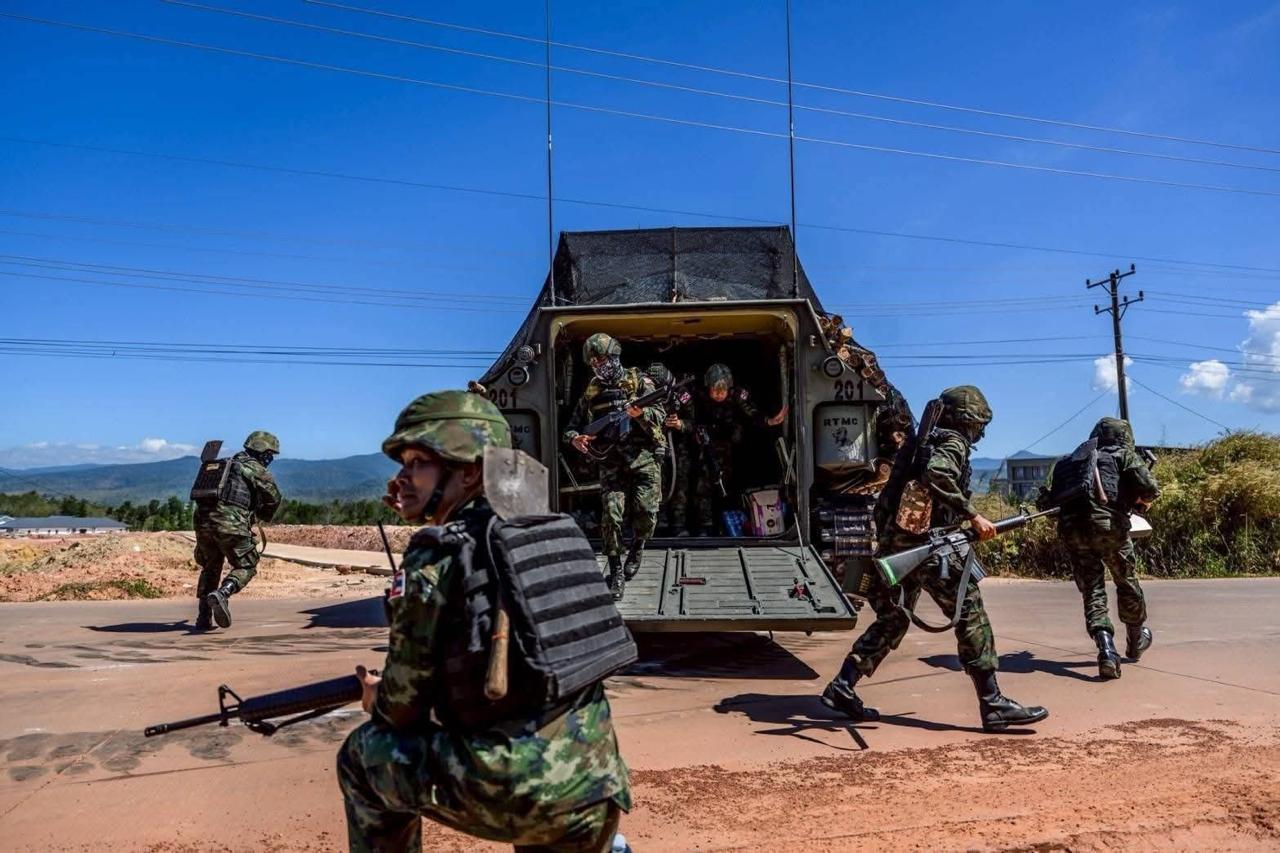
Between February and May 2025 each side accused the other of boundary incursions. Then in May, General Boonsin Padklang, the Second Army Region commander who headed Thai forces along the border, appeared to defy his prime minister by deciding independently that he recognised a border map geographically favourable to Thailand, and closed the border with Cambodia. Though clearly defying civilian rule, in providing border security against Cambodia the Thai military enjoyed a surge in popularity, enabling it to engineer a resurrection of its autonomy beyond the civilian leadership’s preferences.
With the intensification of violent standoffs, the Paetongtarn government sought deescalation. On 15 June Paetongtarn called Hun Sen, explaining her desire to reopen the border and ensure peace but that she could not control Boonsin. Almost simultaneously, a royal entourage delivered gifts to border-based soldiers — implying the palace’s solidarity with the troops and its support for military insubordination — and met with Boonsin. Cambodia’s later public revelation of Paetongtarn’s call caused her immediate public embarrassment and led to her temporary court-ruled ouster. Four days after the call, BJT withdrew from the governing coalition.
Tensions culminated in July during a border clash that killed at least 32 people. Eventually, the 2025 ASEAN Chair, Malaysia negotiated a tenuous ceasefire with US and Chinese support. But by that point Thailand’s military was acting independently, nationalist sentiment had surged and the PT-led government seemed to have lost both popular and palace support.
On 29 August, the Constitutional Court removed Paetongtarn from office, ruling that her apparent deference to a foreign leader in the form of Hun Sen violated ethics rules. On 5 September, a parliamentary majority voted in conservative BJT leader Anutin Charnvirakul as her replacement, with the progressive PP instrumental in guaranteeing his success. Almost simultaneously, the judiciary ruled that Thaksin had not properly served a previous prison sentence and required he be imprisoned for one year.
In exchange for the PP’s support, the BJT made numerous concessions. The Lower House’s dissolution was promised within four months — Anutin later reluctantly set the dissolution’s date no later than 31 January 2026 — with elections scheduled for within 60 days of the parliament’s dissolution. Anutin also promised to support PP’s efforts to establish a drafting committee to make constitutional changes. In October, the PP-favoured charter amendments bill passed and it appeared set to pass all three required readings by December.
Unlike Paetongtarn, Anutin enjoys a harmonious relationship with the military. With the generals supporting him, Anutin green-lit the army to respond to border tensions and gave it a free hand over counter-insurgencies in Thailand’s deep south. Anutin also maintains good relations with Thailand’s royal family, having long been a close associate of King Vajiralongkorn.
But Anutin’s public popularity has waned with the prolongation of the crisis with Cambodia, criticism of his response to recent flooding, and fresh corruption allegations.
Despite a formal declaration of peace in late October, Cambodian-placed land mines along the border continued to injure Thai soldiers. In response, Anutin announced in November that Thailand no longer observed the peace accord with Cambodia. But US pressure — including threats of higher tariffs — led Anutin to soften his stance.
Flooding in November undermined his standing further, with a poll showing public support for Anutin decreasing from 48 to 23 per cent as the elections loom.
In November, reports also surfaced that the Prince Group, a cybercriminal network, had rented office space from Anutin’s family, while a photograph surfaced of Anutin with Benjamin Mauerberger, the alleged point man of several such criminal networks. PT promised to file an ethics complaint and censure motion against the government when the parliament reconvened in December.
When December came and PP attempted to pass the constitutional reform bill, BJT suddenly withdrew its support, and PP called for an immediate no-confidence motion against the prime minister. Anutin himself then unexpectedly dissolved the Lower House on 12 December, and the general election was set for 8 February 2026. The acceleration of elections comes as Thailand and Cambodia resume their violent border conflict, with heavy fighting occurring along the frontier in December 2025.
The new year is set to be a year of continued instability for Thailand given the exacerbation of border violence and the possibility of political change, with 8 February election resulting in either a continuing BJT-led coalition or (less likely) bringing in a coalition led by PP or PT. Whether or not BJT leads will determine the prospect of constitutional reform.
The resurgence of the Thai military, which is increasingly acting independently of civilian preferences looms over Thai politics. Though the military works well with BJT, its growing power might embolden it to launch coups to preempt efforts to expand Thailand’s political space, such as might follow a PP electoral landslide. Given Thailand’s history of coups, the military could reemerge as the greatest threat to Thailand’s democratisation.
Paul Chambers is Visiting Fellow at the ISEAS-Yusof Ishak Institute, Singapore, and has published extensively on military affairs in Southeast Asia.
East Asia Forum