
Cambodia’s newest airport could take off as a regional hub
 Cambodia’s newest airport could take off as a regional hub
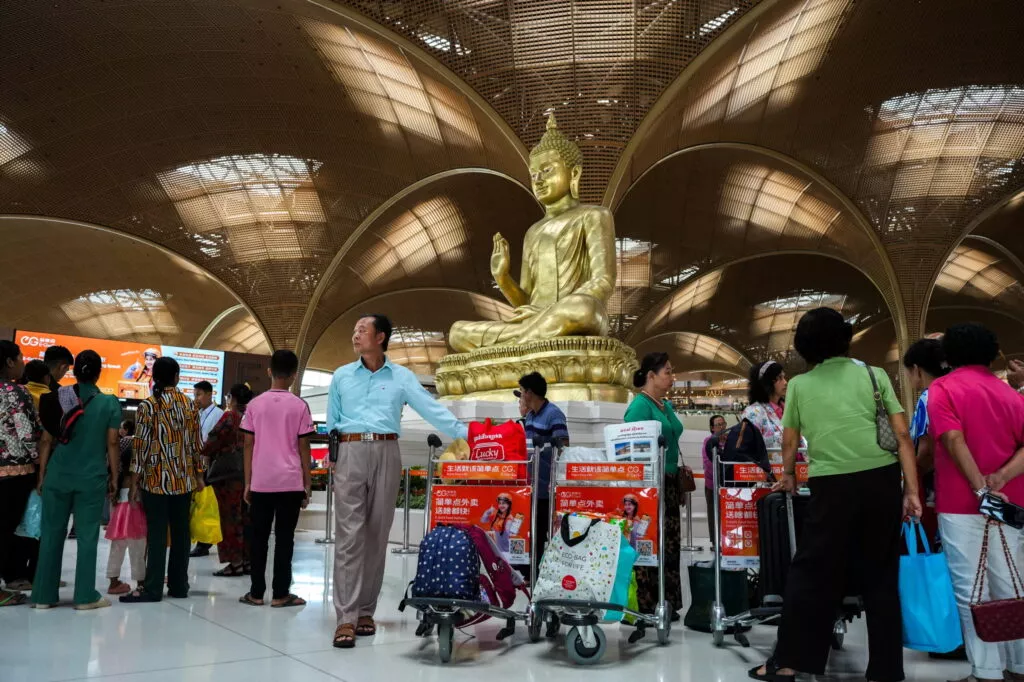
Phnom Penh, 27 December 2025 — Techo International Airport (KTI) represents Cambodia’s aspiration to reposition itself within Southeast Asia’s evolving air transport network. The airport is touted as stimulating growth, reinforcing regional integration and supporting Cambodia’s economic diversification. But sustainable connectivity and the growth of Cambodia’s local aviation industry will ultimately depend on how effectively the government aligns aviation governance, market incentives, and long-term institutional coordination within an increasingly competitive aviation landscape.
KTI’s eco-oriented terminal, 4000-metre runway and planned multi-runway expansion reflect Cambodia’s strategy to embed itself within ASEAN connectivity frameworks, including the ASEAN Connectivity Strategic Plan 2026–35, the ASEAN Single Aviation Market and the Multilateral Agreement on Air Services. Government projections link KTI and its associated projects to sizeable macroeconomic spillovers across logistics, airport operations and auxiliary services.
Phnom Penh’s former airport was constrained by a single 3000-metre runway and a design capacity of around five million passengers annually, with no feasible room for expansion. KTI’s phase one facilities will accommodate 13 million passengers, with plans to raise this to 30 million by 2030 and 50 million by 2050.
But infrastructure alone will not enhance connectivity unless KTI becomes an aviation hub supported by strategic partnerships, regulatory coordination and crucially, a strong national carrier.
Flag carriers anchor hubs, influence route development and shape bilateral negotiations. Cambodia Angkor Air, rebranded as Air Cambodia in 2025, operates six aircraft to 18 destinations, with plans to grow its existing fleet. To support this trajectory, Air Cambodia has signalled interest in acquiring narrow-body aircraft including up to twenty COMAC C909s. Air Cambodia is the anchor for KTI to begin functioning as a regional hub rather than a gateway, but early steps must be consolidated into a coherent hub-building strategy.
Hub competitiveness depends on network logic, not just infrastructure alone. Airlines use banked waves of arrivals and departures to aggregate demand and support high-frequency services. This hub-and-spoke model underpins the success of Singapore’s Changi Airport and Bangkok’s Suvarnabhumi Airport, enabling them to sustain profitable long-haul routes that local demand alone would not justify.
With KTI operating mainly as a spoke feeding into Bangkok, Kuala Lumpur and Singapore, adopting a hub-oriented network strategy is essential to reduce such dependency. Air Cambodia’s new service to Tokyo and the forthcoming Osaka flight mark early steps towards building connectivity, while additions by foreign carriers, including Etihad Airways and Turkish Airlines from December 2025, have improved access to Europe and the Middle East.
But these gains also highlight Cambodia’s current vulnerability — KTI’s long haul links expand only when foreign airlines allocate capacity, leaving connectivity exposed to shifts in external demand. A strong policy to develop the country’s aviation sector is critical to shift Cambodia from a rule-taker of other airlines’ network strategies to a rule-shaper with greater leverage in bilateral negotiations and codeshare agreements.
Airports also anchor ecosystems of high-value activities such as maintenance and repair operations (MRO), training academies and ground-handling services, all of which generate skilled employment. In South Korea, Korean Air’s new engine MRO complex near Incheon Airport integrates advanced inspection, repair and component-shop capabilities that service both national and foreign carriers.
Cambodia has begun taking steps in this direction. KTI hosts an MRO joint venture which brings some technical capacity onshore. But the experience of leading Asian hubs shows that fully developed aviation ecosystems require a broader range of downstream industries. Over time, expanding such capabilities around KTI could position the airport as a maintenance and training node within mainland Southeast Asia.
Ground connectivity will also shape KTI’s wider economic impact. Road access via a new expressway and airport bus service remains the main link, but road-only access will constrain growth as passenger volumes rise. The government is studying a light rail link — along with continued rail development and road upgrades — to cut travel times, improve reliability and align ground access with KTI’s broader economic role. Over time, integrating KTI into national corridors connecting Phnom Penh with Siem Reap and Sihanoukville would help disperse visitor flows.
KTI is entering a competitive regional market. Singapore Changi handled 67.7 million passengers in 2024 and is constructing Terminal 5 to extend connectivity beyond 200 destinations. Kuala Lumpur International Airport processed 57 million passengers and ranks as Asia’s top ‘megahub’, while Bangkok Suvarnabhumi Airport handled 62.2 million passengers in 2024 and operates with a third runway capable of 94 movements per hour.
Competing with established regional hubs will require Cambodia to address institutional and technical constraints. In 2025, the government advanced three major draft aviation laws to modernise the regulatory framework, aiming to clarify institutional roles, strengthen safety oversight and licensing and align national rules with international standards. They also seek to boost investor confidence by providing clearer regulations for airport concessions, airline operations and technical service providers.
Further priorities include strengthening Air Cambodia through capitalisation, fleet expansion and alignment with global alliances, as well as investing in training and certification facilities. The government should also improve regulatory coherence across civil aviation, tourism, investment and logistics and integrate aviation planning with industrial zones and tourism strategies.
The central challenge is cultivating the governance capacity to transform infrastructure into connectivity. If Cambodia can align infrastructure investment with a coherent airline strategy, KTI could emerge as a competitive regional hub and escape its current dependency on the commercial calculus of foreign carriers.
Marc Pinol Rovira is Assistant Professor of International Relations at the American University of Phnom Penh.
East Asia Forum