Preah Vihear: What International Law Actually Says
 Preah Vihear: What International Law Actually Says
A social media post circulating online claims that Preah Vihear “loses protection from all laws in the world” because of alleged military use and therefore becomes a legitimate target. That framing misrepresents how international law is structured. International law does not work by sweeping declarations on social media. It works through specific treaties and obligations that apply to states and actors in defined circumstances.
Under the United Nations Charter, all member states must refrain from the threat or use of force against the territorial integrity or political independence of any state. Article 2(4) of the Charter establishes this prohibition clearly, and there is no exception that legalizes crossing a recognized international boundary with bombs or artillery simply because one side alleges military use of a site. (United Nations, Charter of the United Nations, Article 2(4).)
Preah Vihear’s status was judicially settled by the International Court of Justice (ICJ) in a 1962 judgment that awarded sovereignty to Cambodia for the Temple and surrounding promontory. The ICJ’s Statute makes judgments final and without appeal in cases where jurisdiction has been accepted, which was the situation in that dispute. (International Court of Justice, Statute of the ICJ, Article 60; Case concerning the Temple of Preah Vihear, Judgment, 15 June 1962.) A later ICJ interpretation in 2013 confirmed Cambodian sovereignty over the entire promontory on which the temple stands. (Case concerning the Temple of Preah Vihear, Interpretation of the Judgment of 15 June 1962, 2013.)
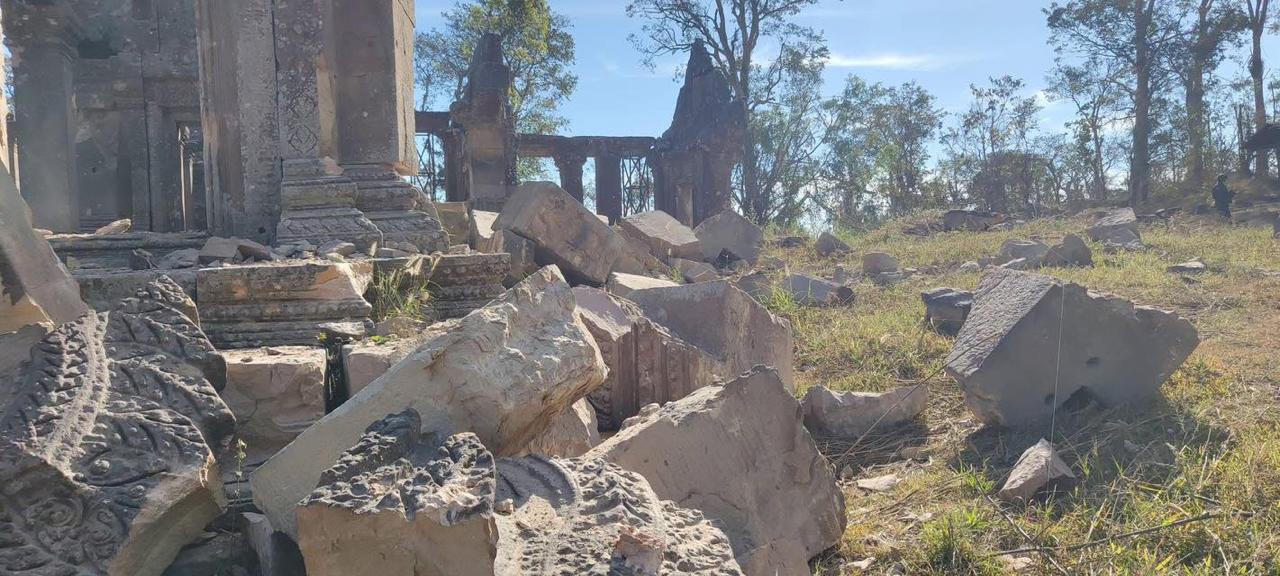
Even in situations of armed conflict, cultural property such as temples retains protected status under international humanitarian law. The 1954 Hague Convention for the Protection of Cultural Property in the Event of Armed Conflict obligates parties to avoid using cultural property in ways that expose it to destruction and forbids acts of hostility against such property unless imperative military necessity exists a very high and tightly constrained threshold. (Hague Convention for the Protection of Cultural Property in the Event of Armed Conflict, Articles 4 and 6.) Further, Additional Protocol I to the Geneva Conventions specifically bars acts of hostility directed against historic monuments and works of art that constitute the cultural heritage of peoples. (Additional Protocol I, Article 53.)
The rules do allow that cultural property loses its special protection in certain extreme circumstances, but this does not mean the loss of all legal constraint, nor does it mean a state can freely decide through rhetoric that a site is now a lawful target. Claims about military use must be verified against evidence, and even then the attacker must still comply with the higher-level principles of distinction, proportionality, and precautions in both the Geneva Conventions and customary international humanitarian law.
Finally, individuals who intentionally direct attacks against protected cultural objects may face criminal liability under the Rome Statute of the International Criminal Court. Attacks on buildings dedicated to religion, historic monuments, or cultural heritage that are not military objectives can constitute war crimes when done intentionally. (Rome Statute of the International Criminal Court, Article 8(2)(b)(ix).)
What this means is straightforward. Cultural heritage sites like Preah Vihear do not “lose protection from all laws in the world” because of an unverified social media statement. Sovereignty issues have already been legally decided by the world’s highest court. The use of force across a frontier remains prohibited under the UN Charter. Cultural property retains protection under the Hague Convention and Geneva law, and reckless talk about flattening sacred sites can expose actors to serious legal and reputational consequences.
If anyone claims that a cultural site is being misused for military purposes, the burden of proof is on them to present verifiable, independently reviewable evidence in appropriate international mechanisms, not on others to accept the claim as fact without scrutiny.
Midnight