How the Thailand–Cambodia Border Dispute Has Shifted from Force to Procedure
 How the Thailand–Cambodia Border Dispute Has Shifted from Force to Procedure
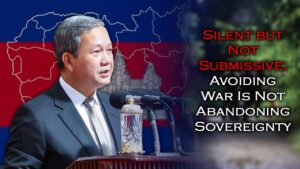
The ceasefire along the Thai–Cambodian border should not be mistaken for resolution. It marks a transition in the nature of the dispute. When gunfire stops, pressure does not dissipate; it relocates into procedure, timing, domestic politics, and the management of legitimacy. The conflict has moved from terrain to process, from movement on the ground to movement in calendars, legal language, and institutional channels.
Thailand is now operating deliberately in this second arena. With parliament dissolved and elections scheduled for early February, Bangkok has positioned itself behind caretaker-government constraints, constitutional limits, and pending leadership decisions. This posture allows Thailand to avoid committing to boundary mechanisms without formally rejecting them. The repeated emphasis on “timing and conditions” for future talks functions as a legally defensible delay, one that preserves flexibility while projecting restraint. It is notable that even as ceasefire mechanisms progressed through military-to-military channels, Thailand avoided placing MOU 43 on the agenda of ceasefire discussions, keeping humanitarian calm and boundary procedure carefully compartmentalized.
Domestic politics further tighten this posture. Thai public sentiment has hardened sharply, creating an environment in which any move interpreted as withdrawal or concession would carry high political cost. This explains why Thailand increasingly speaks in the language of international law and stability while withholding concrete timelines. The emphasis on restraint, proportionality, and peaceful means is paired with explicit reservations of the right to self-defense under the UN Charter, a form of narrative insurance that signals readiness while claiming compliance. Thailand is not escalating, but it is preloading justification should force again be deemed “necessary.”
At the same time, Bangkok has broadened the dispute well beyond demarcation. Humanitarian law, landmines, drone incidents, and transnational cybercrime have all been drawn into the frame. By invoking the Ottawa Convention and civilian protection obligations, and by linking border stability to cooperation on online scam networks and trafficking, Thailand expands the agenda in ways that shift reputational pressure onto Cambodia. These parallel tracks allow Thailand to appear constructive while ensuring that Cambodia must continuously demonstrate compliance across multiple domains, even as the boundary mechanism itself remains stalled.
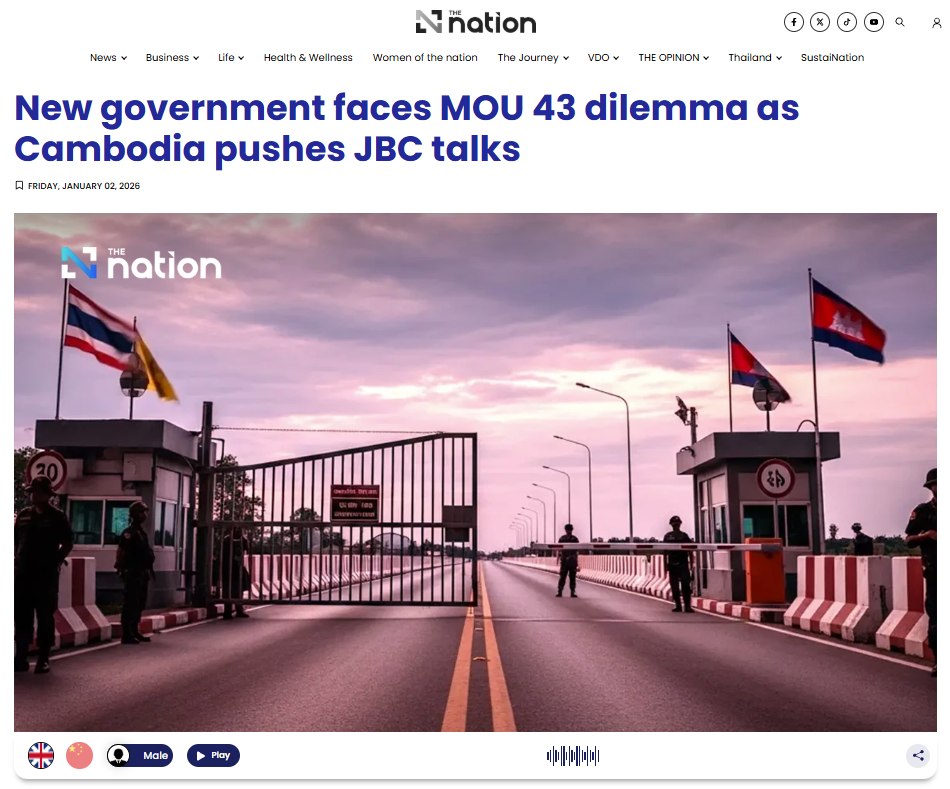
Cambodia’s posture, by contrast, has been consistent and narrowly procedural. Its repeated calls to activate the Joint Boundary Commission under MOU 43, including proposals for early meetings with clearly identified technical scopes, are not about speed or theatrics. They are about record. In disputes that have entered an institutional phase, legitimacy accumulates through documentation, minutes, proposals, and unanswered letters. Each formal request strengthens the evidentiary trail that matters to third parties long after immediate headlines fade.
This divergence in posture now defines the strategic balance. Thailand holds positions on the ground and seeks to normalize calm without locking itself into outcomes, while Cambodia seeks to prevent normalization from turning into quiet stagnation. Neither side is escalating, but only one side is actively reinforcing the procedural architecture. The burden of explanation, therefore, is beginning to shift. Delay must be justified. Silence must be defended.
External actors are observing this shift closely. Recent trilateral diplomatic efforts framed around de-escalation and restoration of cross-border exchanges reflect a regional preference for stability and economic continuity. For Thailand, reopening checkpoints eases commercial and political pressure. For Cambodia, reopening without procedural movement risks dissolving attention before structural issues are addressed. This tension explains why ceasefire calm, while necessary, is insufficient as an endpoint. Stability without process favors the status quo; stability with process redistributes leverage over time.
The critical variable now is not rhetoric but behavior. Who continues to propose meetings. Who defers them. How humanitarian and economic normalization is sequenced relative to boundary mechanisms. Thailand’s current strategy relies on time, domestic constraints, and agenda expansion. Cambodia’s strategy relies on persistence, narrow institutional focus, and restraint. In this phase, outcomes will be shaped less by statements than by records, and less by visible strength than by who allows time to work against them.
For regional and international observers, this is the signal to watch. The dispute has not cooled; it has thickened. And in disputes that thicken into procedure, patience, consistency, and documentation eventually outweigh noise.
Midnight