Thailand train crash and China’s information reflex
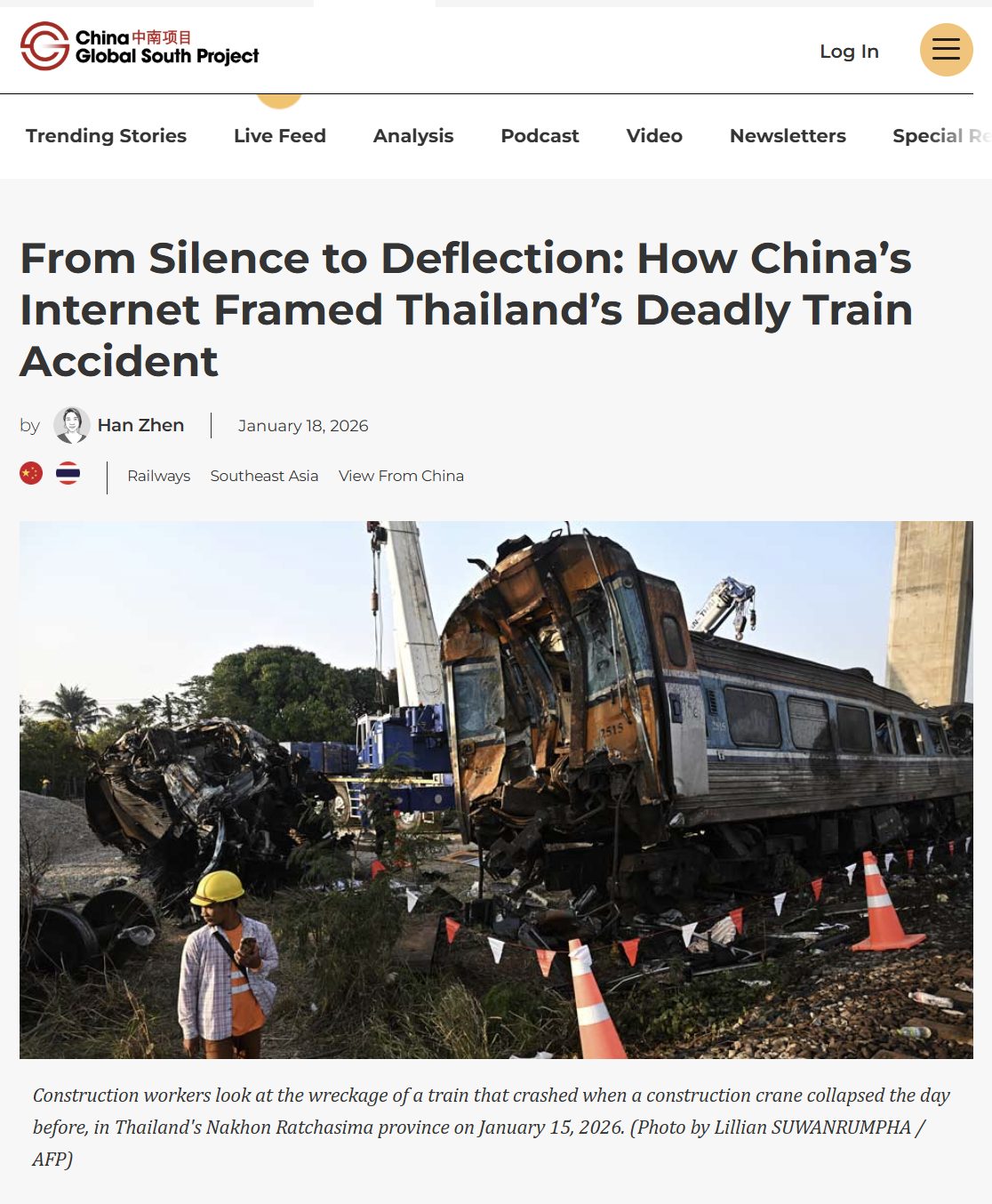 Thailand train crash and China’s information reflex
After a crane collapsed onto a passenger train in Thailand, killing dozens, discussion on Chinese social media did not disappear. It moved rapidly into anticipatory defense.
The dominant framing was clear and quickly consolidated. The construction site was operated by a Thai contractor. China, users argued, was being unfairly implicated because the rail line carries Belt and Road branding. Responsibility, they insisted, lay elsewhere. This narrative hardened even as official investigations were still underway.
What is notable is not the presence of debate, but its direction. There was little sustained examination of China’s actual exposure to the project, whether financial, managerial, or reputational. Nor was there serious engagement with recent precedents that help explain why suspicion arises when Belt and Road projects are involved.
Those precedents are recent and documented. A separate building collapse in Thailand had already drawn detailed international reporting on Chinese capital participation, subcontracting practices, and material quality issues. In mainland discourse, that episode faded quickly. Corporate messaging linked to the project quietly disappeared. The lessons of that scrutiny were not debated, but absorbed.
The reaction to the train crash reflects this learning process. Rather than silence, the response was preemptive framing. China was positioned as a potential scapegoat before questions of responsibility were settled. Infrastructure risk was treated as abstract and universal, detached from governance structures, incentives, or project oversight.
In Belt and Road projects, visibility is inseparable from risk. Branding that amplifies success also magnifies scrutiny when accidents occur. The instinct to deflect may offer short term reputational insulation. Over time, however, it narrows the space for credible discussion and signals how constrained debate has become when infrastructure, politics, and national image intersect.
Midnight