Cambodia bets big on state-led development
 Cambodia bets big on state-led development
Two stories stood out in Cambodia’s 2025 development landscape — the opening of the country’s newest and largest international airport and the consolidation of a national digital payment system, Bakong.
Neither is remarkable for its immediate economic impacts, which are likely to materialise only over time, but rather for the novelty they reveal in Cambodia’s emerging economic governance — one likely to shape the country’s development trajectory for years to come. These developments point to a reconfiguration of how the Cambodian state governs development through new institutional forms, legal instruments and infrastructure-building practices that extend its role beyond regulation alone.
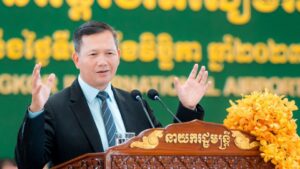
The launch of Techo International Airport in September 2025 marks Cambodia’s most ambitious infrastructure project undertaken outside traditional aid frameworks and foreign investment-led ownership models. Costing over US$2 billion, the airport is a domestic joint venture in which the Overseas Cambodian Investment Corporation holds a 90 per cent stake, with the remaining 10 per cent held by the state through the State Secretariat of Civil Aviation.
This ownership structure is unprecedented in Cambodia. Since the 1990s, its major infrastructure projects have typically relied on concessional loans, grants and, especially since the 2000s, build–operate–transfer (BOT) arrangements dominated by Chinese capital. Though initially structured around external financing, the project was ultimately delivered through domestically mobilised capital, including bond issuance.
A rapidly growing share of financial transactions now passes through a state-built and state-operated centralised digital platform. Since its launch in 2020, the Bakong digital payment system has become Cambodia’s core national financial infrastructure and interfaces with major regional and global payment networks. By the end of 2025, Bakong had registered 30 million wallets — nearly double the country’s population — and processed over US$150 billion in transactions, more than three times the country’s GDP. Beyond payment efficiency, Bakong embeds the state within the architecture of an ever-expanding share of everyday domestic and transnational financial transactions.
Bakong and the airport form part of a broader portfolio of digital and physical infrastructure projects, including Cambodia’s first national expressway, the US$1.7 billion Techo Funan canal and platforms for data exchange and document verification. These initiatives demonstrate the Cambodian state’s growing technical sophistication and its increasing capacity to plan, finance and participate directly in large-scale projects.
More fundamentally, they appear to be rooted in the country’s longer-term, highly coordinated development strategy, articulated through successive high-level frameworks since the mid-2010s. National development strategies such as the Cambodia Industrial Development Policy (2015–2025) and the Digital Economy and Society Policy Framework (2021–2035) have placed infrastructure and digital connectivity at the centre of economic upgrading. These shifts were reinforced by revenue mobilisation reforms that strengthened fiscal capacity. At the same time, reforms to the public–private partnership framework moved the state beyond concession-based contracting, enabling it to appraise projects, allocate risk and take equity stakes.
These practices mark a shift in how the Cambodian state engages with major investment and infrastructure systems. In this sense, Cambodia aligns with a broader global shift towards a development paradigm centred on financialisation. Under this model, states play an active role in de-risking investment by devising flexible public–private partnership schemes, building advanced digital and physical infrastructure and institutionalising legal frameworks that make large-scale projects attractive for global financial capital.
Deep dependence on foreign investment, especially from China, in Cambodia’s infrastructure and broader economic development will likely persist. Even so, reforms since 2015 have introduced a new and consequential dimension to the country’s economic governance.
Yet the speed and extent to which these reforms translate to tangible economic gains will depend on how effectively they are taken up and embedded in practice. Much will hinge on the airport’s capacity to strengthen regional connectivity and attract trade and tourism over time, as well as on Bakong’s role in supporting greater formalisation, transparency and efficiency across the economy.
Operating, maintaining and extracting value from such high-stakes assets will also require governance arrangements that push further towards formalisation and transparency. This developmental drive — set out explicitly in Cambodia’s ambitious national development strategy unveiled in 2023 — will weigh heavily on the state’s trajectory in the years ahead.
While these initiatives reveal new dynamics in Cambodia’s emerging economic governance that may shape its development trajectory, significant challenges remain. Chief among them are translating recent reforms into stronger state institutions capable of operating effectively amid pervasive informality and systemic corruption, and restructuring an economy that remains narrowly-based and heavily dependent on low-skilled, labour-intensive export manufacturing.
At the same time, growing evidence — including the arrest of Chen Zhi, chairman of Cambodia-based Prince Group who has been accused of involvement in regional scam networks — suggests that transnational cybercrime has penetrated deeply within the Cambodian economy. These developments risk damaging the country’s international reputation and are attracting mounting pressure, particularly from the United States. They have been further complicated by intensifying border tensions with Thailand, injecting new uncertainty into an already fragile development momentum.
Kimhean Hok is PhD candidate at Lund University’s Centre for East and Southeast Asian Studies.
East Asia Forum