Response to the Interview of the Thai Foreign Minister on France 24
 Response to the Interview of the Thai Foreign Minister on France 24
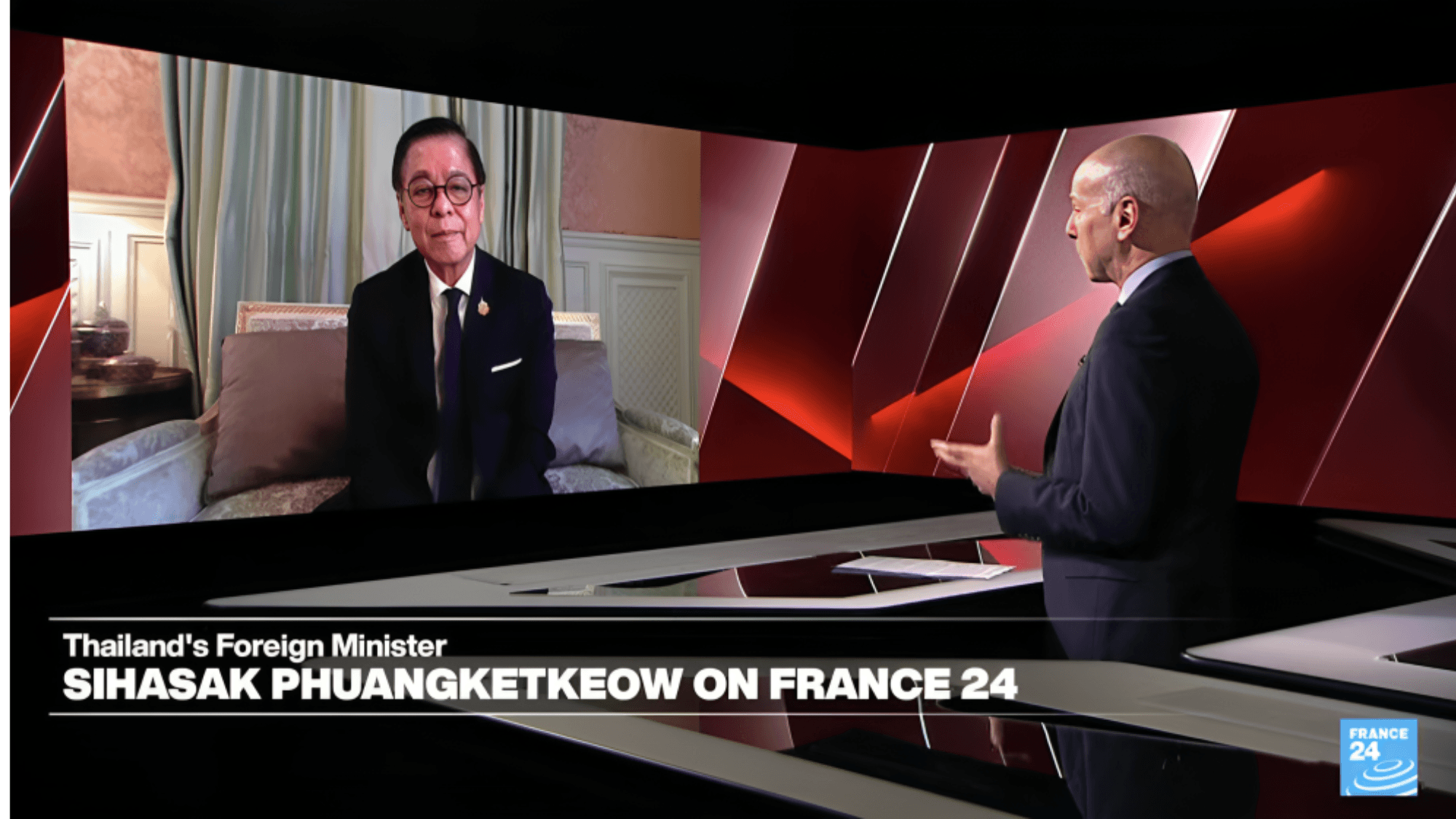
The recent interview of Sihasak Phuangketkeow, Thailand’s Minister of Foreign Affairs, with France 24, has become an important case study for the international community in assessing the credibility and legal foundation of Thailand’s claims regarding the Cambodia–Thailand border issue.Rather than providing responses grounded in documentation, international law, and historical facts, the interview clearly revealed the use of misleading rhetoric and the construction of narratives lacking a solid factual basis.
The most striking point in the interview was the assertion that the territory where Thai troops are currently present is Cambodian land dating back to the period when Thailand established refugee camps. Such a claim is not only factually incorrect but also fundamentally contradicts basic principles of international law.
Under universally recognized norms, the establishment or hosting of refugee camps cannot alter territorial sovereignty or confer territorial rights upon any party. The exploitation of humanitarian issues to obscure questions of sovereignty and military presence is a tactic that the international community has long rejected.
During the interview, France 24 journalists repeatedly and clearly questioned the statements made by the Cambodian Prime Minister concerning the continued presence and occupation of Cambodian territory by Thai forces. These questions were direct and demanded legal clarification. However, the Thai side failed to respond with any evidence or official documentation.
Instead, topic diversion, evasive language, and deliberate ambiguity demonstrated that Thailand lacks a solid legal foundation for its claims. When a diplomat is unable to answer straightforward questions from international journalists on a global media platform, it signifies that the underlying claims are fragile, unclear, and devoid of authoritative grounding.
The Thai Foreign Minister’s statement that he “believes in dialogue between Cambodia and Thailand” was further undermined when he acknowledged that communication had been limited to WhatsApp conversations with his Cambodian counterpart. Dialogue on issues of sovereignty and borders cannot be reduced to informal, off-the-record exchanges that lack a legal framework, official records, and accountability.
Unstructured communication does not constitute diplomacy; rather, it serves as a delaying tactic that risks deepening mistrust and further complicating the situation.
This interview clearly confirms that the Cambodia–Thailand border issue is not a matter of differing interpretations, but a matter of respect for law versus the distortion of facts. Cambodia has consistently presented its position publicly on the basis of sovereignty and international law, while the Thai side has been unable to provide clear answers to direct questions posed by international journalists.The international community should therefore carefully consider that dialogue not grounded in truth and law cannot lead to lasting peace.
In conclusion, the interview of the Thai Foreign Minister on France 24 failed to fulfill its role of providing clear explanations to the international community. Instead, it exposed the weakness of Thailand’s claims and a lack of sincerity in the use of diplomatic language. The distortion of history, diversion of issues, and assertions made without supporting documentation cannot replace international law and historical truth.
In diplomacy, territorial sovereignty and respect for international law are not matters of emotion or political convenience, but matters of evidence, documentation, and responsibility. Dialogue that does not rest upon these principles cannot build trust nor lead to sustainable peace.
Within this context, Cambodia will continue to stand firmly on the foundations of truth, law, and transparency, while remaining open to formal dialogue conducted within an appropriate framework and with clear accountability. On the international stage, truths grounded in law invariably possess greater authority and longevity than claims manufactured merely to evade scrutiny.
By: Pin Vichey – Political Science Scholar