Between Peace and War: Diverging Political Directions of Cambodia and Thailand in an Era of Global Uncertainty
 Between Peace and War: Diverging Political Directions of Cambodia and Thailand in an Era of Global Uncertainty
In today’s global context—marked by uncertainty and intensifying power competition—Cambodia and Thailand are clearly demonstrating contrasting political and strategic directions. While Cambodia is actively promoting its image as a peaceful nation through the organization of major cultural events such as “Nokor Sankran,” Thailand, on the other hand, has been observed increasing military activities along the Cambodia–Thailand border. This has raised concerns about a potential resurgence of conflict, contributing to political and security tensions in the region.
“Nokor Sankran” is not merely a festive or entertainment event; it serves as a political instrument to enhance Cambodia’s soft power. Through this event, Cambodia showcases its cultural identity, traditions, and social stability to the international community. This reflects Cambodia’s strategic choice of pursuing “development through peace,” with a focus on improving its economic foundations—particularly in tourism—and strengthening its global appeal.
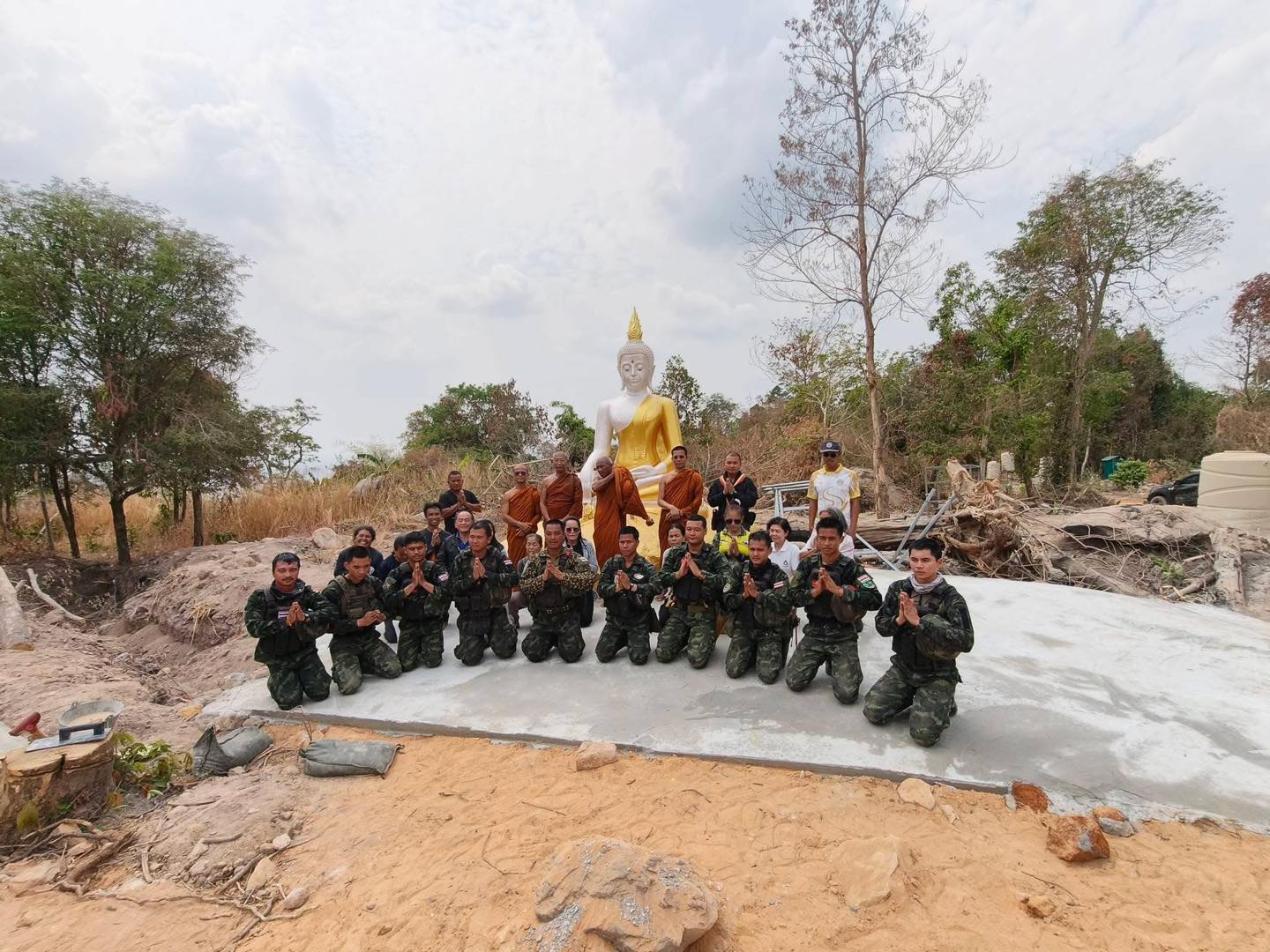
In contrast, Thailand’s military activities along the Cambodian border have persisted despite the existence of ceasefire agreement. These actions suggest increasingly clear strategic intentions that may point toward renewed territorial aggression. For instance, in the Mom Bei area of Preah Vihear province, around Hill 469, Thai armed forces have reportedly cleared land, constructed roads, and built permanent structures, including Buddha statues. Similar activities have also been reported in Thmar Daun village, Banteay Ampil district, Oddar Meanchey province, where roads and infrastructure have been developed in the Domnak Sdach area.
Likewise, in the An Seh area of Preah Vihear province, there have been reports of land clearing, road construction, and the raising of the Thai national flag. Comparable developments have occurred in multiple locations, including O Phka Sne, Hill 677, and Hill 500, where Thai forces, alongside Buddhist monks, have constructed Buddha statues. Furthermore, in Ta Thav and areas near Prasat Don Toun, permanent structures have been built on Hill 505 and Hill 333. Similar land clearing and road construction activities have also been observed in Ta Seum and Chak Preng.
Moreover, Thai forces, with the participation of monks, have erected Buddha statues at various sites within Cambodia’s legally recognized sovereign territory, including Ta Thav and Phnom Trop in Preah Vihear province, as well as O Smach and Prasat K’nar in Oddar Meanchey province. These actions indicate an effort to create “facts on the ground,” which could potentially influence future border negotiations.
Such actions go beyond the mere use of military force; they can be interpreted as political pressure and attempts to unilaterally alter the geographical status quo. These moves contradict the principles of international law and bilateral agreements, including the 2000 Memorandum of Understanding and mechanisms for reducing tensions under the framework of the General Border Committee (GBC), to which both countries have agreed.
From a strategic perspective, this divergence can be understood as a competition between “soft power”—represented by peace—and “hard power”—represented by military force. Cambodia is currently investing in attractiveness, culture, and international credibility, while Thailand appears to be focusing on military capabilities to strengthen its bargaining position. However, history has shown that while hard power may yield rapid gains, it does not guarantee long-term stability without international support. In contrast, soft power can generate more sustainable and legitimate outcomes over time.
Nevertheless, relying solely on soft power is insufficient to safeguard Cambodia’s national sovereignty. In a context of rising security risks, Cambodia requires a balanced strategy that combines “development through peace” with “effective national defense.”
At the same time, the organization of cultural events for affected populations—such as bringing festive programs similar to Khmer New Year celebrations to refugee camps ahead of the upcoming traditional New Year—demonstrates that the Cambodian government and its people remain united. It reflects a collective commitment not to abandon displaced citizens or frontline soldiers, despite difficult circumstances.
At the political and diplomatic levels, Cambodia has continued to actively lodge formal protests against what it considers acts of encroachment and illegal occupation by Thai military forces. It has called on Thailand to cease unilateral actions and return to respecting bilateral agreements. This stance highlights Cambodia’s commitment to seeking peaceful solutions in accordance with international law and the principle that borders must not be altered by force.
In conclusion, in an increasingly complex world of power competition, Cambodia is pursuing a strategy grounded in long-term vision—promoting soft power while striving to maintain a balance with national defense capabilities. This balance will be key to safeguarding national sovereignty and ensuring sustainable development for the country.
By: Pin Vichey – Political Science Scholar