Cambodia and Thailand Turn to International Conciliation to Resolve Maritime Dispute
 Cambodia and Thailand Turn to International Conciliation to Resolve Maritime Dispute
The decision of the Cambodian government to invoke the Compulsory Conciliation procedure under the United Nations Convention on the Law of the Sea (UNCLOS) to address its maritime dispute with Thailand is not merely a technical legal step. Rather, it reflects a long-term strategic vision founded on the belief that national interests and sovereignty can be protected and strengthened more effectively through the power of law and international legitimacy than through power politics.
In today’s global context, where many territorial and maritime disputes often evolve into political, economic, or security confrontations, Cambodia has chosen a path that is consistent with international law and widely recognized by the international community. Instead of allowing the dispute to be shaped by power dynamics or political pressure, Cambodia has opted to place the matter within a legal framework established by international law. This choice demonstrates an understanding that lasting peace and stability can only be achieved when disputes are resolved on the basis of principles that all parties can accept.
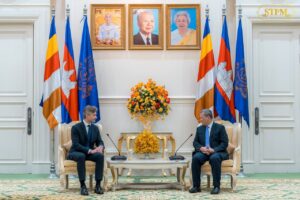
What further strengthens Cambodia’s position is the composition of its representative team, which combines diplomatic experience with high-level expertise in international law. The participation of Peter Taksoe-Jensen, a former senior United Nations official and veteran Danish diplomat, indicates that Cambodia clearly understands that resolving international disputes is not solely a legal contest but also a process requiring deep knowledge of the United Nations system, diplomacy, and international relations.
At the same time, the involvement of Professor Jean-Marc Thouvenin, a distinguished expert in international law, adds significant strength to Cambodia’s case. His extensive experience before international courts and legal forums demonstrates that Cambodia is preparing its arguments on the basis of legal principles and the law of the sea with great care and rigor. This also signals that Cambodia is relying on the strength of legal reasoning and evidence rather than political pressure or the creation of new facts on the ground.
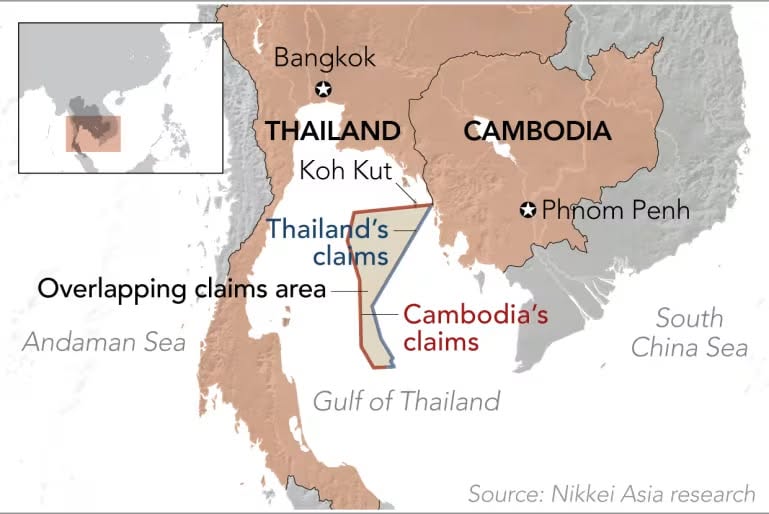
Meanwhile, Thailand’s decision to appoint Rüdiger Wolfrum and Albert Hoffmann as its conciliators is equally significant. Although the two countries continue to hold differing views regarding rights and interests in the overlapping maritime claims area, Thailand’s participation in the procedure demonstrates that the dispute has already entered a recognized international legal framework. In other words, competition based on power is being replaced by competition based on legal arguments and reasoning.
International experience has consistently shown that, in disputes between states, economic or military strength does not always determine the final outcome. More often, what proves decisive is the legal validity of a state’s claims and its ability to persuade the international community of their legitimacy. In this sense, Cambodia is relying on the “power of legitimacy,” a critical strategic asset in safeguarding national interests on the international stage.
Furthermore, the dispute in the overlapping claims area in the Gulf should not be viewed merely as an economic issue concerning oil and gas resources. Beyond the economic value of natural resources, the matter directly concerns national sovereignty, territorial integrity, sovereign rights over natural resources, and the country’s standing in the international community. Therefore, protecting Cambodia’s interests in this case is not simply about securing economic resources; it is also about defending the nation’s lawful rights and preserving development opportunities for future generations.
For the Cambodian people, the greatest source of pride lies not only in the eventual outcome of the process but also in the method Cambodia has chosen. By upholding international law, utilizing peaceful mechanisms, and assembling world-class experts to defend national interests, Cambodia has demonstrated a sophisticated diplomacy grounded in knowledge, professionalism, responsibility toward the nation, and commitment to regional peace.
Overall, Cambodia’s decision to pursue the conciliation procedure under UNCLOS and to establish a highly qualified legal and diplomatic team is more than a response to a maritime dispute. It represents a broader vision of how international disputes should be managed—through faith in the power of law, diplomacy, and international legitimacy. Through this approach, Cambodia is demonstrating that the protection of sovereignty and national interests does not necessarily require confrontation or the use of force. Instead, such objectives can be achieved through reason, legal principles, and norms recognized by the international community.
By Pin Vichey
Political Science Researcher