Cambodia Warns Against Thailand’s Politicisation of the Mine Ban Convention at Geneva Meeting
 His Excellency Ambassador Dara In, Permanent Representative of Cambodia to the United Nations in Geneva
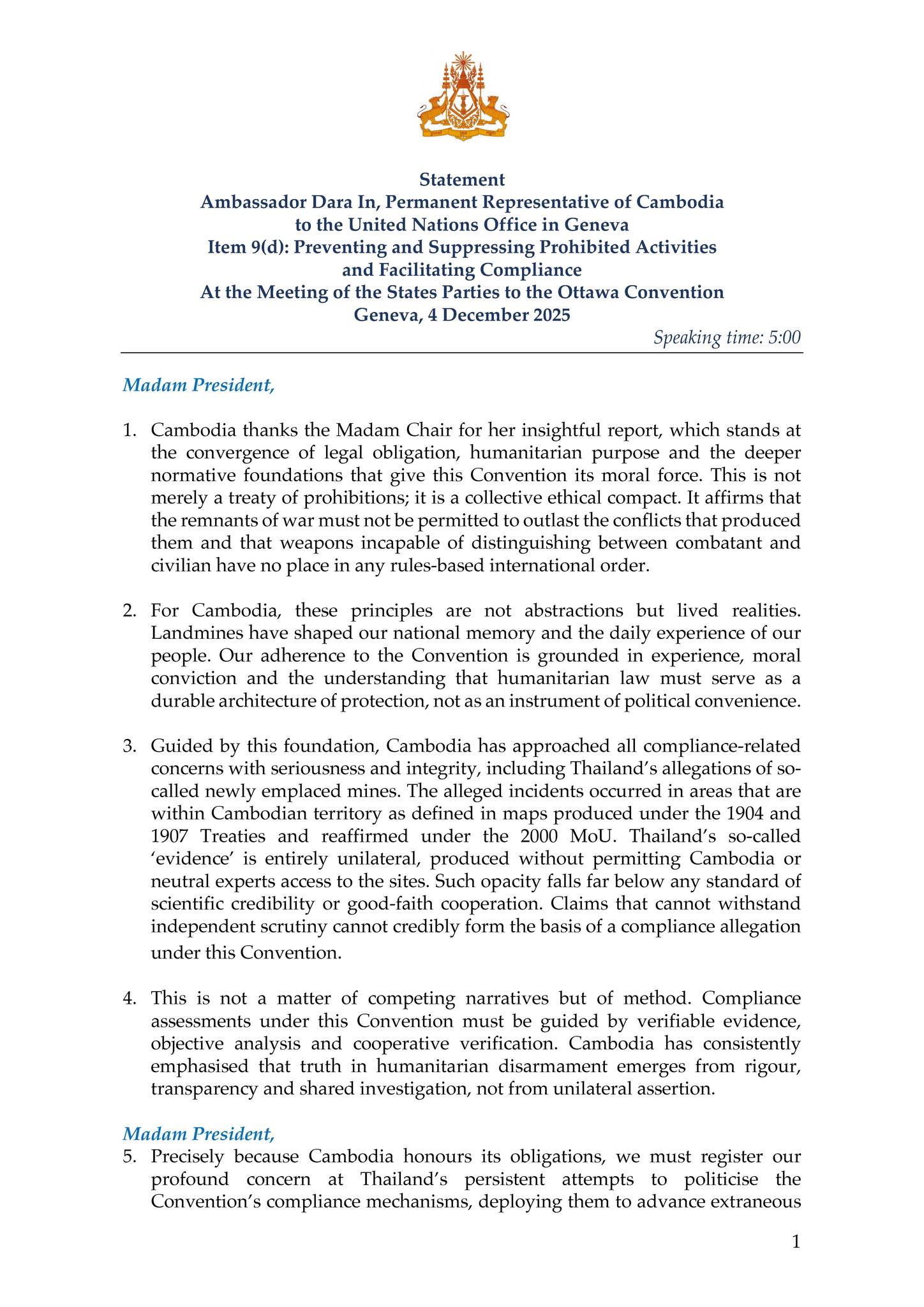
Geneva, 4 December 2025 — His Excellency Ambassador Dara In, Permanent Representative of the Kingdom of Cambodia to the United Nations in Geneva, delivered a strong and principled intervention under Agenda Item 9D—Preventing and Suppressing Prohibited Activities and Facilitating Compliance—during the Meeting of States Parties to the Mine Ban Convention.
In his address, the Ambassador recalled the profound human toll landmines have inflicted on the Cambodian people, stressing that Cambodia’s unwavering commitment to the Convention is rooted in moral conviction and the imperative that international humanitarian law must remain “a durable architecture of protection, not an instrument of political convenience.”
Addressing Thailand’s latest allegations concerning so-called “newly emplaced mines,” Ambassador Dara In firmly rejected the claims, underscoring that the alleged incidents occurred well within Cambodian territory. He noted that Thailand’s assertions are based on “entirely unilateral” materials produced without any access granted to Cambodia or to neutral technical experts—an approach that “falls far below any standard of scientific credibility or good-faith cooperation.”
“Claims that cannot withstand independent scrutiny,” he stated, “cannot credibly form the basis of a compliance allegation under this Convention.”
The Ambassador expressed deep concern over Thailand’s continued attempts to politicise the Convention’s compliance mechanisms, warning that these mechanisms were never designed to serve as “levers in bilateral disputes or instruments for strategic messaging.” Such actions, he cautioned, undermine confidence, erode trust among States Parties, and weaken the integrity of the Convention as a whole.
Reaffirming the legal obligations under Article 8, the Ambassador stressed that genuine consultation is required before any formal compliance steps are pursued. Thailand’s decision to bypass this requirement, he noted, constitutes “a deliberate instrumentalisation of the Convention’s compliance tools for purposes wholly unrelated to mine action,” replacing fact-based inquiry with adversarial posturing—“precisely the abuse of process the drafters sought to prevent.”
Cambodia, he stated unequivocally, firmly rejects such misuse.
Ambassador Dara In concluded with a call for all States Parties to uphold evidentiary integrity, resist politicisation, and safeguard the humanitarian purpose at the heart of the Mine Ban Convention. “Humanitarian disarmament,” he emphasized, “is sustained not by political expediency but by principled conduct.”