Did Hun Sen Really Abandon the 18 Heroic Soldiers as Alleged?
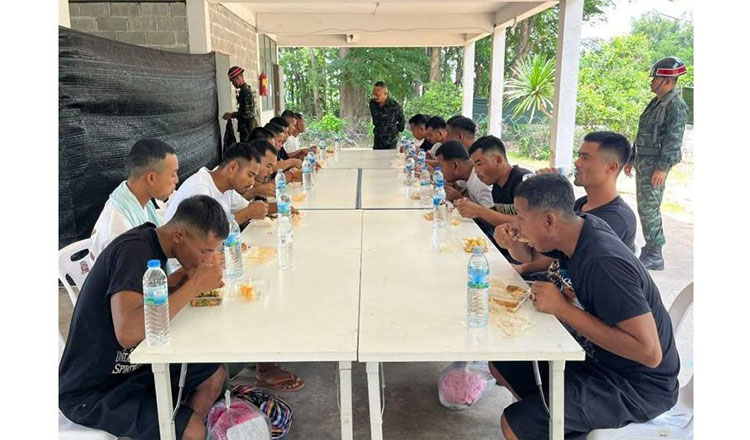 The 18 Cambodian soldiers detained in Thailand
At the end of July 2025, when 18 Cambodian soldiers were illegally arrested by Thai forces after the ceasefire had become official — in the early morning of July 29, 2025 — the incident sparked a wave of mixed emotions among the Cambodian public and across social media both inside and outside the country. Opinions related to the peace process between the two states also resurfaced amid heightened tensions at that time. However, the explanation later given by Hun Sen, who stated that the 18 soldiers had already made a “supreme sacrifice” for the nation, became a central point of discussion about national security, unity, and what some have called “political heroism.” It also prompted heavy criticism from extreme opposition groups and even some Thai nationals on various online platforms.
Attacks created by overseas extremist opposition groups and certain Thai groups — claiming that the Cambodian government had abandoned and failed to care about the 18 heroic soldiers — became a political strategy aimed at sowing doubt and distrust in truth, with an apparent intention to fracture national unity. Yet in reality, the true intention of Hun Sen and the Cambodian government was never to ignore or fail to care for Cambodian soldiers, as accused. On the contrary, the government has taken into account not only the welfare of frontline soldiers but also of their families, such as by easing their bank loan burdens. All these efforts represent significant commitments and policy actions, because the sacrifices and contributions of our 18 soldiers cannot be undervalued. These clarifications show clearly that neither Hun Sen nor the Cambodian government abandoned them, failed to care about them, or disregarded their value.
The arrest of the 18 Cambodian soldiers at the Cambodia–Thailand border after the war, on July 29, 2025, is an incident linked to the Kuala Lumpur Peace Accord — an agreement which the Thai side violated by refusing to comply. Consequently, the Cambodian government has had to pursue diplomatic and international human rights channels to resolve the matter. Nevertheless, this incident has shown that we are now facing an “information war,” used as a new regional political weapon against the Cambodian government. Instead of joining efforts to demand the release of the 18 soldiers, some overseas extremist groups fabricated claims that Cambodia had abandoned them or failed to care about its own troops. This strategy has one clear objective: to destabilize Cambodia’s political environment and to fracture internal unity within Cambodian society, while undermining public confidence in the government’s leadership.
As we have seen, these attacks are politically motivated, seeking personal advantage by generating pressure on the Cambodian government.
In a national context where border issues strongly inflame nationalist emotions, the creation of such negative narratives can undermine public trust and deeply damage national unity. Disseminating false information can cause the public to lose confidence and develop suspicion toward the government, driven more by emotion than by rational understanding of the actual facts.
Contrary to the accusations, Hun Sen’s words honoring the extraordinary heroism of the 18 soldiers represent a clear affirmation that these Cambodian troops were not “abandoned,” but rather are national heroes who served their country with sacrifice. When examining the government’s quiet but persistent actions, we see that it has focused on concrete support for all soldiers, including reducing families’ debt burdens, providing assistance to families of fallen soldiers, advancing social security policies for military families, and officially recognizing their heroism. These efforts show that the management of this crisis is not only about public explanations but also reflects the political responsibility and commitment to the armed forces as the core of national security.
Disinformation, distortion, and manipulation are among the most destructive forms of information warfare, functioning as tools to erode public trust, create conflict, break national unity, and attack the government — a strategy widely used globally in this era.
The case of the 18 Cambodian soldiers detained illegally by Thailand, still unresolved, has triggered waves of propaganda from overseas extremist groups aiming to divide national unity among Cambodians and pursue political gain under a populist guise. These fabrications, without any clear factual basis, stand in direct contrast to what the government has been doing in reality. Yet Hun Sen’s explanation can be understood by social analysts as the government’s deeper strategy to preserve the dignity of soldiers — by supporting their families and demonstrating high responsibility. The prime minister’s comprehensive consideration reaffirms that Cambodian soldiers are never abandoned. Instead, the government continues to show the highest level of concern for all 18 soldiers.
This case will serve as a mirror reflecting the importance of national unity and cohesion — essential tools for maintaining political stability and safeguarding Cambodia’s sovereignty.
By: Pin Vichey – Political Science Scholar