No stability in Myanmar without democracy
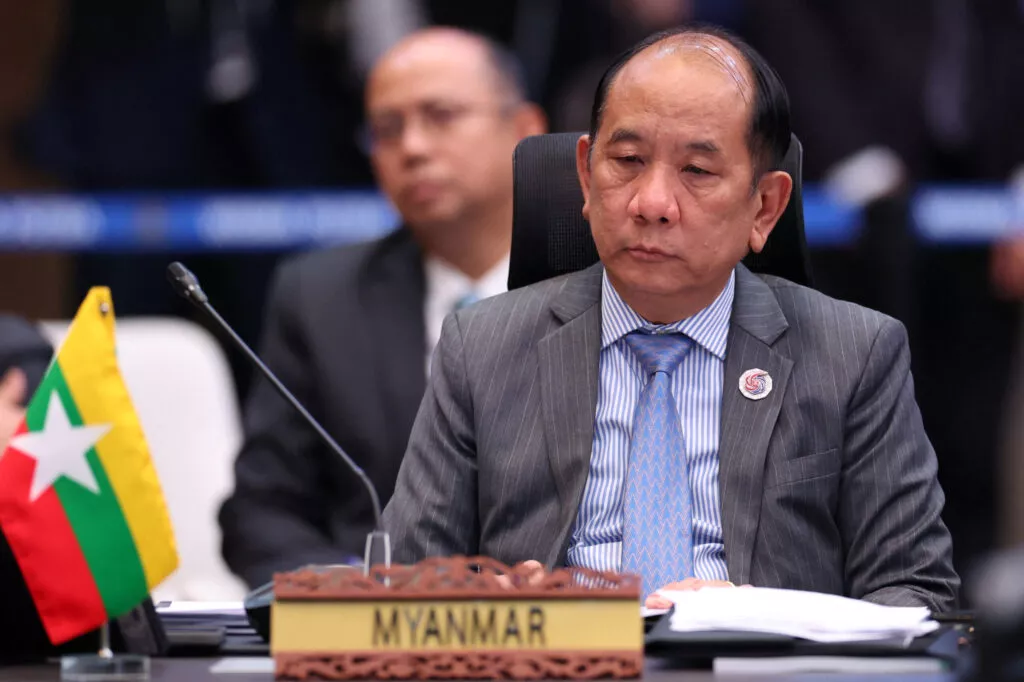 No stability in Myanmar without democracy
Perhaps even more than questions of tariffs and trade wars, the ongoing civil conflict in Myanmar has the potential to drive a wedge through ASEAN’s membership. As the junta in Naypyidaw determinedly ignores the provisions of the Five Point Consensus (or ‘5PC’, in ASEAN parlance) that it disingenuously agreed to with ASEAN leaders in April 2021 and moves forward with bogus elections, ASEAN seems almost irrelevant in steering the outcome of the conflict.
The key milestone on the horizon is the elections planned to be held in two stages in December 2025 and January 2026. First, there is the impossibility of holding elections in conflict-torn peripheral areas.
Second, the junta’s proxy party, the Union Solidarity and Democratic Party (USDP), has been granted a leg-up given ‘most opposition parties remain banned or dissolved and their leaders imprisoned’.
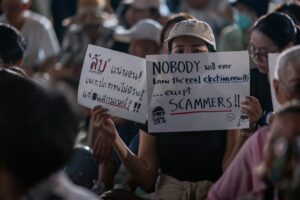
Third, given the near-certainty of electoral fraud, the elections are manifestly a ‘sham’, as Shwe Yi Myint Myat writes in the first of this week’s lead articles. ‘[T]he evidence overwhelmingly indicates they will be carefully managed to elevate the junta leader, Min Aung Hlaing, to the presidency and entrench military rule.’
These conditions will offer foreign governments inclined to cooperate with the junta a semi-plausible pretext for recognising the USDP-controlled government that will surely emerge from the polls.
The junta’s exclusion of the National League for Democracy from the elections makes a mockery of the Five Point Consensus’s clear implication that any political process to resolve the conflict must involve the government duly elected by Myanmar’s people in 2020.
Conversations within ASEAN have accordingly focused not just on whether to recognise the results of the elections, but on whether to legitimise them ex ante by sending observers in ASEAN’s name. ASEAN leaders used the occasion of the summit in Kuala Lumpur in October to voice disappointment in ‘the lack of substantive progress in the implementation of the 5PC’, and ASEAN foreign ministers declined to endorse an ASEAN election observer mission. But junta-friendly ASEAN members (alongside dialogue partners like China, Russia and India) may well telegraph their impatience to get back to business as usual with the generals by sending their own observer teams.
Given that, as Malaysia’s foreign minister acknowledges, there is nothing ASEAN can do to stop the elections going ahead, it will soon be presented with a superficially civilian, nominally ‘elected’ government in Myanmar as a fait accompli. With that, ASEAN is set to be wedged further on whether, and how, to reintegrate political-level representation from Myanmar into ASEAN processes. Dialogue partners will likewise be split along political lines over what level of Myanmar participation in ASEAN-plus processes — including, worryingly, RCEP — they are willing to tolerate.
The democratic dialogue partners who eschew cooperation with the junta on principle are faced with some real dilemmas about whether to make their own participation in ASEAN-plus processes be shaped by the presence of Myanmar representatives going forward.
As Adam Simpson writes in the second of this week’s lead articles, those who favour sanctioning and sidelining a junta-controlled Myanmar may be in the minority. The junta has increasingly drawn sustenance from its relationships with Russia and North Korea, and China — after a period of hedging its bets in the post-coup conflict — appears to have concluded that its interests are best served by deepening cooperation with the generals in Naypyidaw. The Trump administration has seen de facto US support for the resistance wane largely through disinterest, and ‘will not expend political capital on pushing for democratic reforms’.
The stalling of the resistance’s battlefield momentum and international developments increasingly favourable to the junta ‘leave anti-junta forces playing a localised, transactional game to maintain their interests’ in the periphery, literally and figuratively, writes Simpson.
The region faces the prospect of a chronically divided and unstable Myanmar, where the economy will be hobbled by the junta’s need to fund its war machine, and the likelihood that sporadic violence will deter investment. Under the rule of a junta-backed government that has a proven record of disinterest in the welfare of those it rules, Myanmar will continue to be a reservoir of infectious disease, a safe haven for organised crime and a source of irregular migration.
This scenario stands as a rebuttal to the argument that the ‘pragmatic’ course is to capitulate to the reality of junta rule and work around it. Incoming ASEAN chairs, the Philippines and Singapore, need to use every source of leverage they have over the junta in the post-election period — including taking as firm a line as they can with the junta’s friends in ASEAN on questions of Myanmar’s participation in ASEAN processes — to secure the release of political prisoners, restore political pluralism and forge a pathway back to pre-coup politics.
There is only one path back to relative stability and social and economic progress in Myanmar, and that is a path towards a political system in which the Myanmar people decide which political force is best placed to govern in their interests. On the Myanmar issue, for ASEAN, principle and pragmatism are tightly dovetailed.
The EAF Editorial Board is located in the Crawford School of Public Policy, College of Law, Policy and Governance, The Australian National University.
East Asia Forum