Op-Ed: The Doctrine of Denial
 Op-Ed: The Doctrine of Denial
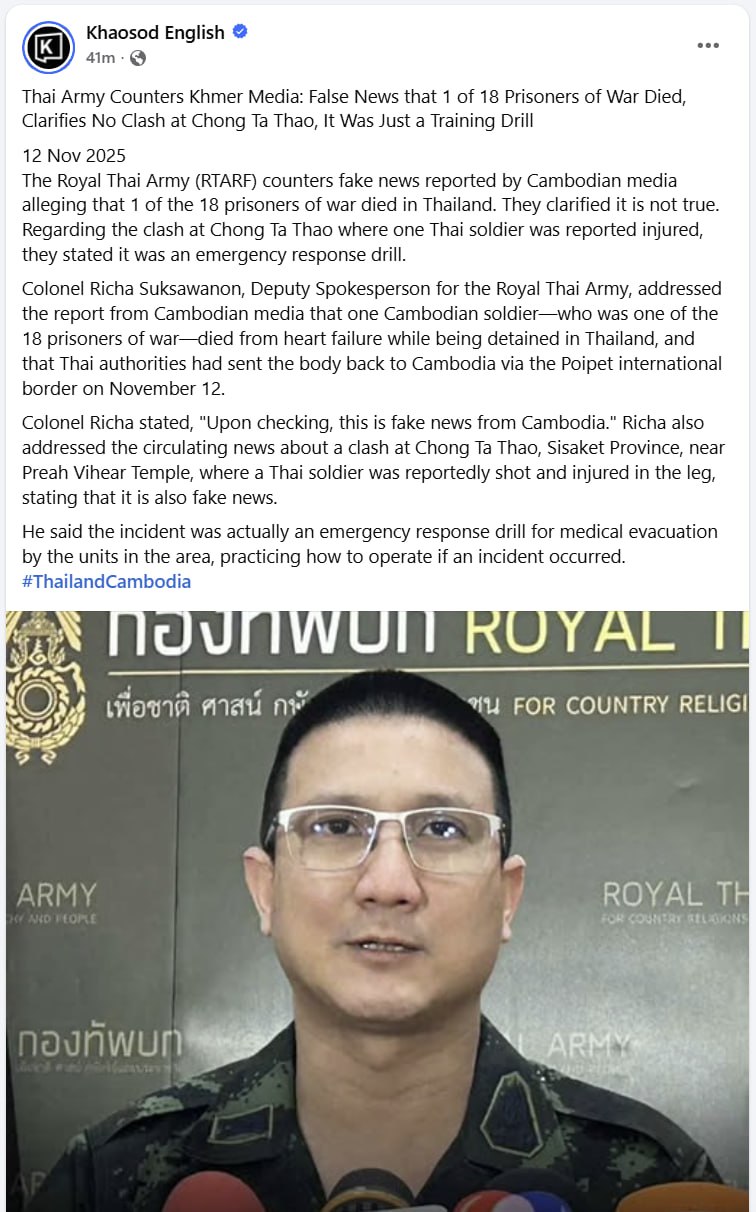
The phrasing is deliberate: fake news, training drill, professionalism.
It is the same triad now repeated across every incident: Prey Chan becomes “self-defense,” Chong Ta Thao becomes “medical drill,” and a dead soldier becomes “non-existent.”
The pattern works because it replaces proof with tone, evidence with posture. It rewires the public reflex: when they hear gunfire, they now hear a rehearsal.
Every denial, however, leaves its shadow.
To call a report fake is to confirm the report exists.
To describe a clash as a drill is to admit troops were active.
To justify self-defense is to concede that fire was exchanged.
The more they clarify, the clearer the conflict becomes.
This is not journalism; it is jurisdiction by narrative.
By insisting that every event happens “inside Thai territory,” the Army re-maps the border in the public mind. Repetition turns fiction into familiarity, and familiarity becomes sovereignty.
What’s missing speaks louder than what’s said.
No names of the eighteen prisoners.
No independent verification from ICRC or ASEAN.
No timestamped footage of these supposed drills.
Only official sentences that close before they can be questioned.
Cambodia should not chase noise with noise.
It should document quietly, completely, and publicly: names, coordinates, shell fragments, medical records, every trace of truth that bureaucracy cannot erase.
Because in the long record of wars of narrative, the side that documents outlasts the side that denies.
When everything becomes a drill, nothing is accountable.
And when denial becomes routine, even silence begins to sound like proof.
By: Midnight