Planned War Escalation: Thailand’s Aggressive Strategy to Alter the Cambodia–Thailand Border Status Quo
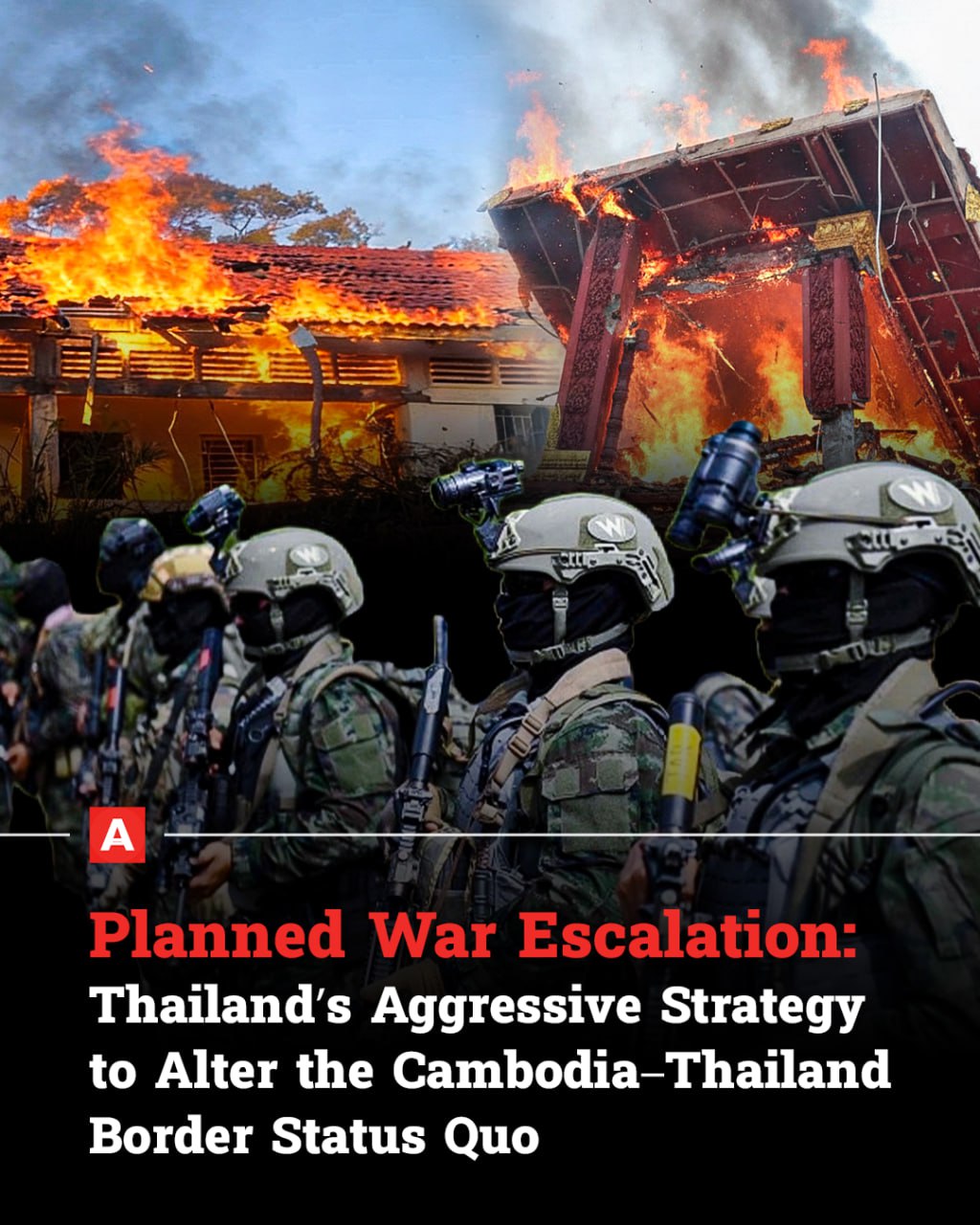
The two most recent outbreaks of armed conflict along the Cambodia–Thailand border in 2025 have clearly demonstrated the existence of prior planning and pre-arranged military scenarios by the Thai armed forces aimed at seizing Cambodian territory. The first clash occurred between 24–28 July 2025, while the second attack took place between 7–27 December 2025. These two incidents were not accidental border skirmishes, but rather integral components of a strategy that had already been carefully planned.
A crucial point that must be emphasized is that Thailand’s military actions went far beyond ordinary border confrontations. They revealed an aggressive and systematic military strategy with a clear objective: to seize territory through the use of an illegal map at a scale of 1:50,000, which Thailand claims to be its “official” map. Areas from which Cambodian displaced civilians have been unable to return were unilaterally designated by Thailand as its own territory. From Cambodia’s perspective, however, the areas occupied by Thailand have been under Cambodian control for decades, based on the legally recognized 1:200,000 map that has been officially acknowledged and deposited with the United Nations.
Therefore, Thailand’s reliance on a unilaterally drawn and illegitimate map as a legal basis constitutes a deliberate destruction of the existing legal status quo and clearly demonstrates its intent to alter the border through the use of military force.
Since Thailand’s military incursions into Cambodia’s sovereignty, the Cambodian Prime Minister, diplomatic corps, military officials, government spokespersons, and state institutions have all responded strongly. They have firmly rejected territorial occupation by military force and heavy weaponry, and have lodged formal protests through diplomatic notes and on international platforms. Even though armed clashes have subsided, this does not imply any agreement to cede territory in exchange for peace. On the contrary, recently, Thai army spokesperson Winthai Suvaree claimed that Cambodian civilians and soldiers living in areas where Thailand has erected barbed wire and placed shipping containers are not displaced persons, but rather groups that have “violated Thailand’s sovereignty.”
Such claims not only strip Cambodian citizens of their rights, but also form part of a broader legal and political strategy designed to portray Thailand’s territorial encroachment as a legitimate exercise of self-defense of its sovereignty. However, the factual reality is that the Cambodia–Thailand border has been determined by international law, and Thailand itself has long recognized that border based on the 1:200,000 map, dating back to previous Thai governments.
Accordingly, the second military offensive in December 2025 clearly demonstrated that it was a continuation of a plan to permanently occupy Cambodian territory. Despite the existence of a ceasefire agreement, Thai forces continued to violate it by resuming attacks from 7 to 27 December 2025 in order to fulfill what they considered remaining strategic objectives.
In the process of creating a so-called “new situation,” Thai forces destroyed Cambodian civilian homes and numerous civilian infrastructures in the conflict areas. These actions were aimed at altering the original status quo, eliminating the presence of indigenous Cambodian civilians, and creating conditions that would allow Thailand to exercise permanent control over the area. Thailand’s intentions were unmistakably clear: these locations must fall under its sovereignty, as the primary objective was to “reclaim land from Cambodia,” which Thailand unilaterally claims as its own.
Beyond the mobilization of forces, the timing of attacks, and concrete military operations on the ground, there is no doubt that Thailand was the party that initiated the war and had prepared these strategies well in advance.