Thai election’s illusion of stability
 Thai election’s illusion of stability
The formation of a new Bhumjaithai Party-led coalition government following Thailand’s election on 8 February 2026 has been widely interpreted as a return to political stability after years of deadlock and volatility. Yet this stability is more apparent than real and does not signal a renewed era of conservative dominance. The post-election settlement reflects a fragile stability, one grounded less in ideological consolidation than in elite adaptation through electoral politics.
The government coalition’s strength appears considerable. Bhumjaithai, led by Prime Minister Anutin Charnvirakul, has emerged as the pivotal parliamentary actor. Certified election results show the party winning 172 constituency seats and 19 party-list seats, for a total of 191 in the 500-member House of Representatives — more than any other party, though still short of an outright majority. Bhumjaithai has since announced plans to form a governing coalition with the Pheu Thai Party, led by a nephew of Thaksin Shinawatra, which secured 74 seats, along with several smaller parties, giving the alliance a comfortable working majority.
This outcome does not amount to a consolidation of conservative power in any classical sense. Unlike earlier conservative coalition governments anchored in Thailand’s military–bureaucratic nexus, the Bhumjaithai-led government is rooted primarily in provincial patronage networks. Its core strength lies not in ideology or mass legitimacy, but in its capacity to mobilise local political machines, entrenched political families and informal brokers who dominate constituency-level politics.
This was further reinforced by Bhumjaithai’s leveraging of the bureaucratic linkages it had formed during its years in government, particularly within the Ministry of the Interior, where personnel appointments — alongside the prominent role of district chiefs as election commission chairs across constituencies — helped create institutional conditions favourable to the party’s 2026 campaign.
That machine politics were key to Bhumjaithai’s victory is evident in its divergent performance in different elements of Thailand’s mixed-member electoral system, where voters cast ballots for single-member constituency seats and a party list ballot that allocates seats proportionally. Bhumjaithai’s commanding lead in constituency seats stands in sharp contrast to its weaker performance in the party-list vote. It was outpolled by the reformist People’s Party, which secured 32 party-list seats and received roughly four million more party-list votes. Bhumjaithai’s party-list support was narrowly concentrated, topping the party list vote in only 56 constituencies, compared with the People’s Party’s dominance in 215.
This contrast is even starker in Bangkok, where Bhumjaithai failed to win a single constituency, while the People’s Party swept all 33 seats, indicative of the extent to which Bhumjaithai’s electoral success depends on constituency level mobilisation in provincial areas. Rather than drawing national support on programmatic appeals, at its core Bhumjaithai remains a provincial patronage-based party, drawing on nationalist sentiment merely as a temporary strategy.
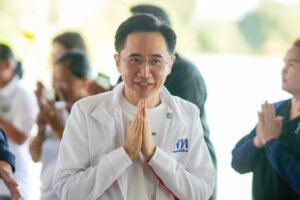
Anutin projects the image of a pragmatic leader — moderate, managerial and non-confrontational. On the day before the election, he was granted a royal audience, an act which carried significant symbolic weight and was widely interpreted, particularly among conservative voters, as a signal of recognition and legitimacy. But behind this public face, the party’s organisational backbone rests with figures such as Newin Chidchob, a political boss from the Northeast, whose influence derives from dense and long-standing provincial networks.
This distinction is critical. Conservative rule in Thailand has historically rested on a centralised alliance linking the monarchy, the military, the judiciary and senior bureaucrats — an alliance capable of disciplining elected politicians and suppressing mass mobilisation. Repeated coups, constitutional engineering and judicial interventions have weakened the legitimacy of overt authoritarian control while failing to extinguish popular demands for reform. Traditional elites have been forced to adapt their strategies, work through electoral intermediaries rather than ruling above politics. Bhumjaithai functions as one such intermediary. It is best understood not as an ideological conservative party, but as an electoral machine co-opted into cooperation with the existing power structure.
Since the 2023 election, the royal, military and judicial elites have increasingly relied on political accommodation rather than direct domination to contain reformist challengers. This strategy has involved the pragmatic incorporation of actors long viewed as adversaries, including Pheu Thai. The current election represents a continuation of this accommodation — what binds these actors together is not a shared political vision, but a mutual interest in office holding, stability and access to state resources.
This arrangement may generate a form of stability that is conditional and potentially fragile. The coalition appears characterised by factional competition, overlapping claims on patronage and ongoing bargaining over cabinet positions and policy priorities. Managing the ambitions of faction leaders, each backed by distinct political networks, is likely to require continual negotiation and sustained material distribution. Economic conditions may complicate this balancing act, as fiscal pressures, slowing growth and rising social expectations constrain the government’s capacity to accommodate competing demands.
Externally, the government continues to face legitimacy challenges. Many voters view the post-election settlement as the result of institutional exclusion, not democratic choice. This is reinforced by legal proceedings against reformist politicians linked to the People’s Party, including the case of 44 former members of parliament from the banned Move Forward Party who may be disqualified following a ruling that their attempt to amend lèse-majesté was unconstitutional.
Concerns have been further amplified by widespread allegations of election irregularities in the 2026 poll, which have weakened confidence in the electoral process and led multiple actors to petition the courts to review, and in some cases annul, the election results. These developments all risk becoming a source of post-election instability.
Thailand has not exited its cycle of political uncertainty. The challenge ahead is not the restoration of conservative rule, but the continuing gap between electoral mandates for political change and a power structure that selectively accommodates electoral outcomes while insulating established elite interests.
Prajak Kongkirati is Associate Professor in the Faculty of Political Science at Thammasat University, and Guest Scholar and Japan Foundation JFSEAP Visiting Fellow at CSEAS Kyoto University.
East Asia Forum