The Stance of “Peace and Respect for International Law” as Cambodia’s Strategy to Safeguard Sovereignty
 The Stance of “Peace and Respect for International Law” as Cambodia’s Strategy to Safeguard Sovereignty
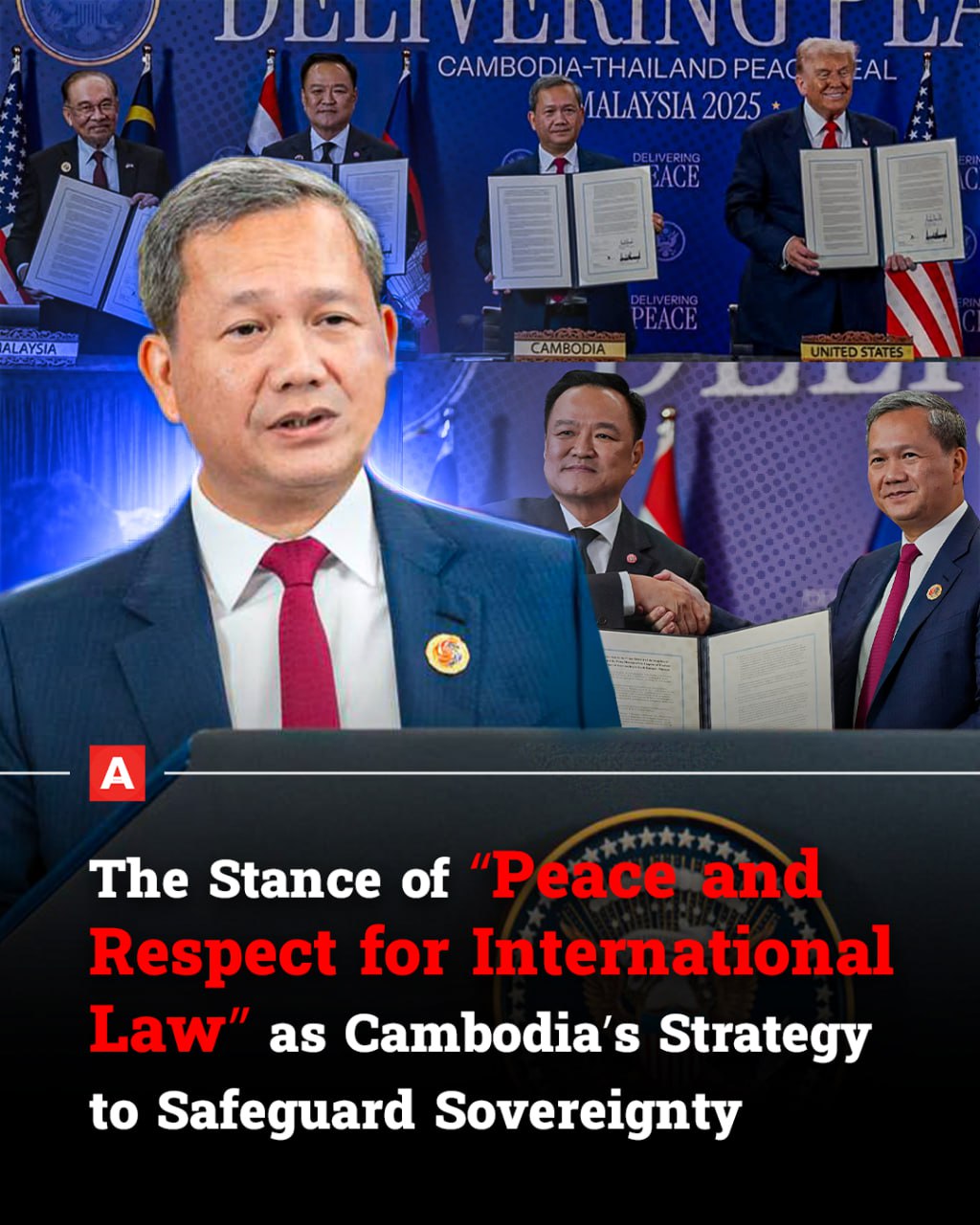
Along the border areas, the smell of gunpowder has not yet faded. Yet, another sound is now being heard loudly—no longer the sound of gunfire, but it is the voice of a political message coming from Cambodia’s leadership, Prime Minister Hun Manet, before, during, and after the ceasefire, has consistently articulated a clear choice: between territorial claims pursued through armed force and the defense of sovereignty through law and diplomacy; between peace as a shared strategic interest for humanity and peace as a fundamental value that enables civilians to continue living with dignity and security.
In this context, Cambodia has chosen not to use weapons to determine the nation’s future. Instead, it has embraced respect for international law and international obligations as a guiding compass to lead the country toward sustainable and enduring peace.
Cambodia has continued to implement a clear and resolute peace strategy—one that does not signify surrender, but rather the use of peace itself as a strategic instrument to safeguard sovereignty, protect its people, and defend the country’s legal legitimacy on the international stage. Through the ceasefire, the continuation of the bilateral Joint Boundary Commission (JBC), respect for existing agreements, and the maintenance of international support, Cambodia is shifting the battlefield from military confrontation to a legal arena, and transforming a bilateral dispute into a multilateral legal and diplomatic process.
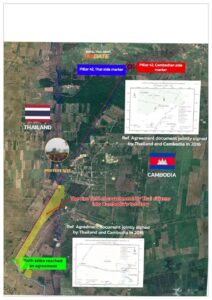
At the core of the Cambodian government’s position is the firm rejection of the notion that Cambodia is trading territory for peace. The head of government has made it unequivocally clear that the current Thai military control is “temporary, not permanent.” This constitutes a strategically deliberate rejection, as the Cambodian government fully understands that such “temporary control” is a tactic used by one party to create a fait accompli—deploying troops into disputed areas to compel the other side to eventually recognize occupation as legitimate sovereignty. This approach reflects a well-known pattern of deceptive territorial encroachment that has been employed in numerous border conflicts around the world.
This clearly demonstrates that Cambodia is defending its sovereignty against Thai encroachment not only through military means, but also through legal, diplomatic, and historical pathways.
At the same time, Cambodia’s sincere adherence to the ceasefire must not be misinterpreted as weakness. Rather, it is a reflection of national self-mastery and integrity in conflict resolution. This approach highlights Cambodia’s prioritization of civilian lives over “immediate victories.” It is a strategy that seeks to end war by first valuing human life, before proceeding to resolve political disputes.
This represents a transformation of “military power” into “moral authority”—a form of power that carries far greater influence on the international stage.
Furthermore, Cambodia’s repeated diplomatic notes requesting Thailand to convene JBC meetings demonstrate that Cambodia does not wish this conflict to escalate into an armed confrontation. Instead, Cambodia seeks to transform it into a dispute resolved through legal documentation, maps, and internationally recognized border principles. However, should Thailand evade or refuse to attend JBC meetings as requested by Cambodia, this would not merely constitute a diplomatic issue, but a matter of legal legitimacy and accountability for national and regional peace.
Cambodia’s stance is not that of a small nation fearful of war. Cambodia has endured decades of conflict and suffering. Rather, this is the position of a country that understands that “war is not the best way to defeat war.” In this sense, Cambodia appears intent on affirming that sovereignty does not originate from weapons, but from national self-reliance, unity, respect for law, and the trust of the international community.
Ultimately, Cambodia’s true victory lies in demonstrating the enduring value of moral integrity rooted in the spirit of peace—a message to the world that Cambodia does not seek territory from any neighboring country, nor territorial expansion. Instead, Cambodia seeks to safeguard its sovereign domain and secure its legitimate rights over its ancestral land, while aligning itself with the prevailing conscience of the international community—one that will ultimately deliver justice by recognizing Cambodia as a genuine victim seeking a peaceful and lawful border.
By Pin Vichey
Political Science Scholar