Time to Act: Anutin’s New Cabinet Is Obliged to Return to the JBC Negotiation Table with Cambodia to Continue Resolving Border Issues
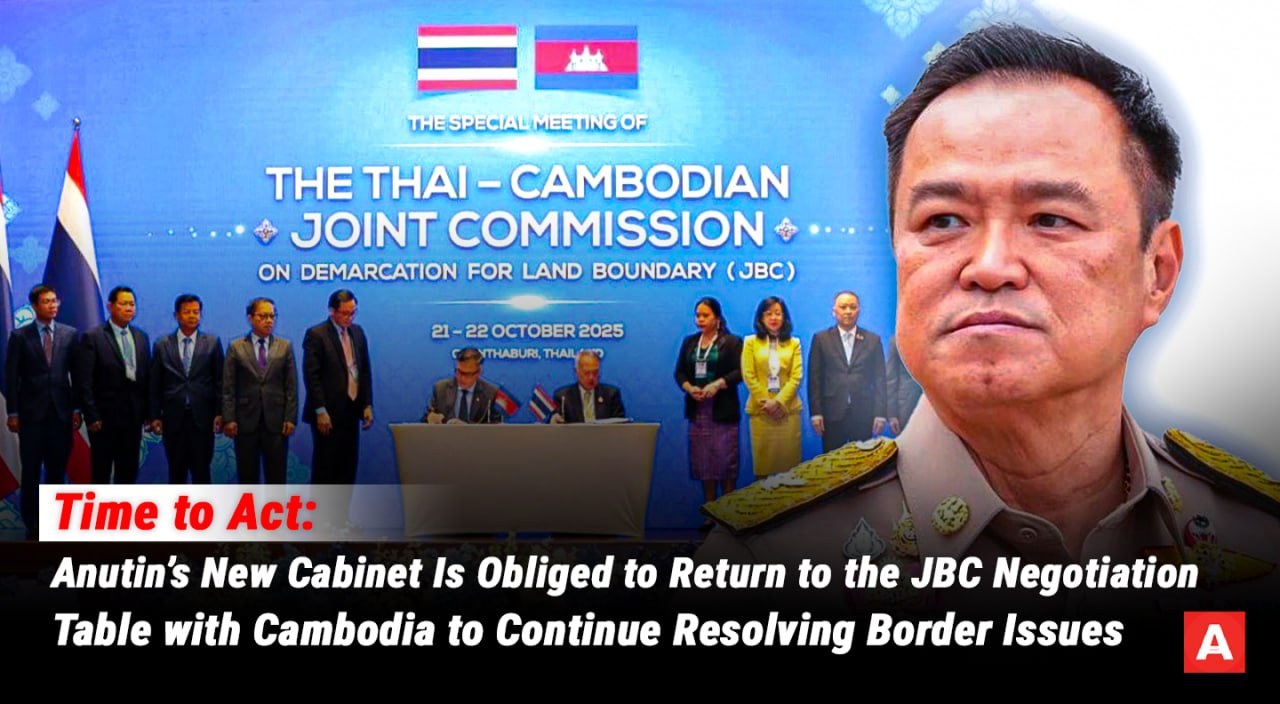 Time to Act: Anutin’s New Cabinet Is Obliged to Return to the JBC Negotiation Table with Cambodia to Continue Resolving Border Issues
In international politics, there is no such thing as “waiting indefinitely.” The border issue between Cambodia and Thailand is not a game of testing willpower or political strength; rather, it is a matter of sovereignty and national security that requires a clear resolution through legal means—both bilateral mechanisms and, when necessary, international mechanisms. Thailand must honor the commitments it made following its recent election.
In this context, resuming the meetings of the Joint Boundary Commission (JBC) is no longer an option, but an obligation.
The continued silence and repeated delays by the Thai side—citing the formation of a new government as a reason for not participating in JBC meetings—not only reflect a lack of political will but also raise doubts about Thailand’s true intentions. Is avoiding the JBC negotiation table a strategy to maintain ambiguity, allowing room for strategic maneuvering over the border issue with Cambodia? If so, this does not reflect the spirit of friendship and cooperation. On the contrary, it increasingly reveals to the world that Thailand’s image is deteriorating, tainted by questionable conduct—effectively continuing tactics of encroachment on Cambodian territory that cannot be denied.
In reality, Cambodia has consistently demonstrated a clear and responsible stance, firmly upholding international law and supporting peaceful resolution mechanisms. This approach is grounded in respect for international law and historical documents, including the Franco-Siamese maps, conventions, international treaties, and the 2000 Memorandum of Understanding (MOU 2000), also known as MOU 43, which both countries signed and have used as a basis for effective land boundary demarcation in the past. Cambodia’s repeated calls to resume JBC meetings are clear evidence that it does not wish to see the border issue dragged into a political flashpoint or become a source of renewed armed conflict.
Conversely, if Thailand continues its delaying tactics or avoids negotiations, it could lead to serious consequences for both countries. Not only would it harm bilateral relations, but it would also undermine Thailand’s leadership role in the region. Within ASEAN—where dialogue and cooperation are fundamental principles—unwillingness to negotiate equates to rejecting the values of the international community. Moreover, the border dispute is no longer purely a bilateral matter, as it has drawn attention and involvement from multiple countries, including ASEAN member states and the United States, all of whom have a clear understanding of the situation.
Major international media outlets such as Reuters, Fox News, and France 24 have previously reported on the reality of encroachments on Cambodia’s sovereignty by Thai military forces. These reports have exposed evidence, images, and actions including incursions into Cambodian territory, installation of barbed wire, placement of shipping containers, land clearing, destruction of homes, damage to public and private property, and various other violations along the border and within Cambodian villages.
Despite these actions contradicting the principles outlined in the ceasefire agreement between Cambodia and Thailand at the end of December 2025, returning to the JBC negotiation table would provide a valuable opportunity for both sides to rebuild trust and seek a long-term peaceful solution. This platform also offers a chance to clarify border issues based on maps, legal frameworks, and historical facts—rather than emotions or domestic political pressure.
In this context, the Thai government must ask itself: What is the true intention behind these delays? Do they enhance Thailand’s credibility in the eyes of the international community? Or do they instead reveal uncertainty in handling critical national issues?
Cambodia has made its message clear: the door to bilateral negotiations remains open to Thailand, while international mechanisms remain fully within Cambodia’s rights to pursue truth, justice, and resolution of border disputes—ensuring a firm and peaceful boundary. Therefore, the time has come for Thailand to end its delaying strategy under the pretext of forming a new government. What is required now is a clear demonstration of political will through active participation in JBC meetings with Cambodia—this is a decision that can no longer be postponed.
If Thailand truly values peace, stability, and good relations with its neighbor, there is no justification for further delays. The border issue is not a platform for political games aimed at gaining popularity among ultra-nationalist groups. Rather, it is a line defined by mutual agreement and respect between the two nations in the most sincere manner.
Given that border issues are neither minor nor suitable for prolonged ambiguity, returning to JBC negotiations is the only rational and responsible step for Thailand. Continued delay not only damages bilateral relations but also risks creating instability that could spread across the region.
From a political standpoint, this is the moment for Thailand to demonstrate maturity, integrity, dignity, and responsibility—not to act as a party that provokes conflict or avoids dialogue. Participating in JBC meetings is not a concession to Cambodia; it is an act of respecting international law and safeguarding its own long-term national interests.
Finally, if Thailand genuinely seeks a peaceful and definitive resolution to the border issue, there is only one path forward: return to the negotiation table. Time has not yet run out—but it must not be wasted further, before Cambodia turns to international mechanisms, which Thailand itself has previously experienced and from which it received outcomes in 1962.
By: Pin Vichey – Political Science Scholar