What is the Cambodia–Thailand MOU 2000?
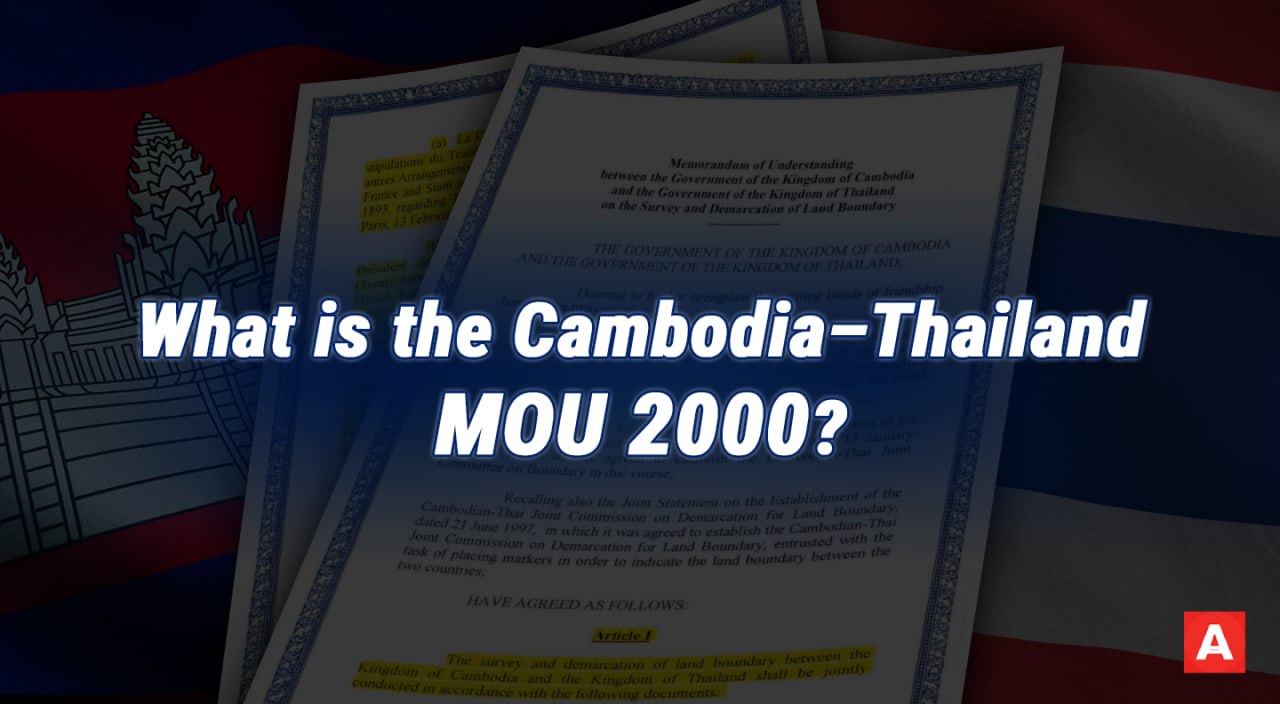 What is the Cambodia–Thailand MOU 2000?
The 2000 Memorandum of Understanding (MOU) between Cambodia and Thailand, officially titled the Memorandum of Understanding on the Survey and Demarcation of Land Boundary, marked a significant turning point in shifting from confrontation toward peaceful negotiation. This agreement is not merely a technical document for land boundary surveying, but a meaningful political strategy for managing and reducing tensions along the border between the two neighboring countries.
The 2000 MOU established a foundation for cooperation between Cambodia and Thailand in clearly defining their land boundary, based on historical documents and international law. The agreement to use the Franco–Siamese maps at the scale of 1:200,000 from 1904–1907 was not only a technical choice, but also a political signal reflecting respect for legal and historical foundations acceptable to both sides.
Importantly, the MOU created the Joint Boundary Commission (JBC), which serves as a platform for negotiation and coordination on border-related matters. Through this mechanism, both parties are able to resolve technical and political issues peacefully, avoiding military confrontation. It is a key instrument in transforming conflict into cooperation.
Furthermore, the principles of “maintaining the status quo” and non-use of military force became central to ensuring stability along the border. These principles mean that even if boundary demarcation is not yet complete, both sides must respect the current situation and refrain from actions that could escalate tensions. This approach has proven effective in preventing the escalation of disputes and armed clashes.
From a strategic perspective, the 2000 MOU can be seen as a “conflict-prevention tool” that enables both countries to manage disagreements without allowing them to escalate into border or security crises. It reflects a shift from the use of “hard power” (military force) toward “soft power” and reliance on international law.
In addition, the agreement underscores the ommitment of both Cambodia and Thailand to respect sovereignty, territorial integrity, and equality before the law and history. Both parties agreed to carry out surveying, boundary determination, and boundary marker placement in stages, using appropriate expertise and technical methods.
In practice, the MOU clearly states that in the event of any disputes, both parties must resolve them through peaceful negotiation, mutual understanding, and on the basis of shared interests. This demonstrates the active engagement of both countries in an international political system grounded in law and peaceful mechanisms.
Finally, the 2000 MOU entered into force on the date of signing and may be amended only through mutual agreement between the two parties. It remains in effect until the boundary demarcation process is fully completed. This shows that it is a flexible agreement with a clear long-term objective.
In conclusion, the 2000 MOU is a crucial political instrument that connects the past, history, and the political future of Cambodia and Thailand. It is not only a foundation for boundary demarcation, but also a mechanism for peaceful coexistence, conflict avoidance, and strengthening good neighborly relations between the two countries.
“The 2000 MOU is a peace instrument for surveying and demarcating boundaries through cooperation, respect for sovereignty, and peaceful dispute resolution.”
By: Pin Vichey
Political Science Scholar