What’s Actually Happening at Border Mark 42–43
 What’s Actually Happening at Border Mark 42–43
This update looks small, but it is the first real test of the Cambodia–Thailand peace track.
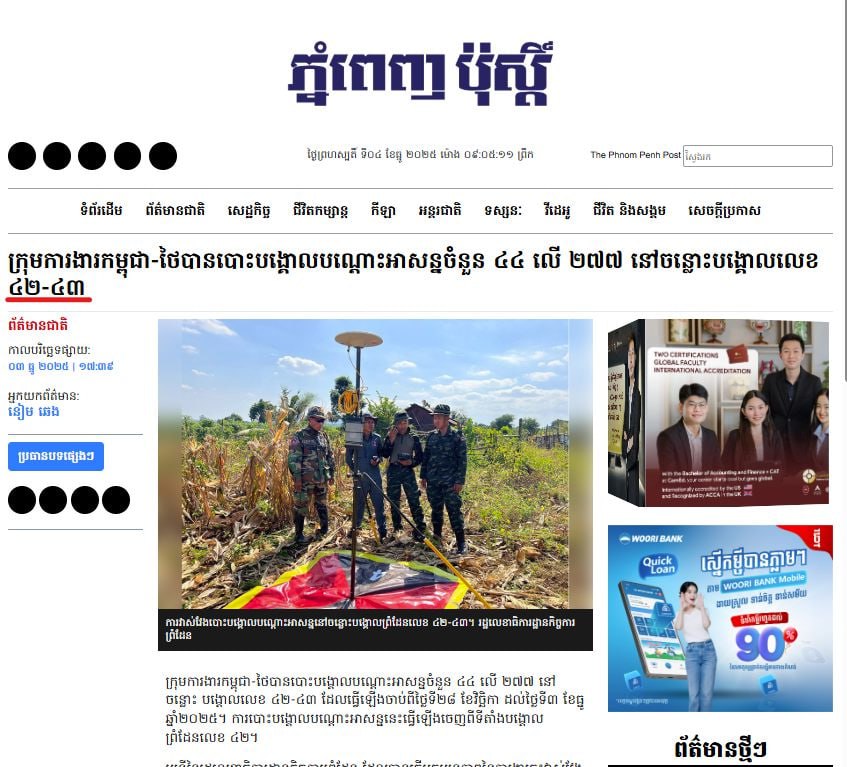
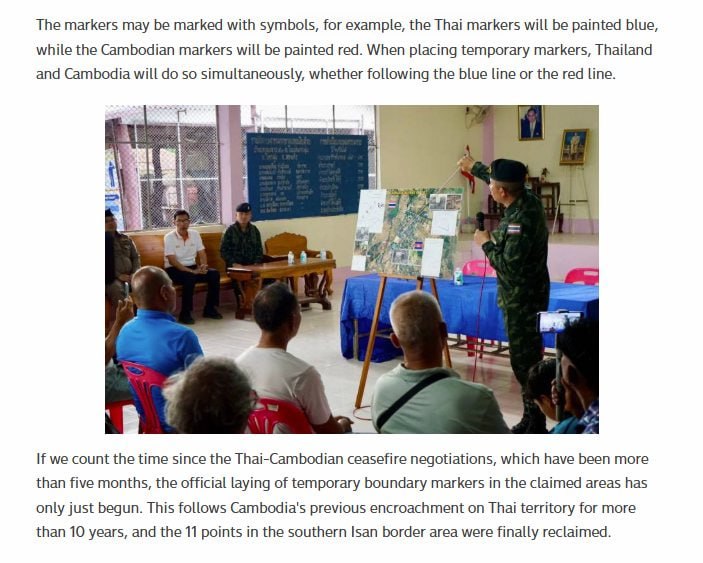
Both governments sent mixed teams into the O’Chrov–Khok Sung stretch, a seven-kilometre zone between pillars 42 and 43. They mapped the terrain, flew drones, and planted forty-four temporary markers out of a planned two hundred seventy-seven.
These markers are not final borders. They are technical waypoints under the JBC process, a method to stabilise a historically blurry area.
How Cambodia is framing it
Cambodia keeps the tone low and procedural. It highlights joint technical work, the drone photomap, the seven-kilometre survey, and the continuity of JBC operations. It avoids claiming victory, loss, or encroachment.
It avoids linking this to Thailand’s landmine accusations.
The message is simple: Calm, Treaty-based, Routine, Nothing emotional.
How Thailand is framing it
Thailand splits into two voices. The MFA uses a technical tone: the JBC is functioning, the process is smooth, foreign defence attachés were invited to observe.
Thai PBS adds politics
These markers are presented as a result of the peace agreement, proof of correcting Cambodian “encroachment,” and part of “reclaiming” eleven locations.
They revisit the colonial treaties and paint the survey as a Thai diplomatic win.
How this ties to the landmine narrative
This mapping occurs in the same week Thai authorities report new landmine incidents in Sa Kaeo.
Cambodia calls the accusations fake news designed to mislead the international community.
The temporary markers now serve three functions:
- De-escalation
Reduce ambiguity. Reduce chances of clashes. Both sides can say: we’re using the JBC, not force. - Evidence for later
Every point becomes part of the future legal argument. Thailand will claim consistency with its interpretation.
Cambodia will say: this was MoU 2000 work, not acceptance of Thai claims. - Domestic messaging
Cambodia signals stability and cooperation. Thailand signals sovereignty defence and peace-deal success.
The deeper signal
Both governments publicly admit the JBC is active.
That alone prevents unilateral action.
Cambodia leans into technical neutrality to keep its legal position clean.
Thailand turns technical steps into political credit.
Thailand brings foreign attachés to the border.
Cambodia emphasises observers and verification.
Both sides are preparing their files for later scrutiny.
How to read the 42–43 stretch
This is the test strip of the peace accord.
If work here continues without incident, the ceasefire track holds.
These temporary markers will be used by both sides later.
Thailand will say the line is clearer. Cambodia will say markers do not equal sovereignty.
Cambodia keeps the story low-heat. Thailand keeps the story high-volume.
So who is gaining? No land has changed hands.
Temporary markers do not transfer sovereignty.
But Cambodia gains more leverage.
Every marker is placed under MoU 2000, not under Thai interpretation.
This locks Thailand into a legal framework Cambodia knows how to navigate.
Silence protects Cambodia from giving Thailand anything that looks like recognition of their claim.
Thailand gains domestically.
It can tell the public the land is being reclaimed and the peace deal is working.
But this creates a future risk:
If final demarcation does not match today’s political messaging, the backlash lands in Bangkok, not Phnom Penh.
The structural truth
These markers freeze ambiguity.
Freezing ambiguity helps Cambodia.
When you cannot win territory outright, preserving legal ambiguity inside a protective framework is a strategic advantage.
Cambodia has used this logic in ICJ cases, maritime boundaries, and ASEAN diplomacy.
Thailand excels at loud storytelling but struggles with long-term legal terrain.
The final picture
No one has won land.
Cambodia has won the position.
Thailand has won the headline.
Thailand shapes the mood.
Cambodia shapes the archive.
And when borders go to ASEAN, the UN, or a court, the archive always beats the noise.
Midnight