When War-Crimes Language Becomes a Shortcut
 When War-Crimes Language Becomes a Shortcut
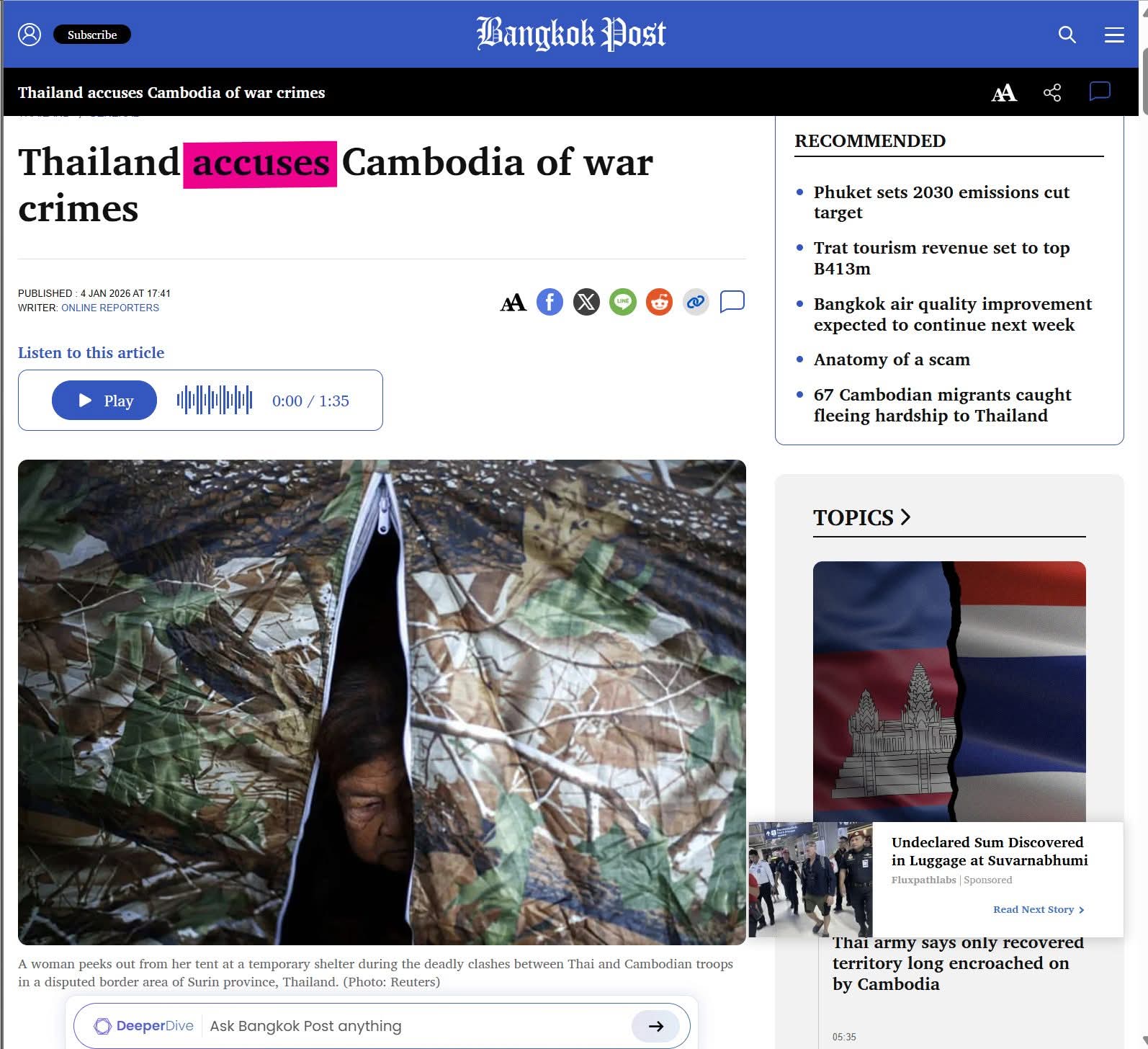
When a state publicly accuses another of “war crimes,” the instinctive response is moral urgency. The correct response, however, is procedural restraint. War crimes are not a category of outrage; they are a legal conclusion that emerges only after evidence is disclosed, examined, and tested through independent mechanisms over time.
Thailand’s recent accusation against Cambodia illustrates a wider and increasingly common pattern in international conflict: the early deployment of humanitarian law language as a framing device, rather than as the outcome of investigation. This pattern is not confined to Southeast Asia. It appears wherever unresolved territorial disputes, fragile ceasefires, and civilian harm intersect under intense media pressure.
The structure of such accusations is by now familiar. First comes territorial certainty, where contested geography is presented as settled fact. Next comes civilian harm, often described through damage to homes or infrastructure. Then intent is inferred, commonly through allegations such as the use of civilians as shields. Finally, the narrative is sealed with a humanitarian claim that carries emotional weight, such as the improper treatment of the dead. Each element is grave. Combined, they form a moral narrative that feels complete long before facts are verified.
What is absent is not seriousness, but method.
International humanitarian law is deliberately exacting. Civilian harm alone does not establish a war crime. The law requires specific elements: precise time and location, weapon identification, civilian status at the moment of impact, proportionality assessment, precautions taken, and command responsibility. These are technical thresholds designed to prevent tragedy from being transformed into propaganda. Without them, accusations remain assertions, not findings.
The strategic value of deploying such language early lies in perception. In the contemporary information environment, the first moral label often becomes the enduring reference point, even if later evidence complicates or contradicts it. This is the logic of lawfare: shaping the interpretive battlefield before institutions can engage. Once suspicion is anchored, correction becomes exponentially harder.
A further complication arises when distinct legal tracks are collapsed into a single moral claim. Border demarcation disputes, ceasefire compliance, and humanitarian law obligations operate under different regimes, with different forums and standards of proof. When they are rhetorically fused, unresolved territorial questions are quietly bypassed. Geography becomes morally settled before it is legally settled, and humanitarian allegations appear clearer than the facts may support.
There is also an asymmetry worth naming. Accusations amplified through state platforms can travel globally within hours, while the accused may have no equivalent forum for neutral adjudication at that stage. Calls for the international community to judge based on “verifiable evidence,” when paired with the withholding of that evidence, invert the burden of proof. The accused is pressed to disprove claims whose factual basis has not yet been disclosed. This is effective communication, but fragile law.
The cost of this approach is not merely political. It risks degrading the integrity of humanitarian law itself. When war-crimes language is used as pressure rather than process, future claims, including those made by genuine victims, may be met with skepticism. Civilians are not protected by moral acceleration; they are protected by mechanisms.
There is a deeper danger as well. When civilian harm is invoked without verification, civilians risk becoming narrative instruments rather than protected persons. Their suffering is mobilised to authenticate claims instead of being investigated to prevent recurrence. This dynamic incentivises escalation over de-escalation and erodes the very norms humanitarian law was designed to uphold.
None of this requires denying harm, dismissing concern, or assigning guilt from afar. Civilian suffering is real, and accountability is essential. But accountability is produced by process, not volume. Independent access, neutral monitoring, forensic transparency, and disciplined separation of legal issues are what reduce violence and misinformation in practice.
Time is also an essential component of law. Courts, commissions, and fact-finding missions do not operate at the speed of headlines, and they should not be forced to. Restraint in response, when anchored in procedure, is not evasion. It is often evidence of seriousness. States confident in their position submit to scrutiny; they do not race it.
Equally important is reciprocity. Any state invoking humanitarian law must be willing to accept neutral examination of its own conduct under the same standards it applies to others. Credibility in this domain is symmetric. Without that symmetry, humanitarian language becomes selective and loses authority.
The responsible path forward in situations like this is therefore clear. If evidence exists, it should be released with sufficient detail to allow independent assessment. If violations occurred, impartial mechanisms should be invited to examine them. If borders remain disputed, they should be addressed through agreed legal frameworks rather than moral shortcuts. Humanitarian access and verification should be expanded, not replaced by rhetoric.
International law survives only when it is treated as a process, not a weapon. In moments of heightened tension, the most stabilising act is not accusation, but submission to scrutiny. That standard protects civilians, preserves credibility, and ensures that justice, when it arrives, rests on fact rather than momentum.
Midnight