Will Temporary Border Demarcation Cause Cambodia to Lose or Gain Land?
 Will Temporary Border Demarcation Cause Cambodia to Lose or Gain Land?
The border issue between Cambodia and Thailand has long been a sensitive topic rooted in history and national politics. Recently, the process of surveying and installing temporary border markers has sparked heated debates across social media, leading many to question which country will benefit or suffer from this activity. As a result, some people are now asking: “Is Cambodia losing land or gaining land?”
These questions often arise from a lack of comprehensive information and misunderstandings about the true intent of the government, as well as emotional nationalism that overlooks historical context and the foundations of international law.
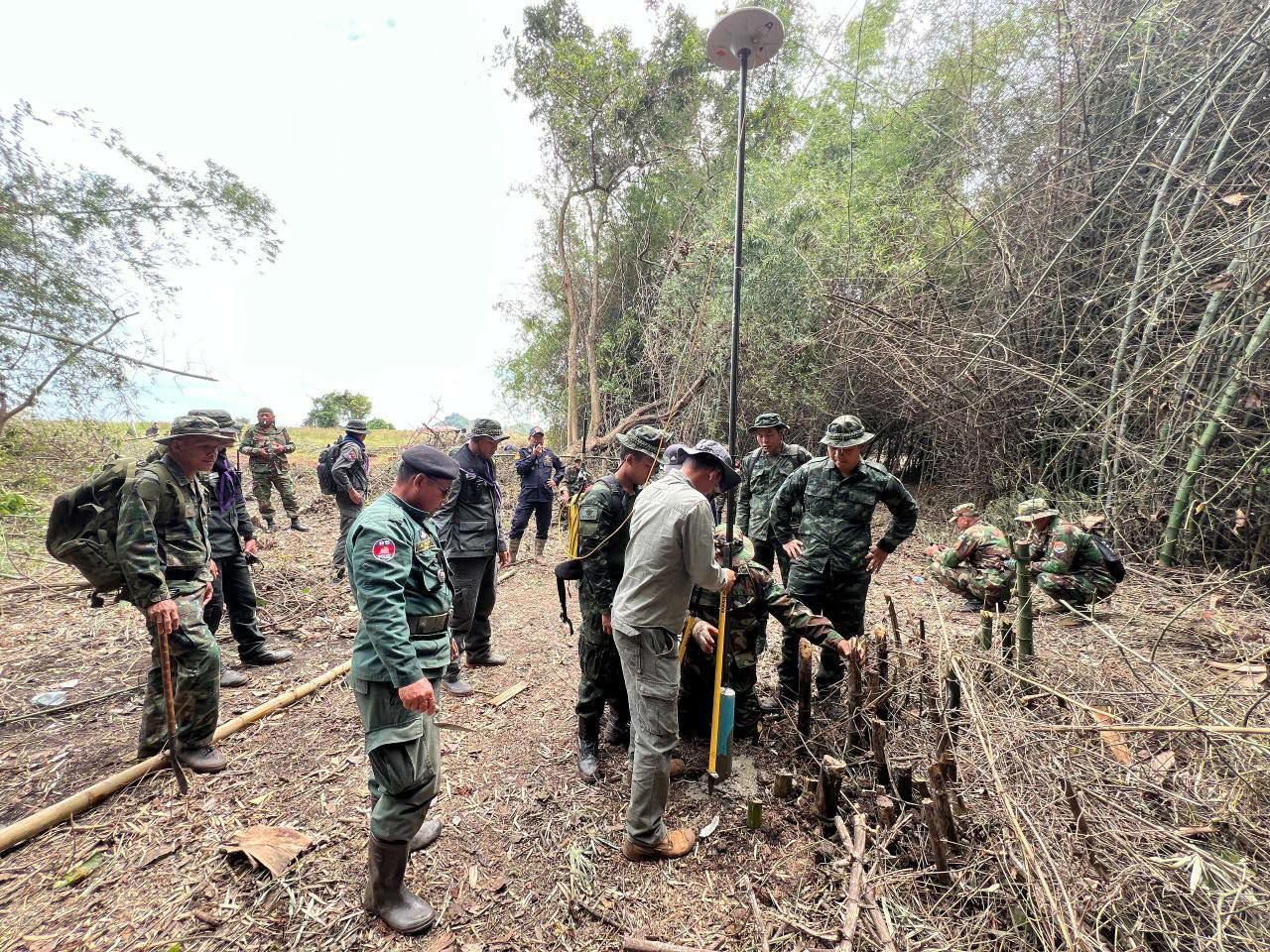
The legal basis of border demarcation cannot be altered. Therefore, any surveying and physical installation of border pillars is not a negotiation to exchange or sacrifice land, but rather a process of ensuring that the historical boundary follows what is shown on official maps—transforming what is on paper into reality on the ground. This work does not result in loss or modification of national territory, and that is exactly what the government has been striving to do.
Cambodia and Thailand are working on the border based on internationally recognized legal documents including the Procès-Verbaux of 1908–1909 and 1919–1920. “Procès-Verbaux” refers to official boundary records documenting joint agreements on border lines and pillar locations—records which cannot be denied by either party later. These documents form the firm legal foundation of the original international border between Siam and French Indochina. Cambodia not only accepted the maps but also insists on strict and concrete respect for these historical border agreements.
Today, the discussion should not revolve around winning or losing territory, but about establishing legal clarity that both countries can accept—ensuring mutual benefit and national interests for both sides, whose leaders must answer to history.
What the government is doing is fixing the border to avoid future disputes—promoting security, management, and stability along the frontier. Without clear borders, risks of armed conflict remain high and some groups may exploit border issues for political gain or populism, especially during times of domestic political uncertainty. When borders are clear, no country can arbitrarily change them.
In many parts of the world, people desire exactly this certainty: peaceful and stable livelihoods, free from fear of conflict.
From a military standpoint, defined borders reduce the risk of clashes, prevent troop encroachment, and guarantee sovereignty and territorial integrity.
From an economic and social perspective, calm borders promote development, trade, and local business opportunities—turning borders from zones of conflict into zones of peace and cooperation that improve livelihoods.
In summary, temporary border demarcation will not cause Cambodia to lose land. It resolves uncertainty, counters misinformation, and prevents extremist groups from weaponizing border topics to attack the government. Instead, it strengthens Cambodia’s sovereignty and territorial integrity, ensures Cambodia will not lose land in the future, and supports long-term peace, security, and development—protecting the lives and property of border communities.
By: Pin Vichey – Student of Political Scholar