
Experts Warn of ‘Rain Bombs’ as Thailand Avoids 2011-Scale Flood Pattern
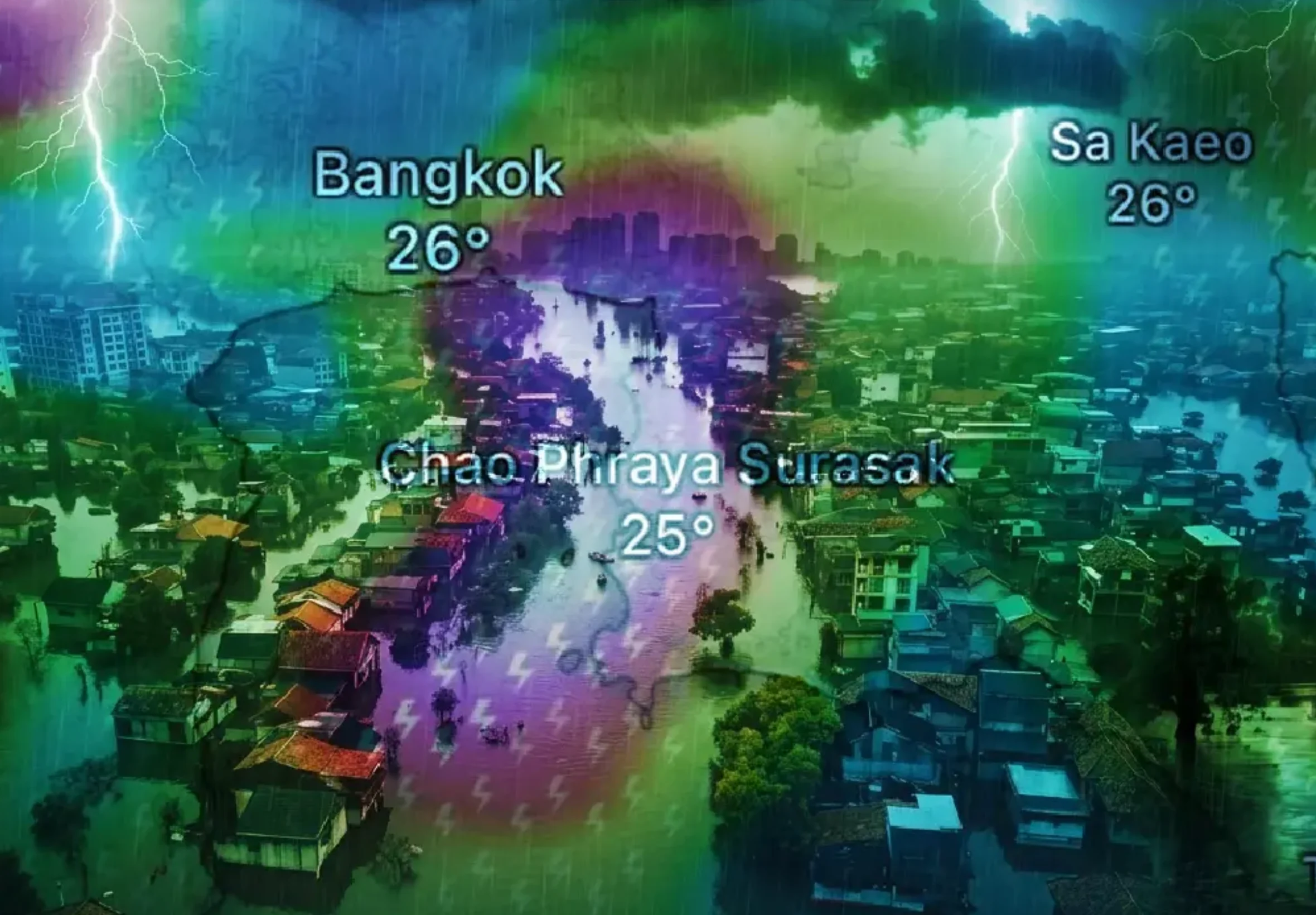 Experts Warn of ‘Rain Bombs’ as Thailand Avoids 2011-Scale Flood Pattern
BANGKOK, Sept. 26, 2026 — Thailand is facing widespread flooding and heavy rain, but a repeat of the devastating 2011 nationwide flood disaster is “virtually impossible” this year, according to two Thai disaster and environmental specialists.
Assoc. Prof. Dr. Seree Supratid of Rangsit University’s Climate Change and Disaster Centre and Asst. Prof. Dr. Thon Thamrongnawasawat of Kasetsart University’s Faculty of Fisheries said current weather and water conditions differ significantly from those in 2011.
Their assessment comes as heavy to very heavy rain continues across parts of Thailand, with accumulated rainfall exceeding 300 millimetres in several areas during Sept. 25–26. The western provinces and parts of the central region are currently facing the greatest rainfall risks.
Water flows far below 2011 levels
Seree said water flowing through Nakhon Sawan, a key point for assessing floodwater moving south through the Chao Phraya basin, was currently around 1,800 cubic metres per second, compared with as much as 4,600 cubic metres per second in 2011.
“The difference remains substantial,” he said.
The Royal Irrigation Department has increased releases from the Chao Phraya Dam to about 1,850 cubic metres per second, with authorities warning residents in low-lying areas outside flood embankments to closely monitor water levels.
Seree said a major warning sign for a disaster on the scale of 2011 would be northern floodwaters overtopping embankments.
Three major differences from 2011
Thon pointed to three major differences between the current situation and the conditions that contributed to the 2011 floods.
First, Thailand experienced La Niña during the first part of 2011, with rainfall in March and April reaching roughly twice the average. This year, he said, conditions are influenced by El Niño.
Second, five tropical cyclones directly affected Thailand in 2011, whereas no tropical cyclone had directly affected the country so far this year, according to his assessment.
Third, satellite data from Thailand’s Geo-Informatics and Space Technology Development Agency showed a substantial difference in the extent of flooding. Cumulative flooded areas in August 2011 reached about 912,000 hectares, compared with less than 64,000 hectares in August 2026.
Localised “rain bombs” remain a serious threat
The experts stressed, however, that the assessment does not mean Thailand is free from significant flood risks.
Thon warned that climate change can contribute to increasingly intense localised rainfall, sometimes described as “rain bombs.” Such downpours can produce flash floods or overwhelm drainage systems even when there is no nationwide mega-flood.
He said warmer seas increase evaporation and that atmospheric water vapour rises by approximately 7% for every 1°C increase in temperature, potentially contributing to intense rainfall events.
Low-lying and poorly drained areas, including parts of Bangkok and Pattaya, remain vulnerable to such sudden downpours.
Western Thailand remains under watch
Thailand’s Meteorological Department has warned that an active low-pressure system and strengthened southwest monsoon are producing heavy to very heavy rain across several regions, including Bangkok and surrounding areas. The department has warned of accumulated rainfall that could trigger flash floods, overflows and landslides, particularly around waterways, foothills and low-lying areas.
The experts expect rainfall to decline significantly in much of the country from Sept. 27, although western Thailand could continue to experience heavy rain before conditions gradually improve.
They advised residents to monitor local weather conditions closely, particularly through rain-radar information and official updates from the Thai Meteorological Department.
The assessment provides some reassurance that Thailand is not currently following the same hydrological pattern as the 2011 catastrophe, but experts continue to warn that severe local flooding remains possible even without a repeat of the 2011 disaster.