Can Thailand Unilaterally Terminate the 2000 MOU?
 Can Thailand Unilaterally Terminate the 2000 MOU?
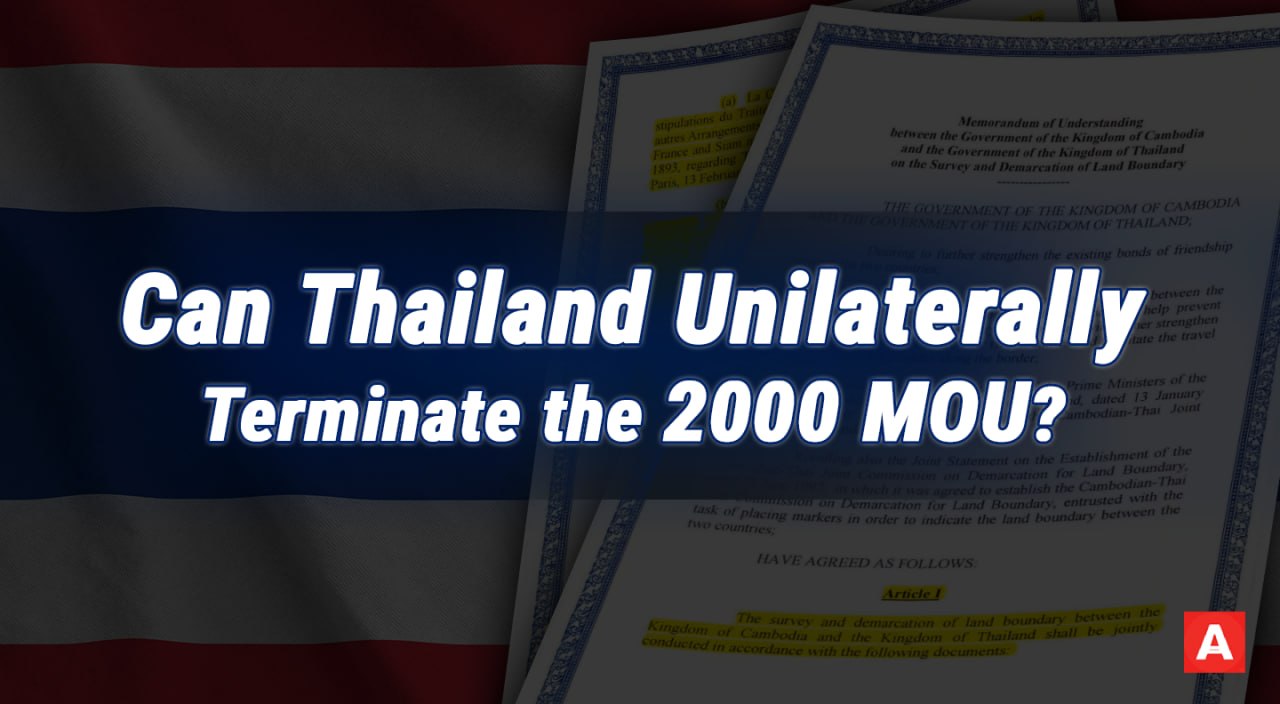
According to the spokesperson of the Secretariat of State for Border Affairs of Cambodia, on March 24, 2026, a response was given to several Thai local media outlets that had reported on statements by a Thai Senate committee proposing a review of the possible termination of the 2000 Memorandum of Understanding (MOU) between Cambodia and Thailand. This issue has drawn significant attention, particularly from the perspectives of international law and regional political stability.
The 2000 MOU, signed on June 14, 2000, is a highly significant agreement with both historical and legal value. Its primary objective is to demarcate and delimit the land boundary, maintain peace, and establish cooperative mechanisms between the two countries for the peaceful settlement of disputes.
Regarding the question being raised—“Can Thailand unilaterally terminate the 2000 MOU?”—the answer under international law is no, unless there is mutual consent from both parties or clearly defined provisions within the agreement that allow for termination. However, in the case of the 2000 MOU, there is no specified expiration date or explicit termination clause.
According to Article 62, paragraph 2 of the Vienna Convention on the Law of Treaties (VCLT) of 1969, international agreements cannot be terminated or modified unilaterally. This means that such an agreement cannot be invalidated based solely on domestic law considerations of one party.
Therefore, although it is termed a Memorandum of Understanding (MOU), because this agreement establishes obligations and legal commitments and is internationally recognized, it effectively carries the same legal weight as a treaty.
Moreover, the 2000 MOU serves as the foundation for the establishment of the Joint Boundary Commission (JBC), which plays a crucial role in surveying and demarcating the boundary on the ground. Over time, the JBC has achieved several milestones that have helped reduce tensions and build mutual trust between the two countries.
From a historical perspective, the Cambodia–Thailand boundary delimitation is closely linked to the Franco–Siamese Treaties of 1904–1907, which were referenced in the 1962 judgment of the International Court of Justice (ICJ). These documents continue to hold legal value and are used as a basis for interpreting boundary issues to this day.
It is also noteworthy that the Franco–Siamese Treaties of 1904–1907 were signed and recognized by Thailand itself, preserved in France, and cited during proceedings at the International Court of Justice, where Thailand lost the case to Cambodia in 1962.
Additionally, there exists a Joint Statement issued in Malaysia, associated with the 2000 MOU and the implementation of the GBC and JBC mechanisms, signed by Donald Trump, the Prime Minister of Malaysia, and the Prime Ministers of Cambodia and Thailand. This clearly reflects international support for the 2000 MOU as a peaceful mechanism for resolving border issues.
In the event of a unilateral termination of the MOU, the consequences could be severe. It would not only affect Cambodia–Thailand relations but could also escalate tensions along the border, potentially leading to renewed conflict. It would undermine trust within the ASEAN framework and damage Thailand’s credibility on the international stage. Furthermore, it could result in legal disputes being brought before international courts if one party chooses to pursue legal action.
In conclusion, any attempt to terminate the 2000 MOU unilaterally—whether driven by motives of conflict escalation, military force, territorial expansion, or violation of sovereignty—would not only contravene international law and the principle of uti possidetis juris, but also obstruct peaceful resolution of border disputes. It would hinder efforts to establish a stable, peaceful, and development-oriented boundary between the two countries.
The 2000 MOU is not merely an ordinary agreement; it is a foundation for peace, stability, and cooperation between Cambodia and Thailand.
Therefore, respecting and continuing to implement this agreement serves the shared interests of both parties and the broader region. Peaceful resolution of border issues, grounded in international law, remains the best path toward sustainable peace—something Cambodia firmly aspires to achieve.
By: Pin Vichey – Political Science Scholar