Thailand’s “White Paper”: Document or Assertion — What Determines the Truth?
 Thailand’s “White Paper”: Document or Assertion — What Determines the Truth?
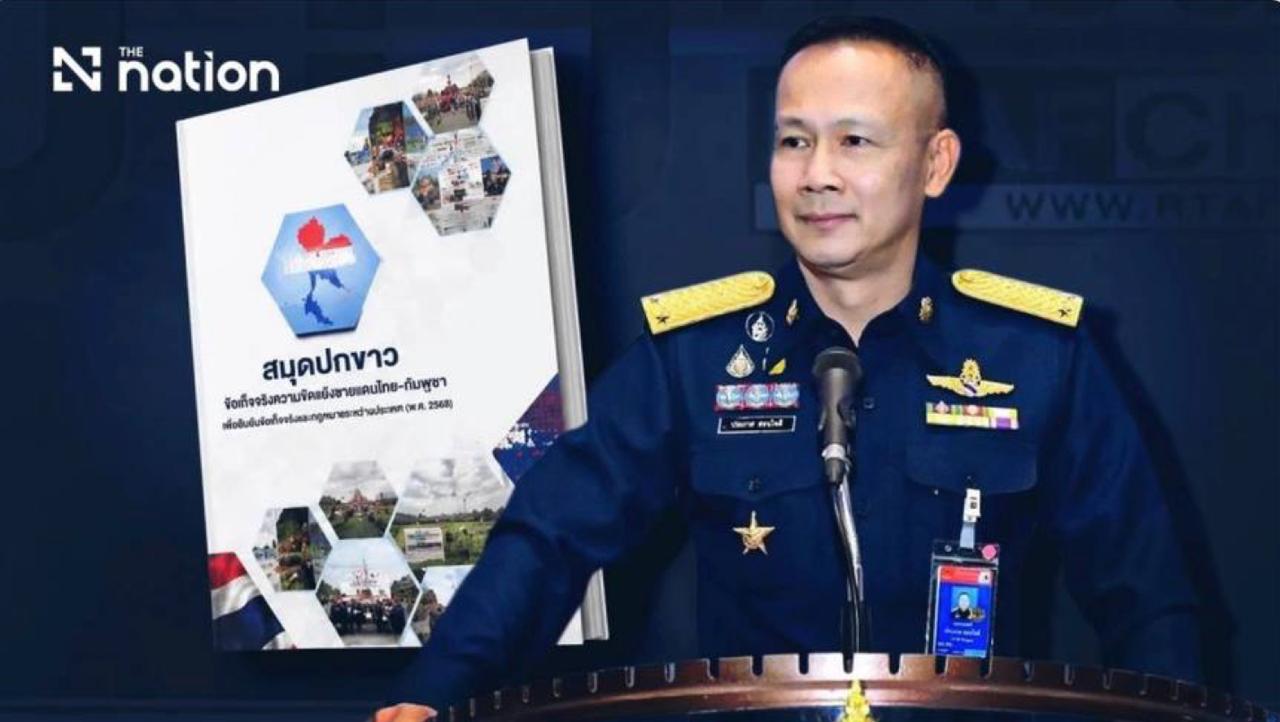
The preparation of a “White Paper” by Thailand’s Joint Information Center (JIC) on the situation along the Cambodia–Thailand border demonstrates that the dispute between the two countries is no longer confined to the border area. It is increasingly expanding into the battlegrounds of information, diplomacy, and interpretations of international law. Thailand itself claims that the document compiles facts, historical records, chronology, evidence, and principles of international law so that the public, journalists, researchers, and the international community can examine them.
As a matter of principle, Cambodia has no reason to oppose calls for the public to examine information based on facts and evidence. However, the questions that should instead be asked are: What constitutes a fact? Where does the evidence come from? And can Thailand’s interpretation be regarded as legal fact? The answer is certainly no.
The “White Paper” is a document presenting Thailand’s position. It may have value for studying and understanding Thailand’s own perspective, but it is neither a judgment of an international court nor an acknowledgment by the international community. Therefore, Cambodia has no need to compete with Thailand through emotional rebuttals or counterclaims. A more effective approach is to take the very principles Thailand itself has invoked — “facts, evidence, and international law” — and use them as the standards against which the White Paper should be examined.
Border issues cannot be determined by which side disseminates information faster or produces more maps. Rather, they must be examined on the basis of treaties, agreements, maps, historical documents, the conduct and practices of the parties, and international law. Therefore, if Thailand relies on history and maps as the basis for its claims, Cambodia can likewise rely on original historical documents that have received international recognition and subject them to verification and comparison.
At that point, the question is not simply which side’s map is correct. Instead, the questions should be: Where did the map come from? What is its legal status? Has it received international recognition? And was it mutually agreed upon by both parties?
The history of the Cambodia–Thailand border contains a vast number of documents and cannot be selectively interpreted by extracting only those portions that suit the wishes or claims of one party. The Treaties of 1904 and 1907, together with the relevant documents and maps, constitute important parts of the legal history of the boundary between the two countries. Even the 2000 Memorandum of Understanding (MoU) on the Survey and Demarcation of Land Boundary between Cambodia and Thailand refers to these treaty frameworks and related documents as the basis for joint work.
This point demonstrates that the border issue cannot be resolved solely through the unilateral interpretation of either party. If there are differences of opinion, both sides should return to the original documents and the existing mechanisms that they have already agreed upon and review them accordingly. This is precisely why mechanisms such as the Joint Boundary Commission (JBC) are important, as they provide a framework for technical work and peaceful negotiations.
With regard to issues that have already been recognized by international judicial decisions, the matter becomes even clearer. In the case of the Temple of Preah Vihear, the International Court of Justice (ICJ) ruled in 1962 that the Temple of Preah Vihear was situated in territory under the sovereignty of Cambodia. In 2013, the Court further clarified the interpretation of its 1962 Judgment. Therefore, an ICJ judgment is a legal document that cannot be replaced by any interpretation contained in Thailand’s White Paper.
At the same time, another important principle repeatedly emphasized by the international community is the peaceful settlement of disputes and the prohibition of the use of force.
The Association of Southeast Asian Nations (ASEAN) has also called on Cambodia and Thailand to implement the ceasefire, end hostilities, and return to the negotiating table on the basis of the Charter of the United Nations, the ASEAN Charter, conventions, treaties, and existing agreements.
This means that if Thailand claims to respect international law, that claim must be consistent with the full range of principles of international law, rather than selectively invoking only those provisions that are favorable to its own position. Cambodia, likewise, adheres to the same principle. This is the way to transform the competition in the information space from a “war of words” into a “competition based on documents and reason.”
Indeed, the establishment of the Joint Information Center (JIC) and the publication of Thailand’s White Paper, if they are based on historical claims, can be met by Cambodia with historical documents of its own. If Thailand raises maps as evidence, their sources and legal status must be examined. If Thailand invokes treaties, their full context must be considered. If Thailand invokes international law, Cambodia must likewise invoke international law as the standard for examination.
And if judgments of international courts are involved, the original judgments must serve as the foundation — not the interpretations of politicians, nationalists, or those attempting to create a new version of history after a ceasefire has come into effect, while simultaneously altering the facts on the ground along the border. The Thai side itself must clearly understand this issue.
Ultimately, the truth does not belong to any particular country. Nor does it belong to Thailand’s JIC or to Cambodia’s media institutions. The truth must be something that a third party can independently examine by reviewing the documents, checking their sources, and verifying the evidence for itself.
A border issue is not determined by which side speaks first, nor by which side publishes a book first. Rather, it must be examined through treaties, agreements, maps, evidence, judgments, and international law.
In the end, if accuracy and truth are what we seek, the documents must be placed on the table — and the truth must be allowed to speak for itself.
By: Pin Vichey