Thailand Approves 35% Tax on Imported EVs Starting January 2027
 Deputy Prime Minister and Finance Minister of Thailand, Ekniti Nitithanprapas
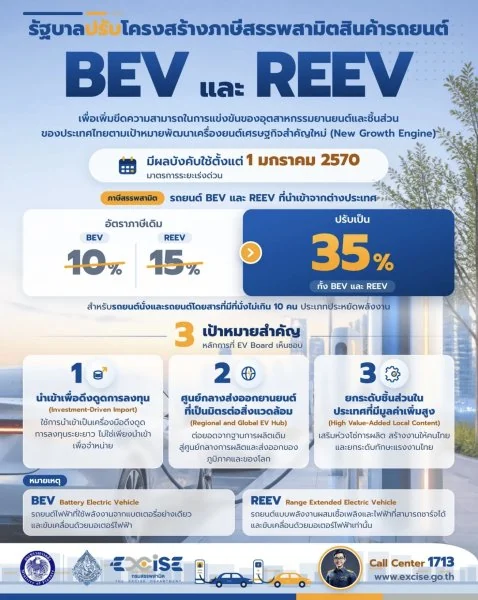
BANGKOK, November 4, 2026 — Thailand’s Cabinet has approved a sharp increase in excise tax on imported battery electric vehicles (BEVs) and range-extended electric vehicles (REEVs), raising the rate to 35% from January 1, 2027, in a move aimed at encouraging domestic EV production and strengthening the country’s automotive industry.
Deputy Prime Minister and Finance Minister Ekniti Nitithanprapas announced the decision following a mobile Cabinet meeting in Udon Thani on November 3, 2026.
Under the new policy, imported BEVs will face an excise tax increase from the current 10% to 35%, while the rate for REEVs will rise from 15% to 35%.
BEVs are powered entirely by batteries and electric motors. REEVs, under the government’s definition, use both fuel and electricity, can be charged externally and are driven exclusively by electric motors.
Thailand seeks to strengthen domestic EV production
The tax adjustment follows decisions made by the National Electric Vehicle Policy Committee at meetings on November 25, 2025, and September 10, 2026.
The Excise Department was instructed to review the tax structure to encourage investment in domestic vehicle production and the manufacturing of key automotive components.
According to the government, the measure is intended to maintain stability in Thailand’s automotive industry amid growing competition from imported vehicles that do not participate in government investment-promotion programmes.
The policy is based on three main objectives: attracting investment linked to vehicle imports, developing Thailand into a regional and global export hub for environmentally friendly vehicles, and increasing the use of high-value locally manufactured components.
Government aims to protect jobs and expand automotive supply chains
The government said the revised tax structure would help strengthen domestic supply chains, create employment opportunities for Thai workers and improve workforce skills.
It also aims to transform Thailand’s traditional automotive manufacturing base into a future centre for green vehicle production and exports.
Ekniti said the new tax structure was designed to create fairer competition for vehicles manufactured in Thailand while encouraging investment in domestic EV production.
He added that local vehicle manufacturers and parts suppliers would benefit through increased production, employment and wider economic activity across the automotive supply chain.
The government described the measure as part of its “Multi Path Way” approach to alternative vehicle technologies, intended to develop a new source of economic growth from Thailand’s established automotive industry.