
Kasikornbank Questions 7 Million Baht Transfer Slip Naming Thai PM Anutin
 Kasikornbank Questions 7 Million Baht Transfer Slip Naming Thai PM Anutin
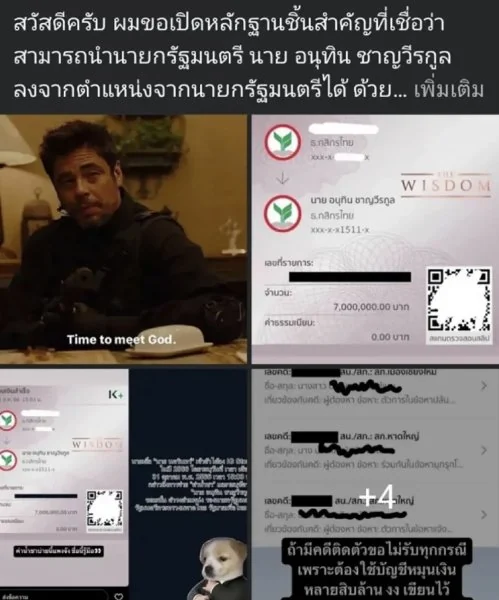
BANGKOK, October 27, 2026 –– Thailand’s Kasikornbank says it could not locate the recipient account number shown on a purported 7-million-baht transfer slip naming Prime Minister and Interior Minister Anutin Charnvirakul, raising further questions about an image circulating online that allegedly showed a bribe payment.
In a statement on Monday, October 26, the bank said the recipient account number displayed in the image did not match an account in its system. It also noted that its K PLUS mobile banking application has a daily transfer limit of 5 million baht.
The image allegedly showed a 2023 payment described as “tea money”—a euphemism for a bribe—to Anutin, who was serving as deputy prime minister and interior minister at the time. The claim sparked criticism and debate on social media.
Bank Cites Unmatched Account Number
Kasikornbank’s clarification cast doubt on the purported transaction, although the statement did not independently establish who created or circulated the image.
Government spokesman Ekkapob Pianpises dismissed the allegation as “fake news” and warned that those responsible for spreading information deemed false could face legal action.
Ekkapob offered three arguments against the claim. He said politicians who accept money or benefits worth more than 3,000 baht could face misconduct allegations, making an unexplained payment worth millions particularly sensitive.
He also cautioned that transfer-slip images could be edited or fabricated. According to the spokesman, larger transfers may require customers to request higher limits, leaving records with the bank.
His third argument was that Anutin was already wealthy and had no need to accept the alleged payment.
Social Media Test Raises Questions About Transfer Limits
The controversy prompted social media personality Dr Khongkwan Fujitnirun to test transfer limits and share images of her results on Facebook, according to Thai media reports.
She said she successfully transferred 7 million baht between separate accounts held in her own name. However, when she attempted to transfer money to another person’s account, the K PLUS application displayed a maximum limit of 5 million baht per transaction.
The results introduced a distinction between transfers involving accounts belonging to the same customer and transfers to other recipients. Kasikornbank’s statement referred to a daily limit but did not explain how transfers between a customer’s own accounts were treated.
Digital Ministry Traces Online Networks
Ekkapob said the Ministry of Digital Economy and Society was tracing accounts and networks involved in circulating the allegation, including those operating in Thailand and overseas or using virtual private networks.
In a separate Facebook post, he alleged that anonymous accounts, organised networks and automated bots had amplified fabricated or distorted claims. He also accused politicians and networks linked to an unnamed political party of helping spread the posts.
The spokesman warned that politicians sharing unverified information could face criminal proceedings or ethics complaints. Investigators, he said, would pursue both the original publishers and those who distributed the material.
The authenticity of the transfer slip and the circumstances surrounding its circulation remain central to the controversy. The bank’s account-number finding raises doubts about the image, but identifying its origin and establishing whether any actual payment occurred would require further evidence.