ASEAN Chair Vows to Strengthen AOT Amid Cambodia–Thailand Tensions
 ASEAN Chair Vows to Strengthen AOT Amid Cambodia–Thailand Tensions
BANTEAY MEANCHEY, Feb 23, 2026 — The Philippines, as chair of the Association of Southeast Asian Nations (ASEAN) in 2026, has pledged to strengthen the operational capacity of the ASEAN Observer Team (AOT) to help maintain the ceasefire between Cambodia and Thailand.
Philippine Ambassador to Cambodia Flerida Ann Camille P. Mayo made the remarks on Monday after visiting border villages in Banteay Meanchey province, where Cambodian authorities allege ongoing Thai military activities despite a Dec. 27 ceasefire agreement.
“The Philippines, as ASEAN Chair in 2026, commends consultations with both parties regarding the ceasefire and is committed to strengthening the operational capacity of the ASEAN Observer Team to help maintain this ceasefire,” Mayo said.
She added that reinforcing the AOT would allow time and space for bilateral mechanisms between Cambodia and Thailand to function effectively in pursuit of a long-term peaceful settlement.
Mayo noted that the Chief of Staff of the Armed Forces of the Philippines had recently visited the area as part of consultations and fact-finding efforts aimed at enhancing the terms of reference of the ASEAN monitoring mission. She said ASEAN stands ready to provide further facilitation at the request of both sides.
“As one ASEAN family, we hope for a peaceful resolution to the Cambodia–Thailand border issue,” she said.
The ambassador’s visit included inspections of disputed areas in Chok Chey and Prey Chan villages and the Boeung Trakoun area, as well as two displacement sites housing civilians affected by the border tensions.
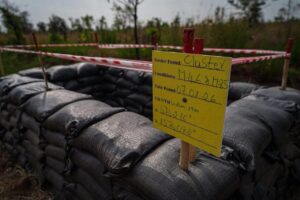
Cambodia has accused Thai forces of installing barbed wire and shipping containers and damaging homes inside what it considers its sovereign territory.
Phnom Penh has lodged repeated diplomatic protests and said it does not recognize any unilateral change to the border through the use of force.
The developments come amid heightened attention within ASEAN over maintaining regional stability and preventing escalation between member states.