
Cambodia Secures 10% U.S. Tariff While Thailand Faces 12.5%
 Cambodia Secures 10% U.S. Tariff While Thailand Faces 12.5%
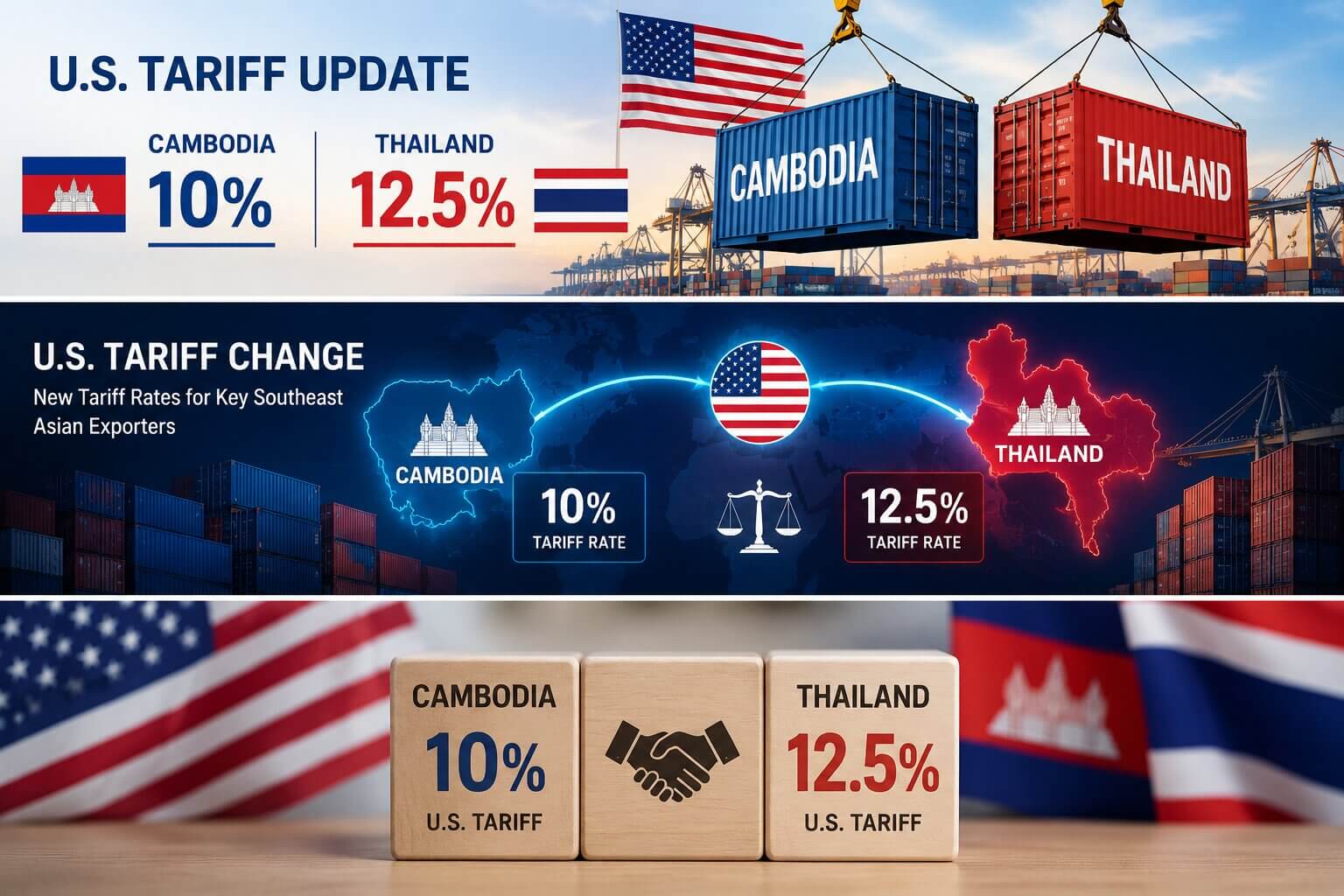
PHNOM PENH, 25 July 2026 — Cambodia has emerged with a competitive advantage over neighboring Thailand after the United States announced new import tariffs that set a 10% duty on Cambodian goods, compared with 12.5% on Thai exports, giving Cambodia one of the lowest rates among Southeast Asian exporters under Washington’s latest tariff regime.
The tariffs took effect after the expiration of a temporary universal 10% tariff imposed earlier this year. The new measures, introduced under Section 301 of the U.S. Trade Act of 1974, apply to imports from 60 economies and are intended by Washington to address concerns over forced labor in global supply chains.
Why Cambodia received a lower tariff
While Washington has not publicly attributed Cambodia’s 10% rate to a single factor, several developments distinguish Cambodia’s position from Thailand’s.
The most significant is that Cambodia concluded a Reciprocal Trade Agreement with the United States, under which Phnom Penh agreed to eliminate tariffs on virtually all U.S. industrial, agricultural and food products entering Cambodia. The agreement marked one of the most comprehensive trade arrangements reached by Washington with a Southeast Asian partner.
Thailand, by contrast, has reached only a framework for a reciprocal trade agreement rather than a finalized accord. While Bangkok agreed to reduce non-tariff barriers and expand market access for U.S. goods, negotiations on a full agreement remain ongoing.
Trade analysts say Cambodia’s completed agreement likely strengthened its position during U.S. tariff deliberations, helping it secure the baseline 10% rate rather than the higher 12.5% applied to Thailand and several other trading partners.
Cambodia gains an export advantage
The difference of 2.5 percentage points may appear modest but could prove commercially significant.
The United States is Cambodia’s largest export market, particularly for garments, footwear, travel goods and bicycles. A lower tariff reduces the landed cost of Cambodian products, making them more competitive against similar products manufactured in Thailand.
Manufacturers sourcing from Southeast Asia may also view Cambodia more favorably when deciding where to expand production, particularly in labor-intensive industries where relatively small differences in import costs can influence purchasing decisions.
Former business leaders in Cambodia have noted that the tariff differential may create new opportunities for Cambodian exporters as buyers seek lower-cost sourcing options within the region.
Thailand faces greater pressure
Thailand’s 12.5% tariff places it in the highest category of the latest U.S. duties imposed under the Section 301 action. Thai authorities have acknowledged the higher rate and are preparing assistance measures for affected exporters while continuing discussions with Washington.
Although many Thai exports remain exempt under product-specific exclusions, industries covered by the new tariff could face increased costs and reduced price competitiveness in the U.S. market.
Outlook
The new tariff structure gives Cambodia a measurable advantage in one of its most important export markets at a time when global manufacturers are reassessing supply chains.
Whether that advantage translates into increased investment and export growth will depend on several factors beyond tariffs, including production costs, logistics, labor availability and continued access to the U.S. market. At the same time, Thailand is expected to continue negotiations with Washington in an effort to secure more favorable trade terms and narrow the tariff gap.
I can also produce this as a Reuters-style analysis with more economic data (trade volumes, export sectors, FDI flows, and expert commentary) similar to articles published by Reuters or Bloomberg.