Anutin’s Visit to An Ses: A Provocative Act Undermining Cambodia’s Sovereignty and Peaceful Border Dialogue
 Anutin’s Visit to An Ses: A Provocative Act Undermining Cambodia’s Sovereignty and Peaceful Border Dialogue
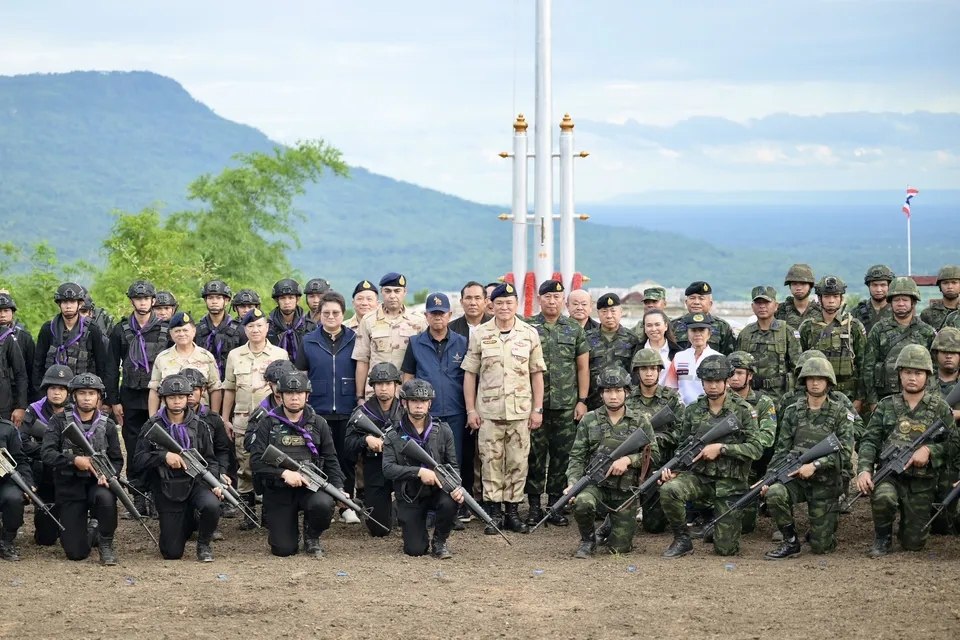
The visit by Thai Prime Minister Anutin Charnvirakul to the An Ses area in Choam Ksan District, Preah Vihear Province, on August 23, 2026, should not be viewed as an ordinary visit, particularly at a time when the area remains subject to disagreement between Cambodia and Thailand over the border issue.
The questions that should be asked are: Why did the Thai leader choose to visit such a sensitive area? And what messages could this visit send to the people of Thailand and Cambodia, as well as to the international community?
For Cambodia, entering this area without the consent of the Cambodian side is completely unacceptable, because the area lies within Cambodia’s sovereign territory based on the 1:200,000-scale Indochina-Siam map. At the same time, Cambodia has formally protested and rejected this action by the Thai side.
Cambodia’s protest is not an emotional reaction. Rather, it is a clear affirmation that Cambodia neither agrees with nor recognizes the actions of the Thai leader in entering the area without prior consultation or consent from the Cambodian side. Cambodia considers this act a serious violation and a disregard for the spirit of the Joint Statement, as well as an action that contributes to increased tensions along the border.
Another important point is that the fact that Mr. Anutin, a Prime Minister who lacks an understanding of history, stood at a particular location cannot turn that location into Thai territory. The presence of a leader at a particular site may constitute a political act, but it cannot replace official documents, historical records, and the relevant legal foundations governing the determination of international boundaries.
The issue of creating a fait accompli, or a new fact on the ground, is another matter that should not be overlooked. The deployment of forces, construction of infrastructure, or implementation of activities aimed at establishing effective control over a disputed area cannot automatically transform such a situation into a legal basis for claiming sovereignty over that territory. Territorial rights must be determined on the basis of law and relevant documents, not through the unilateral creation of a situation on the ground.
If merely standing on a piece of land could be used to determine ownership of that territory, the world would have no need for treaties, maps, agreements, or other dispute-resolution mechanisms. It would mean that might makes right—that whoever is stronger becomes the winner, even if that country uses force, violates another country’s sovereignty, or engages in aggression contrary to international law. If the world operated in such a manner, what would become of the international order? The reality, however, is that the world cannot and does not operate in this way.
Border issues cannot be determined by simply demonstrating a physical presence on the ground. They must be addressed on the basis of documents, historical records, agreements, and consultations between the parties concerned. For this reason, Cambodia continues to uphold the 1:200,000-scale map produced in the context of the demarcation of the boundary between Indochina and Siam as the basis of its position, and categorically rejects the use of the allegedly unlawful 1:50,000-scale maps unilaterally used by Thailand to support its claims over the disputed area.
Conversely, the Thai side uses maps and interprets the boundary line differently from Cambodia. Therefore, this issue cannot be resolved by treating physical presence or effective control on the ground as the decisive factor. When the two parties hold different interpretations, what should be done is to bring the relevant documents, agreements, and existing mechanisms to the negotiating table and seek a mutually acceptable solution—not to compete through military force or use physical presence at a particular location as evidence that the area belongs to one side.
If Thailand genuinely wants to demonstrate that it respects peace and values good relations with Cambodia, what it should demonstrate is not its presence in a disputed area. What it should demonstrate is restraint, respect for dialogue, and respect for the mechanisms that the two sides have already agreed upon.
Ultimately, borders should not be determined by the presence of political leaders or by demonstrations of force. Borders should be addressed through documents, dialogue, mutual understanding, and mutual respect.
For Cambodia, protecting its territory does not mean that Cambodia seeks conflict. It means that Cambodia stands firmly by its position, protects its sovereignty and territorial integrity, while keeping the door open to negotiations and peaceful solutions.
By: Pin Vichey