
Nearly 3 Million Myanmar Workers Face Document Renewal Challenges in Thailand
 Nearly 3 Million Myanmar Workers Face Document Renewal Challenges in Thailand
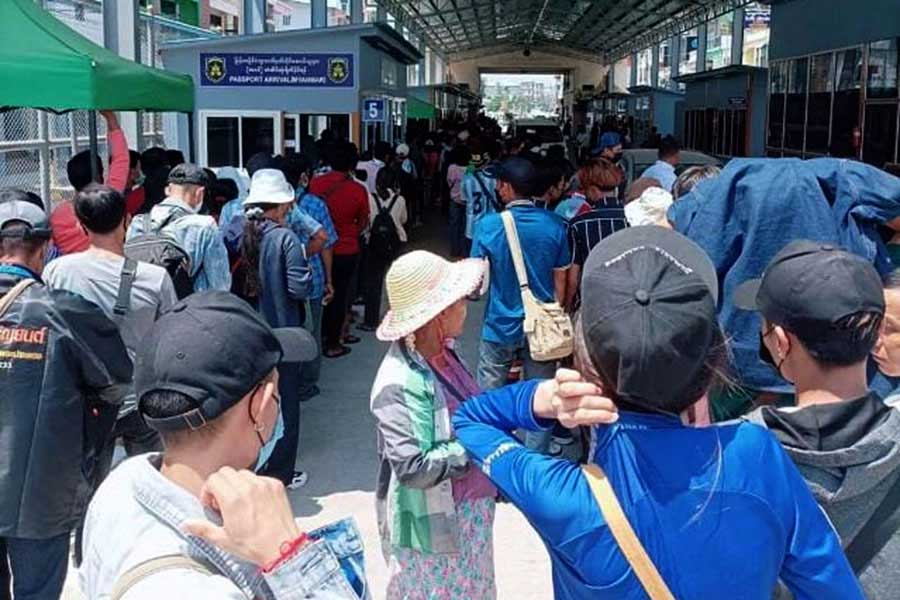
BANGKOK, October 22, 2026 — More than one million Myanmar migrant workers in Thailand could fall out of the formal labour system as Myanmar tightens document-renewal requirements, tax obligations and rules governing the transfer of earnings, civil society groups have warned.
The measures could worsen labour shortages in Thailand, particularly in agriculture and construction, which rely heavily on migrant workers.
Myanmar opened five Certificate of Identity (CI) document centres on October 14, 2026, with operations scheduled to continue until January 14, 2027. However, workers and labour advocates say the wider requirements are creating uncertainty, particularly among men concerned about possible military conscription if they return to Myanmar.
Document Renewal Raises Conscription Fears
Myanmar migrant worker Sai Tun Swe said workers faced uncertainty when their passports expired. While they had previously been able to renew documents through the Myanmar embassy in Thailand, they were now facing pressure to return to Myanmar to complete the process.
He said some workers came from different ethnic backgrounds and lacked the documents required by Myanmar authorities to obtain new papers. Returning home could also expose male workers to conscription risks.
Myanmar has introduced an income tax requirement of 2–3% and requires migrant workers to transfer 25% of their earnings to Myanmar through official banks. Workers reportedly face exchange rates below market levels, while proof of tax payments and remittances is required for passport and CI renewals.
Those who fail to meet the requirements cannot renew their documents, according to the report.
Myanmar has also delayed or suspended permission for men aged 18 to 35 to leave the country under its conscription law. Labour advocates warn that some workers may therefore choose to remain in Thailand without valid documents rather than risk returning home.
Three Groups Face Documentation Challenges
Adisorn Kerdmongkol, coordinator of the Migrant Working Group (MWG), identified around 700,000 workers covered by a Thai Cabinet resolution dated November 11, 2025, who have yet to obtain Myanmar passports. They need CIs to secure visas and work permits, but the five document centres have reportedly faced problems involving agents and queue arrangements.
Sai Tun Swe said the total cost for an individual worker could exceed 10,000 baht. The expenses reportedly include a 2,660-baht CI fee, 1,800 baht in tax payments to Myanmar, a 3,000-baht visa fee and between 1,300 and 1,500 baht in agent-related queue charges.
However, Kriangkrai Jakkapak, an operator of a foreign-worker recruitment company, said at a CI and nationality-verification centre in Samut Prakan on October 21 that the official passport-related fee was 2,660 baht. He said he was unaware of the agent queue charges, describing such payments as service fees agreed between workers and those accompanying them to the centre.
A further group of nearly two million workers covered by Cabinet resolutions dated September 24, 2024, and December 2, 2025, have CIs approaching expiry. They may need to travel to locations such as Yangon and Naypyidaw to obtain passports.
Another 100,000 workers recruited under memorandums of understanding (MOUs) are completing four-year employment terms in 2026–2027. They must return to their home country within 30 days before they can be recruited again.
Employers Urge Thailand to Allow Temporary Registration
Nilubon Pongpayom, representing employers, said businesses were already recovering from the effects of the Covid-19 pandemic and this year’s flooding. Additional paperwork costs and uncertainty over whether workers would return from Myanmar were adding to their difficulties.
She called on Thailand to introduce temporary unilateral registration and renewal arrangements lasting one to two years.
Adisorn supported the proposal, arguing that Thai authorities already held workers’ biometric information, pink-card records and health-check data, which could help facilitate the process.
He also said Thai businesses had already lost more than 400,000 Cambodian workers amid the Thai-Cambodian conflict, with workers from temporary shelter areas providing only a partial replacement.
Losing another one million migrant workers, he warned, could create a severe labour shortage and put further pressure on employers in sectors that depend on foreign workers.