
Vietnam Could Overtake Thailand in Economic Size Before 2030
 Vietnam Could Overtake Thailand in Economic Size Before 2030
HANOI, Oct. 5, 2026 — Vietnam’s economy is increasingly on track to overtake Thailand in overall economic size, with the gap already reversed when measured by purchasing power parity (PPP), while Thailand continues to hold a substantial advantage in income per person.
The contrasting trajectories highlight a growing divide between economic size and individual prosperity. Vietnam’s faster growth is allowing it to close the gap with Thailand’s larger economy, but catching Thailand in living standards will likely take considerably longer.
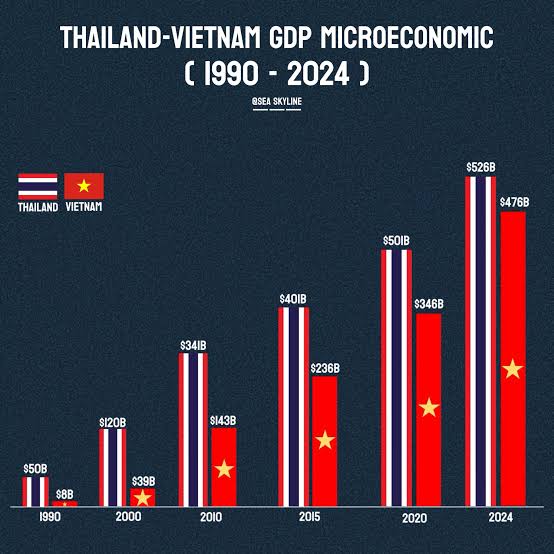
World Bank figures put Thailand’s economy at around US$577 billion in 2025, compared with US$514.7 billion for Vietnam. Vietnam, however, grew by 8% that year, compared with Thailand’s 2.4%.
The growth gap is expected to persist in 2026. The International Monetary Fund (IMF) forecasts Vietnam’s economy to expand by 7.1%, compared with just 1.5% for Thailand.
Vietnam Already Ahead on PPP
The shift is already visible when economic output is measured using purchasing power parity, which adjusts for differences in prices between countries.
IMF projections put Vietnam’s PPP-adjusted economy at approximately US$2.025 trillion in 2026, making it the second-largest economy in Southeast Asia after Indonesia and placing it ahead of Thailand.
By 2031, the IMF expects the gap between Vietnam and Thailand on a PPP basis to exceed US$500 billion.
Bangkok Bank’s Bnomics research team has pointed to a similar long-term trajectory, citing IMF projections that Thailand could fall to fifth place among Southeast Asian economies by 2030, as Vietnam and the Philippines move ahead.
Vietnam Faces Challenges Beyond Growth
Despite Vietnam’s rapid expansion, economists and institutions have cautioned that sustaining growth will require improvements beyond headline GDP figures.
The World Bank has said Vietnam will need stronger institutions, more predictable regulations, better public investment and a more capable and accountable civil service. It has also stressed the importance of creating conditions that allow domestic private businesses to become stronger drivers of productivity.
Other analysts have highlighted potential bureaucratic challenges. Do Khuong Manh Linh of Vietnam’s Ho Chi Minh National Academy of Politics has argued that the Communist Party’s long-running anti-corruption campaign has strengthened public trust but has also contributed to caution among some officials when approving major projects because of concerns about future scrutiny.
Such delays could affect the pace at which Vietnam converts rapid economic growth into higher productivity and stronger domestic businesses.
Thailand Faces Its Own Structural Pressures
Thailand, meanwhile, is dealing with slower economic growth and structural constraints.
The IMF expects Thailand to expand by only 1.5% in 2026, while the Bank of Thailand reported household debt equivalent to 86.7% of GDP at the end of 2025.
Thailand’s economy grew by just 1.9% year on year in the second quarter of 2026, as weaker household consumption weighed on activity.
Vietnam therefore appears increasingly likely to overtake Thailand in total economic size if current growth trends continue.
However, the two countries remain much further apart when measured by income per person. Thailand’s existing advantage in per-capita income remains substantial, meaning that Vietnam overtaking Thailand in economic size would not mean that Vietnamese living standards had caught up with those of Thailand.
For Vietnam, the challenge will be turning rapid economic expansion into sustained productivity gains, stronger domestic businesses and higher household incomes.
For Thailand, its higher income per person remains an important advantage, but the country’s slower growth means maintaining that lead will increasingly depend on its ability to address structural economic constraints.