When Thailand Chooses Evasion to Advance Its Interests, Cambodia Upholds International Law under UNCLOS
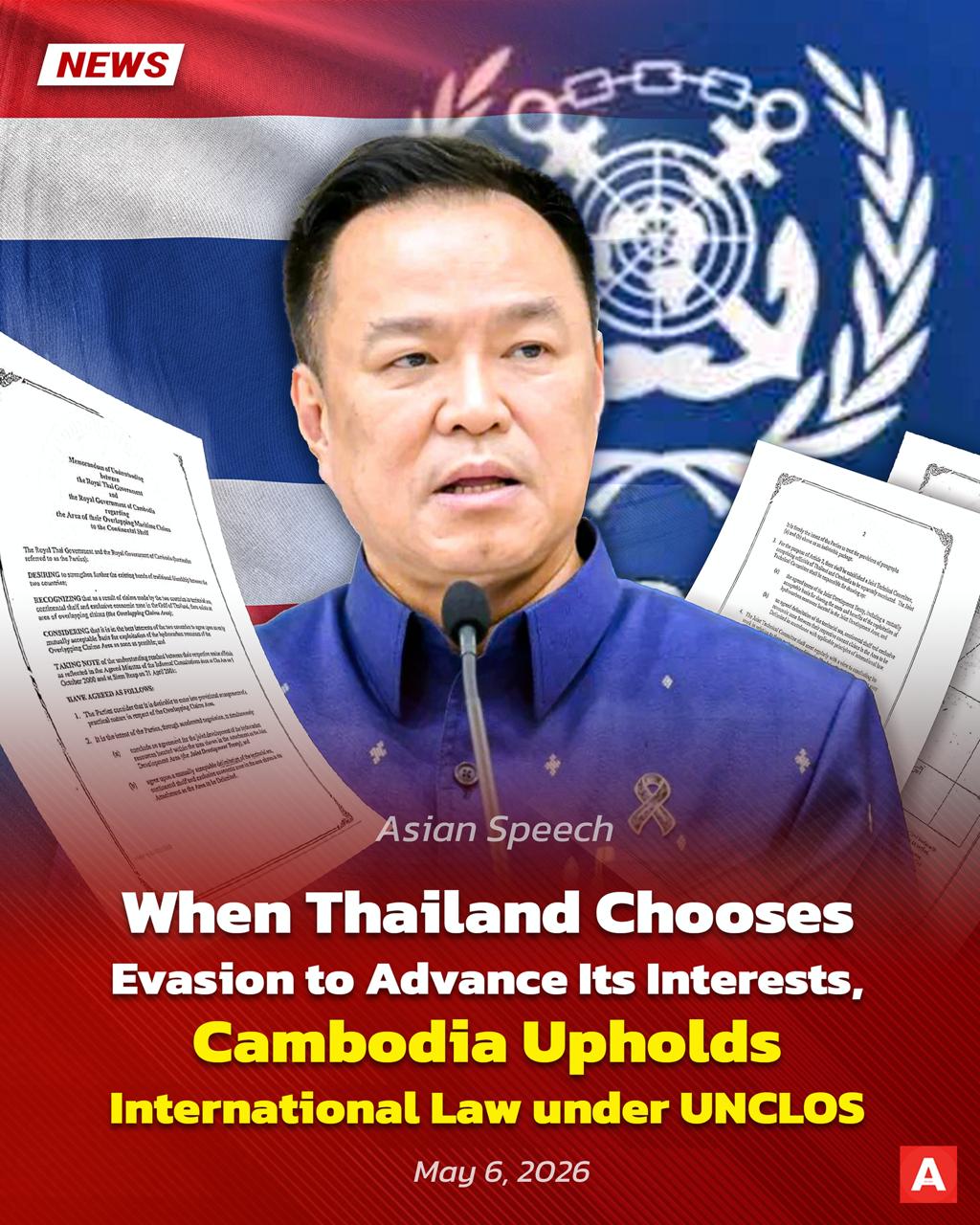 When Thailand Chooses Evasion to Advance Its Interests, Cambodia Upholds International Law under UNCLOS
The unilateral cancellation of the 2001 Memorandum of Understanding (MOU 2001) by Thailand is not a normal act, nor can it be explained as a mere “lack of progress.” It is a political move that clearly demonstrates one party’s deliberate choice to evade transparency and justice in resolving overlapping maritime boundary disputes, while also attempting to mislead public opinion about the real causes.
The question Thailand must answer is not “why has there been no progress?” but rather: who is responsible for the lack of progress? Since the 2006 coup that ousted Thaksin Shinawatra, Thailand has faced ongoing political instability and frequent changes in prime ministers. This constant leadership turnover has undermined policy continuity and disrupted previously established negotiation directions. This is the clearest cause of the so-called “lack of progress” that Thailand refers to—not Cambodia.
In contrast, Cambodia has demonstrated a level of stability that Thailand has not been able to maintain. Under the continued leadership transition from former Prime Minister Hun Sen to Prime Minister Hun Manet, Cambodia’s position has remained consistent, unwavering, and unambiguous. Cambodia does not play political games with national sovereignty. Unlike Thailand, which has used territorial disputes with neighboring countries as tools for domestic political gain, as has become increasingly evident in recent times.
More importantly, why did Thailand completely cancel the MOU 2001 unilaterally if it truly intended to continue negotiations? The answer is simple: because that mechanism could lead to a resolution that Thailand may not be able to control in the future. This cancellation is a way to dismantle the legal process and “buy time,” allowing Thailand to deliberately prolong the situation for political advantage and to boost domestic popularity.
The continued insistence that Cambodia create a new bilateral mechanism—after Thailand itself has already destroyed the existing one—is effectively forcing a return to square one. This is a tactic to delay, not a genuine effort to find a real solution. Thailand’s new government should not treat agreements related to maritime boundaries like toys to be discarded at will, because they are tied to the country’s image, values, and credibility on the international stage—not to mention its integrity in seeking transparent solutions with neighboring states.
As for the accusation that Cambodia is “internationalizing” the issue, this is a major misrepresentation. Cambodia is not running away; it is stepping into the international legal system, such as the United Nations Convention on the Law of the Sea (UNCLOS), which provides clear standards and the possibility of impartial judgment by a third party. The question that should be asked in return is: if Thailand is truly confident in its position, why fear international mechanisms?
At this point, one undeniable truth emerges: a party that dismantles existing mechanisms, rejects standardized new ones, and attempts to impose its own conditions is not acting in good faith to resolve disputes—it is evading justice.
While Cambodia stands firmly on international law, Thailand must decide whether to engage with a system of justice or continue playing political games that the world increasingly sees for what they are.
In summary, Thailand’s unilateral cancellation of the MOU 2001 cannot be described as a lack of progress; rather, it reflects the destruction of an existing mechanism and an evasion of standardized solutions. When a bilateral mechanism is abandoned by one party, demanding the creation of a new one serves no real purpose—it merely delays and creates further uncertainty.
In contrast, Cambodia’s decision to pursue international legal mechanisms such as UNCLOS is not an act of avoidance but a decisive step to ensure that any resolution is based on law, neutrality, and genuine justice.
Ultimately, the issue does not lie in the mechanisms themselves, but in the sincerity of the parties in seeking a solution. If there is genuine intent to resolve disputes, there is no reason to reject international mechanisms. Therefore, Cambodia’s move toward international law is not about defeating any party, but about achieving victory through correctness and justice alone.