Corruption Tops Obstacles to Thailand’s Economic Growth, Survey Finds
 Corruption Tops Obstacles to Thailand’s Economic Growth, Survey Finds
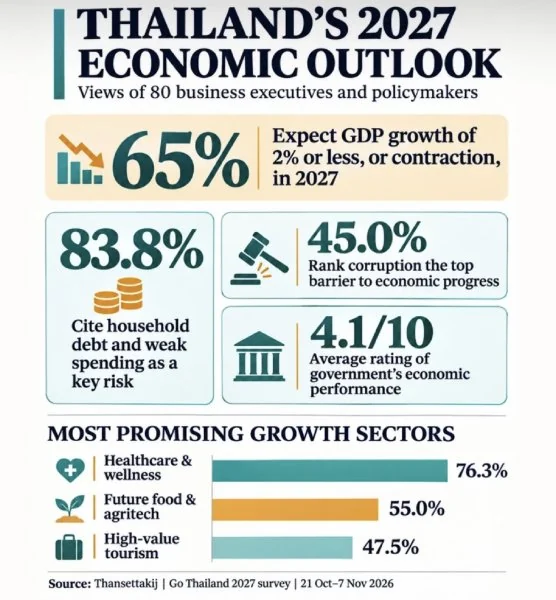
BANGKOK, November 13, 2026 — Corruption has been identified as the biggest obstacle preventing Thailand from escaping the middle-income trap, while business executives and policymakers remain pessimistic about the country’s economic outlook, with most expecting growth of 2% or less in 2027.
The findings come from the Go Thailand 2027 survey, conducted by Thansettakij between October 21 and November 7 among 80 Thai business executives and policymakers. Nearly seven in 10 respondents were chief executives, business owners or senior executives.
Corruption was identified by 45% of respondents as the single biggest barrier to Thailand’s development. It also ranked highest when participants’ three main concerns were weighted. Meanwhile, the government received an average score of just 4.1 out of 10 for its economic performance over the previous 12 months.
Weak Growth Expectations and Doubts Over Government Targets
The survey found that 42.5% of respondents expected Thailand’s economy to grow by between 1.1% and 2% in 2027, while 12.5% forecast growth of 0% to 1%. Another 10% anticipated an economic contraction.
A further 33.8% expected growth of 2.1% to 3%, while only one respondent predicted expansion exceeding 3%.
Household debt and weak domestic purchasing power were the most frequently cited economic risks, selected by 83.8% of participants. Other concerns included political uncertainty and policy continuity (45%), energy and electricity costs (38.8%), geopolitical conflicts (33.8%) and cheap Chinese imports (27.5%).
Respondents also expressed doubts about the government’s economic ambitions. More than half, or 53.8%, considered the target of becoming a high-income country within 12 years unlikely or impossible. Meanwhile, 61.3% questioned the goal of entering the world’s 20 most competitive economies by 2030, while 48.8% doubted Thailand could maintain economic growth above 3%.
Calls for Structural Reforms and New Growth Industries
Anti-corruption measures and the removal of unnecessary regulations emerged as the most urgent reforms, each receiving support from 56.3% of respondents. Other priorities included civil-service reform, digital government services and addressing household and SME debt.
Healthcare, medical services and wellness were identified as Thailand’s strongest potential growth sector over the next five years, followed by future food and agricultural technology and high-value tourism.
Despite the uncertain outlook, 45% of respondents planned to increase investment in 2027, although 31.3% intended to reduce, postpone or suspend investment.
The survey also highlighted concerns about energy costs and workforce readiness. Some 85% supported reviewing electricity contracts and tariffs, while 77.5% backed direct purchases of renewable electricity.
Thailand’s workforce readiness for future industries received an average score of 2.7 out of five. Digital and artificial intelligence skills were identified as the biggest workforce shortages, followed by engineering expertise and analytical skills.
The findings suggest that business leaders see corruption, household debt, weak purchasing power and structural weaknesses as major challenges that Thailand must address to achieve its long-term economic ambitions.