May 28 border skirmish has grown into a regional flashpoint
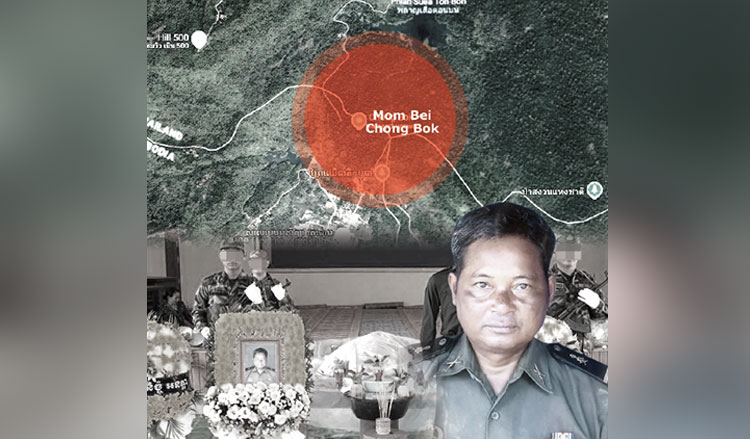 Montage shows the memorial service of Warrant Officer Suon Roun, who lost his life in a gunfight with Thai soldiers last year against a map of the Mom Bei area where a Cambodia-Thailand skirmish took place on May 28, 2025. Khmer Times / TVK
Synopsis: A brief clash between troops at the Emerald Triangle was the spark that reignited a dormant territorial dispute into the most serious Cambodia–Thailand crisis in years, triggering repeated military confrontations and a simmering row that diplomatic efforts have just barely managed to contain.
One year later, the May 28 clash between Cambodian and Thai soldiers at the Emerald Triangle has escalated into the most serious Cambodia–Thailand crisis in years.
On that day, brief but deadly fighting between Cambodian and Thai troops in the remote border area where Cambodia, Thailand and Laos meet reignited one of Southeast Asia’s longest-running territorial disputes and triggered a year of escalating tensions that reshaped relations between the two neighbouring kingdoms.
Trading blame
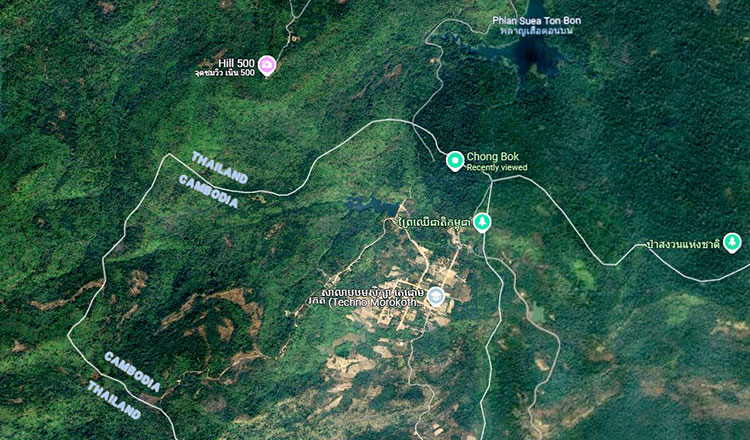
The confrontation took place in the disputed area known in Cambodia as Mom Bei and in Thailand as Chong Bok, near Cambodia’s Preah Vihear province and Thailand’s Ubon Ratchathani province. The exchange of gunfire reportedly lasted around 10 minutes, but its consequences extended far beyond the battlefield. During the clash, Cambodian soldier Warrant Officer Suon Roun was killed, becoming the first confirmed fatality in a renewed phase of the border conflict.
Immediately after the incident, both governments accused each other of provoking the violence. Cambodian authorities said Thai soldiers opened fire first on Cambodian troops stationed in what Phnom Penh described as a long-established Cambodian military position. Thai officials said Cambodian soldiers entered disputed territory and refused to withdraw after being warned.
The clash revived memories of the Preah Vihear Temple conflict between 2008 and 2011, when fighting around the ancient temple area caused multiple deaths and displaced thousands. Although tensions along the border never went away completely after the fighting, the Mom Bei incident marked the first direct military confrontation between the two countries in years and signalled the beginning of a much broader crisis.
Escalation and economic retaliation
In the days that followed the Mum Bei incident, both sides attempted to contain the situation. Senior military commanders from Cambodia and Thailand met along the border on May 29 in an effort to prevent further violence. Official statements from both governments emphasised peace and restraint, but behind the scenes, troop reinforcements were already being deployed.
Additional Cambodian and Thai soldiers were sent to border areas, military readiness levels were raised, and nationalist sentiment quickly intensified on social media in both countries.
Cambodian officials accused Thailand of violating Cambodian sovereignty, while Thai nationalist groups called for a tougher military response.
Cambodia and Thailand had officially entered a prolonged diplomatic, political and military crisis. Cambodia moved to bring disputed border areas before the International Court of Justice, while Thailand rejected international arbitration and insisted on bilateral negotiations through existing mechanisms like the Joint Boundary Commission. Diplomatic talks quickly stalled, with both sides reinforcing troops along the border and accusing each other of aggression.
The dispute soon expanded beyond military tensions into economic and political retaliation. Cambodia restricted Thai entertainment content, reduced certain Thai imports and encouraged boycotts of Thai products, while Thailand tightened border controls and imposed restrictions at checkpoints, disrupting trade and border livelihoods.
Open warfare
The crisis intensified dramatically after a leaked phone conversation between Cambodian Senate President Hun Sen and Thai Prime Minister Paetongtarn Shinawatra triggered a political storm in Thailand. Critics accused Paetongtarn of undermining Thai sovereignty, leading to coalition instability, nationalist protests and eventually her suspension by Thailand’s Constitutional Court.
Military tensions escalated further throughout June and July last year, culminating in major clashes on July 24 across multiple border sectors. Heavy artillery, rockets and Thai F-16 airstrikes employed by the Thai side marked the deadliest fighting between the neighbours in more than a decade, displacing hundreds of thousands of civilians and causing dozens of deaths.
International concern quickly mounted, prompting ASEAN-led mediation efforts under Malaysian Prime Minister Anwar Ibrahim. Cambodia and Thailand agreed to an “immediate and unconditional” ceasefire on July 28, but sporadic clashes and accusations continued afterwards, with both sides blaming each other for violating the ceasefire.
In December, Cambodia and Thailand descended into another round of heavy fighting. Clashes erupted near disputed frontier zones, including areas around Preah Vihear, with both sides accusing each other of initiating attacks. The violence quickly escalated into heavy military confrontations involving artillery, rockets, drones and Thai F-16 airstrikes against Cambodian positions, while Cambodia reinforced troops along the border.
The renewed conflict caused a serious humanitarian crisis, displacing hundreds of thousands of civilians as villages were evacuated and schools shut down near the frontier. More than 100 people were reportedly killed during the fighting. The escalation alarmed ASEAN and the wider international community, prompting mediation efforts led by Malaysia alongside calls for restraint from China and the United States.
After roughly 20 days of clashes, Cambodia and Thailand agreed to a new “immediate ceasefire” on December 27. Although the agreement halted large-scale fighting, the border situation remained uneasy, with both countries continuing to accuse each other of truce violations, leaving relations between the two nations deeply strained heading into 2026.
Regional perspectives
A week ago, Mr Hun Sen described May 28 as “a day of remembrance of the aggression and violation of Cambodia’s sovereignty.”
Kin Phea, director-general of the International Relations Institute of Cambodia, said yesterday that the border conflict stems from Thailand’s historical ambitions regarding its neighbour.
“We see that there have been many diplomatic efforts to end hostilities, to end the conflict, and to move toward a ceasefire between the two countries,” Phea said. “However, the major issue is that the Thai side has not been sincere, lacking the will and commitment to resolve the dispute peacefully, based on diplomatic mechanisms and international law.”
Phea added that tensions remain because provocations from the Thai side are ongoing.
“Cambodia always firmly upheld a peaceful solution and consistently adhered to resolving the issue through diplomatic mechanisms and international law,” Phea said. “However, diplomatic efforts have yet to produce results.”
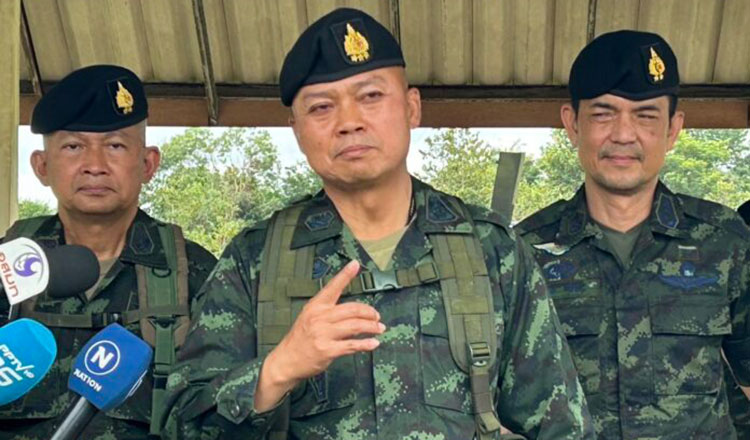
Youk Chhang, director of the Documentation Centre of Cambodia, said Cambodia needs to single out Lt Gen Boonsin Padklang, the former commander of Thailand’s Second Army Region who was initially in charge of border operations with Cambodia, for his role in escalating the dispute.
“Based on the evidence currently available, there are significant concerns about Thai Lieutenant General Boonsin Padklang, who appears to have issued the command to close the border with Cambodia, and who allegedly ordered the killing of an unarmed Cambodian soldier and the torture of prisoners of war,” Chhang said. “Further, he allegedly stated his intention to seize the Cambodian capital of Phnom Penh.”
Youk added that the doctrine of command responsibility in the law of armed conflict applies to superiors when their subordinates have committed unlawful acts, particularly during an international armed conflict.
“There must be an investigation into the matter,” Youk said.
Khmer Times