Thailand Deepens Cooperation with China Ahead of Trade Talks with Trump
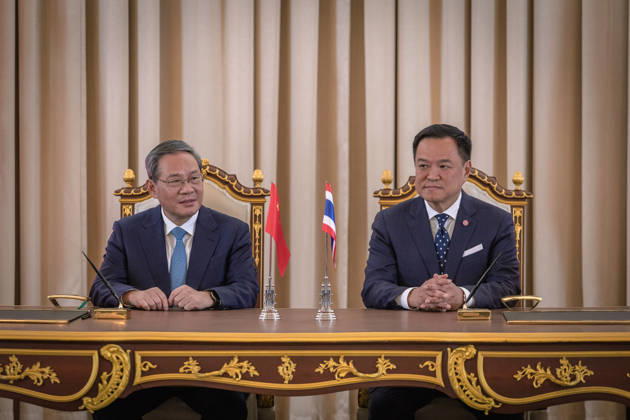 Chinese Premier Li Qiang - Thai Prime Minister Anutin Charnvirakul meeting in Bangkok BANGKOK, THAILAND - NOVEMBER 13: Chinese Premier Li Qiang and Thai Prime Minister Anutin Charnvirakul attend a joint press conference following the signing ceremony of memorandums of understanding between the two countries at Government House during Li s official visit to Bangkok, Thailand on November 13, 2026. Wissarut Weerasopon / Anadolu Bangkok Thailand. Editorial use only. Please get in touch for any other usage. PUBLICATIONxNOTxINxTURxUSAxCANxUKxJPNxITAxFRAxAUSxESPxBELxKORxRSAxHKGxNZL Copyright: x2026xAnadoluxWissarutxWeerasoponx
BANGKOK, November 17, 2026 — Chinese Premier Li Qiang signed eight cooperation agreements with Thailand during a three-day visit, covering electric vehicles, batteries, agricultural exports, industrial supply chains, security and technical cooperation, as Bangkok seeks to strengthen ties with Beijing ahead of an expected trade announcement with US President Donald Trump.
Li’s official visit took place from November 13 to 15, with the main bilateral meetings held on Friday. Thai Prime Minister Anutin Charnvirakul welcomed the Chinese leader at Government House, where the two sides exchanged eight cooperation documents.
The visit came as Thailand prepared for ASEAN meetings in Manila from November 15 to 17. Anutin is expected to meet Trump and announce an understanding on the main elements of an Agreement on Reciprocal Trade. However, the planned communiqué is not a final bilateral trade agreement, and its precise terms have not been made public.
Eight agreements, but major commercial questions remain
The eight documents cover electric and intelligent vehicles, battery technology, recycling, industrial supply chains, food safety, agricultural inspection, vocational education, commercial standards and consular staffing.
They also include a memorandum linked to China’s Global Security Initiative, providing a framework for closer strategic dialogue. However, the published documents do not establish a military alliance or restrictions on Thailand’s existing security cooperation with the United States.
Both governments also discussed telecommunications fraud, online gambling, cybercrime and the safety of Chinese tourists. No comprehensive new joint enforcement package was announced.
On the investment front, Anutin said Chinese companies had submitted nearly 500 investment promotion applications in Thailand during the first nine months of 2026. He said Bangkok wanted Chinese investment to generate greater benefits for domestic manufacturers through increased local component production and stronger supply chains.
However, the applications do not guarantee that the proposed factories will be built or that the investment will materialise.
The electric vehicle memorandum reinforces existing cooperation between Chinese manufacturers and Thai suppliers, including battery production, recycling, technical standards and supply chains. No additional investment total or list of new projects was disclosed.
US trade conditions could affect Thai manufacturers
Thailand is seeking to maintain strong economic relations with both China and the United States. China is a major source of industrial investment, technology and manufactured components, while the United States remains an important export market for Thai businesses.
Washington has raised concerns about Chinese products entering US markets through Southeast Asian countries to avoid tariffs. These concerns could affect Thai manufacturers that use Chinese components or receive Chinese investment.
Future US rules could require closer scrutiny of product origins, imported parts and supply chains before goods qualify for access to the American market.
The Trump administration’s reciprocal trade frameworks have also addressed issues beyond tariffs, including investment screening, export controls and economic security. Potentially affected sectors include electronics, semiconductors, artificial intelligence and advanced manufacturing.
However, the precise implications for Thai industry remain unclear.
Anutin is expected to meet Trump during the Manila meetings before travelling to Shenzhen on November 18 and 19. Li is also scheduled to attend the China-ASEAN Summit in Manila.
Neither government has established that the Bangkok agreements were negotiated in response to specific US conditions. There has also been no verified disclosure that Li asked Thailand to reject, delay or change its planned trade statement with Washington.
Rice purchase and railway funding remain unresolved
Agriculture produced some of the more specific outcomes of Li’s visit. Thailand secured updated export protocols for durian and salacca, while both governments agreed to strengthen food-safety and agricultural inspection cooperation.
The measures could help Thai exporters meet technical requirements for the Chinese market, although their commercial impact will depend on implementation.
However, a proposed Chinese purchase of 500,000 tonnes of Thai rice did not materialise. No binding contract, price, delivery schedule or final purchasing arrangement was announced during the signing ceremony.
Infrastructure also remained an outstanding issue. Anutin reaffirmed Thailand’s target of opening the first phase of the high-speed railway by 2030 and preparing its second phase.
The railway is intended to connect Thailand through Laos to China as part of wider regional connectivity plans. However, neither side announced a new funding package for the full cross-border route or a revised completion guarantee.
China also offered technical assistance and monitoring equipment to address cross-border water pollution. The two countries discussed establishing a joint water-testing laboratory in northern Thailand, but no construction timetable or comprehensive financing arrangement was disclosed.
At a state dinner at Government House on Friday evening, Anutin said stable Thai-Chinese relations would benefit both countries and contribute to regional prosperity amid international uncertainty.
Li referred to more than 2,000 years of relations between the two countries, recalling the establishment of formal diplomatic ties in 1975. He said bilateral cooperation had continued without interruption and highlighted mutual support during natural disasters and economic difficulties.
The next major test will come in Manila, where Thailand’s expected trade understanding with Washington could shape how comfortably Bangkok balances Chinese investment and industrial cooperation with continued access to the US market.