Cambodia’s Diplomatic Path Forward: Seeking a Peaceful Resolution to the Cambodia–Thailand Maritime Dispute
 Cambodia’s Diplomatic Path Forward: Seeking a Peaceful Resolution to the Cambodia–Thailand Maritime Dispute
The first meeting of the Conciliation Commission under Annex V of the United Nations Convention on the Law of the Sea (UNCLOS) between Cambodia and Thailand, scheduled to take place in Singapore from September 14 to 16, 2026, represents a noteworthy step toward addressing the overlapping maritime claims between the two countries.
This process comes after Thailand terminated the 2001 Memorandum of Understanding (MoU), which had previously served as a framework for Cambodia and Thailand to discuss their overlapping maritime areas. Following this development, Cambodia turned to the compulsory conciliation mechanism under the United Nations Convention on the Law of the Sea (UNCLOS) in order to continue seeking a legal and peaceful resolution through an alternative mechanism.
For Cambodia, participation in this process demonstrates that the Royal Government continues to prioritize diplomacy and negotiation rather than confrontation. The maritime dispute between Cambodia and Thailand has a long history and is not an issue that can be resolved within a short period of time. Therefore, having an official forum where both sides can engage in dialogue is important.
The dispute is complex because it involves legal, historical, technical, and national-interest considerations. Attempting to resolve it hastily or through pressure could make the issue even more difficult. By contrast, continuing negotiations with patience and making use of mechanisms recognized under international law could provide an opportunity for both sides to identify areas where agreement may be possible.
At the meeting, Cambodia will be represented by H.E. Prak Sokhonn, Deputy Prime Minister and Minister of Foreign Affairs and International Cooperation, as Cambodia’s representative, while H.E. Lam Chea, Senior Minister in charge of the Border Affairs Secretariat, will serve as the alternate representative, along with legal experts, technical officials, and other members of the relevant working teams. The composition of this delegation demonstrates Cambodia’s approach of addressing both the legal and technical aspects of the process.
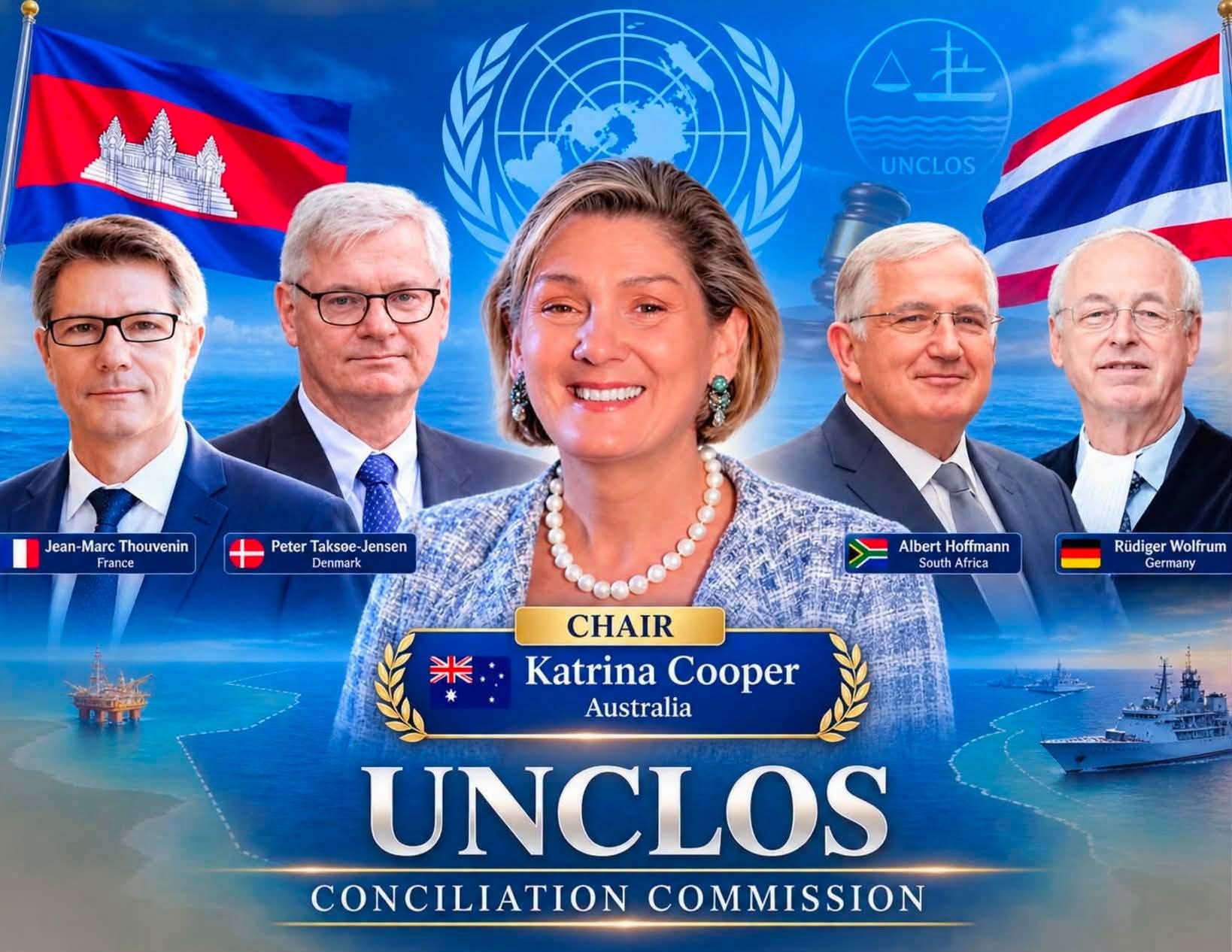
It should also be recalled that the Conciliation Commission consists of five conciliators. Cambodia appointed Peter Taksøe-Jensen and Jean-Marc Thouvenin, while Thailand appointed Rüdiger Wolfrum and Albert Hoffmann. The four conciliators subsequently selected Ms. Katrina Cooper to serve as Chair of the independent Commission.
Another noteworthy aspect is the decision to allow the proceedings to be open to the public. This can help citizens obtain information directly and gain a clearer understanding of the process taking place. For a sensitive issue such as a border dispute, transparency is important because a lack of information can lead to misunderstandings or differing interpretations.
An encouraging point is that both sides now have an opportunity to engage in dialogue within a framework based on international law. Participation in the conciliation process does not mean that either side must give up its national interests. On the contrary, it provides a means for each side to put its position on the negotiating table and seek a solution that can be accepted by both parties.
The issue is also connected to economic opportunities in the overlapping maritime area, particularly natural resources and the potential for oil and gas development. If Cambodia and Thailand can reach a legally based agreement, an area that has long been a source of disagreement could potentially become an area where both sides identify shared interests and mutual benefits.
Nevertheless, expectations should not be set too high that the initiation of the conciliation process will bring the dispute to an immediate end. This issue, which has remained unresolved for more than two decades, requires time, careful negotiations, and political will from both sides. What is important at this stage is to ensure that existing disagreements over the border issue do not become an obstacle that prevents continued dialogue.
For Cambodia, maintaining patience and continuing to rely on diplomatic means is an approach that can help preserve an environment conducive to negotiations. At the same time, legal and technical preparations are equally important to ensure that Cambodia’s interests are clearly and effectively protected throughout the negotiation process.
Ultimately, the goal is not merely to bring an end to a dispute, but to find a solution that enables Cambodia and Thailand to continue living alongside each other with greater trust and stronger cooperation. If both sides can find common ground through international law and peaceful means, an issue that has caused disagreement for many years could open the way for new forms of cooperation and shared benefits in the future.
By: Pin Vichey