
Cambodia Chooses the Rule of Law, Rejects “Fait Accompli” and the Prolongation of Border Disputes
 Cambodia Chooses the Rule of Law, Rejects “Fait Accompli” and the Prolongation of Border Disputes
In the theory of international relations and international law, one of the most important criteria for assessing a state’s sincerity in resolving disputes is not found in political declarations, but rather in the concrete actions it takes when confronted with a dispute. States that are confident in the strength of their legal and factual arguments generally welcome the use of legal mechanisms and peaceful dispute-settlement procedures. Conversely, states that seek to delay proceedings or maintain ambiguity are often perceived as attempting to create new advantages on the ground before a legal resolution is formally determined.
In this context, Cambodia’s position regarding its land and maritime boundary disputes with Thailand clearly reflects a strategic choice grounded in international law rather than power politics or the creation of pressure through facts on the ground. Cambodia’s decision to notify the United Nations and initiate the mechanism of Compulsory Conciliation under the framework of the United Nations Convention on the Law of the Sea (UNCLOS) is not merely a procedural step. It is also a clear political message to the international community that Cambodia seeks to resolve disputes through the authority of law rather than the authority of force.
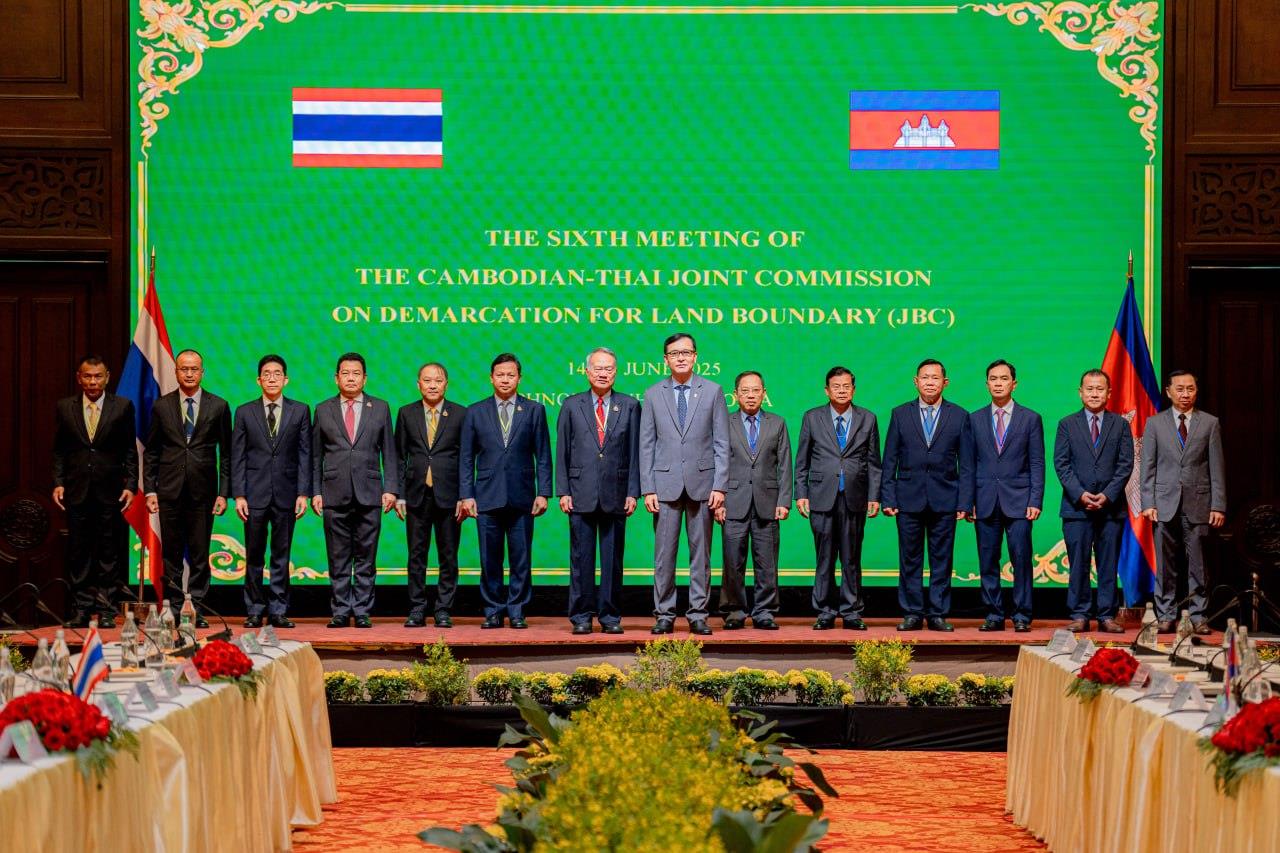
What is particularly noteworthy, however, is that while Cambodia is actively pursuing legal and international mechanisms for dispute settlement, Thailand continues to advocate a return to bilateral negotiations and has repeatedly delayed the work of the Joint Boundary Commission (JBC). From the perspective of international politics, the key question is not whether bilateral negotiations are inherently good or bad, but whether Thailand possesses sufficient political will to implement the outcomes of such negotiations.
In practice, Cambodia has submitted several diplomatic notes requesting special meetings of the JBC and the deployment of Joint Survey Teams (JSTs) to conduct field operations on the ground. Nevertheless, Thailand has repeatedly sought postponements, citing domestic political circumstances and the formation of a new government. More significantly, even after the establishment of Thailand’s new government, the formal appointment of a new Thai JBC delegation has yet to be completed.
From the perspective of international relations, this situation raises an unavoidable question: Is this delay merely a technical issue, or does it represent a political strategy aimed at preserving the status quo and prolonging the dispute?
This question becomes even more significant in light of assertions by Cambodia’s Secretariat of State for Border Affairs that Thailand continues to undertake activities in areas that Cambodia considers to be within its sovereign territory. Under international law, such actions may be examined through the concept of fait accompli, which refers to the creation of a new factual situation on the ground and the subsequent attempt to transform that situation into an irreversible reality.
Throughout international history, some states have sought to employ this method by establishing occupation or altering conditions on the ground and then using those newly created realities as the basis for political or legal claims.
As a fundamental principle, “rights cannot arise from unlawful acts.” This doctrine forms one of the cornerstones of the contemporary international legal order. It means that territorial acquisition through unlawful means, the use of force, or the creation of new realities contrary to international law cannot generate legitimate legal rights. This is also why Articles 2(3) and 2(4) of the United Nations Charter impose an obligation on all states to settle disputes by peaceful means and prohibit the threat or use of force against the territorial integrity of other states.
What is even more significant is that in international disputes, the critical question is not simply “who fired first,” but rather “who created the conditions that made the use of force possible.” Consequently, any actions or rhetoric suggesting that disputed territory must be “reclaimed” may raise concerns that political foundations are being laid for future pressure or other forms of escalation.
In this context, Cambodia’s position demonstrates a remarkable consistency between principle and practice. On the one hand, Cambodia continues to support and encourage bilateral mechanisms such as the JBC and JSTs to carry out their technical work professionally in order to survey and demarcate the border in accordance with agreements and legal instruments recognized by both parties. On the other hand, Cambodia is utilizing international mechanisms to ensure that the dispute is not resolved through the creation of a fait accompli on the ground. This strategy is designed not only to protect Cambodia’s sovereignty, but also to safeguard its legal legitimacy within the international system.
Overall, the Cambodia–Thailand border issue today is not a contest between military forces. Rather, it is a contest between the “power of law” and the “power of facts on the ground.” While one side is advancing legal mechanisms and international institutions, the other faces questions as to whether delays and activities on the ground are creating conditions for a new reality that could ultimately serve its interests.
For Cambodia, rejecting fait accompli is not merely a political position. It is a defense of a fundamental principle of international law: that territorial integrity cannot be altered through force or through the creation of new facts on the ground. In an era where legitimacy carries a value equal to that of power, Cambodia’s choice of legal and diplomatic avenues is becoming a vital foundation for protecting national interests and pursuing a sustainable and peaceful resolution.
By Pin Vichey
Political Science Scholar