Bangkok Sinks 8.5mm a Year as Seas Continue Rising
 Bangkok Sinks 8.5mm a Year as Seas Continue Rising
BANGKOK, May 21, 2026 — Bangkok is sinking at one of the fastest rates among major cities worldwide, scientists have warned, as land subsidence combines with rising sea levels to heighten flood risks across the Thai capital.
A new study led by researchers from the Technical University of Munich found that heavily urbanised coastal regions are experiencing relative sea level rises of about 6 millimetres annually, roughly three times the global average increase of 2.1 millimetres per year.
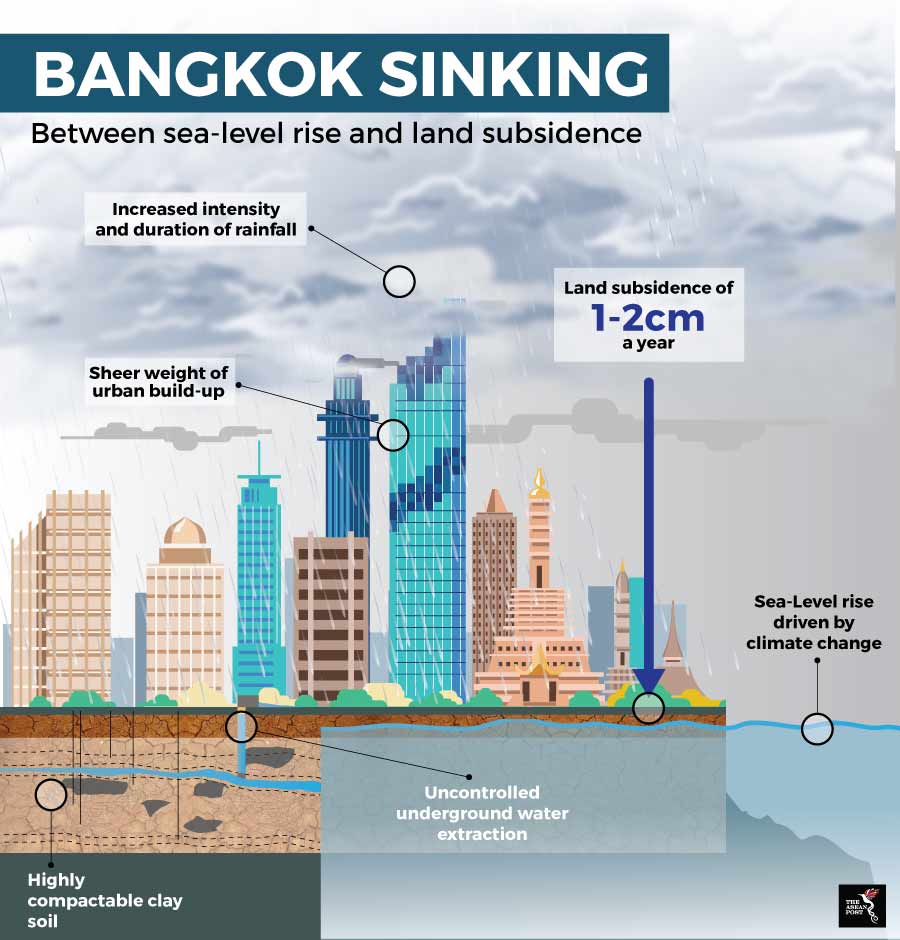
The study identified Bangkok as a major subsidence hotspot, with the city sinking by an average of 8.5 millimetres annually.
Researchers said the combined effects of climate-driven sea level rise and sinking land are making densely populated coastal cities increasingly vulnerable to flooding, especially during storms and extreme weather events.
Scientists said rising global sea levels are primarily caused by melting glaciers and the thermal expansion of warming oceans. However, they warned that land movement itself is significantly worsening the problem in many cities, particularly across Asia and Africa.
The study pointed to excessive groundwater extraction, oil drilling and the growing weight of urban development as major causes of subsidence. As cities expand and high-rise buildings place additional pressure on soft ground, soil layers gradually compress and sink.
Thailand was among several countries identified as facing some of the fastest increases in relative sea levels, alongside Bangladesh, Nigeria, Egypt, China and Indonesia, where sea levels are rising between seven and 10 millimetres annually.
Jakarta was named the world’s fastest-sinking city, subsiding by 13.7 millimetres per year, while Tianjin in China was recorded at 13.5 millimetres annually. In some parts of Jakarta, subsidence rates reportedly reach 42 millimetres per year, leaving nearly 40% of the city below sea level.
Lead researcher Dr. Julius Oelsmann said land movement could “significantly amplify the effects of climate-driven sea-level rise.”
“If we want to understand sea-level rise along coastlines and respond effectively, we must not only observe the ocean but also the land itself,” he said.
Co-author Professor Florian Seitz said stricter government regulation could help slow subsidence rates. He cited Tokyo as an example, where severe subsidence exceeding 10 centimetres annually was substantially reduced after authorities imposed tighter groundwater extraction controls.
Researchers said measures such as improved groundwater management, regulation of extraction and aquifer recharge projects could help slow subsidence in vulnerable cities including Bangkok.
The study also warned that continued delays in cutting greenhouse gas emissions could accelerate future sea level rise, with projections suggesting global oceans could rise by as much as 1.2 metres by 2300 even if the Paris climate agreement targets are achieved.