Ta Moan Thom and Khna Temples Are Located in Cambodian Territory: Defending Historical Truth, Not Escalating Tensions
 Ta Moan Thom and Khna Temples Are Located in Cambodian Territory: Defending Historical Truth, Not Escalating Tensions
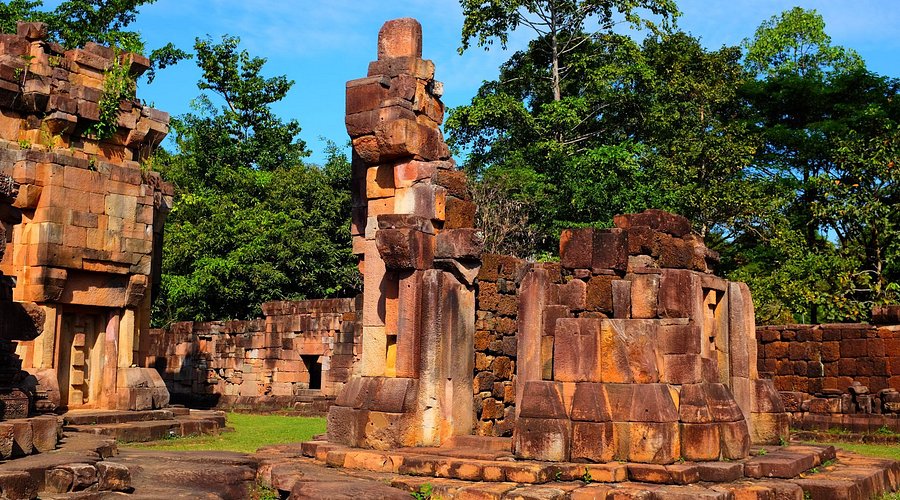
The recent clarification by Mr. Ith Sothea, Permanent Secretary of State of Cambodia’s Secretariat of Border Affairs, regarding the locations of Ta Moan Thom Temple and Khna Temple has attracted significant public attention. His statement affirmed that both temples are situated within Cambodian territory, based on the 1:200,000 scale maps and the official Franco-Siamese boundary delimitation documents. This clarification, however, should be understood as an affirmation of facts grounded in official records, historical evidence, and established legal foundations—not as an attempt to escalate tensions or create a new dispute between the two countries.
Cambodia’s position is primarily based on the 1:200,000 scale maps, the official Franco-Siamese boundary delimitation documents, and the 1908 survey records prepared by the Franco-Siamese Mixed Boundary Commission. These documents clearly demonstrate that both Ta Moan Thom Temple and Khna Temple lie within Cambodia’s sovereign territory.
What is even more noteworthy is that Thailand’s own unilaterally produced L7017 map series at the 1:50,000 scale also indicates that Ta Moan Thom Temple is located within Cambodian territory. Verification of the map shows that the temple is situated approximately 170 meters inside Cambodia from the international boundary line as determined by the internationally recognized 1:200,000 historical maps.
This demonstrates that the supporting evidence is not limited to the historical documents and maps relied upon by Cambodia. Even the maps produced and used by Thailand itself make it difficult to deny the temple’s actual geographical location.
Furthermore, verification through satellite imagery and modern geospatial technology provides additional confirmation that Ta Moan Thom Temple is situated entirely within Cambodian territory.
Accordingly, Cambodia’s position is not based on political sentiment or nationalism. Rather, it rests upon verifiable technical evidence, historical documentation, and established legal principles.
Another important issue concerns Thailand’s unilateral delineation of a boundary line in the Ta Moan Thom area. Under international law, a boundary line drawn unilaterally by one state, without the consent of the other concerned state, cannot create new sovereign rights or alter an existing legal boundary. Any unilateral action undertaken by Thailand therefore cannot constitute legal evidence of territorial sovereignty.
In this context, Cambodia’s concern centers on Thailand’s apparent attempt to create a fait accompli—that is, to establish “new facts on the ground.” In international relations, the term fait accompli refers to actions by one party aimed at creating a new situation on the ground so that it becomes a reality that is difficult to reverse, thereby compelling the other party to accept the altered status quo at a later stage.
From Cambodia’s perspective, the continued occupation of areas whose boundaries have not yet been mutually agreed upon, together with attempts to introduce new unilateral boundary lines, may lead the public to mistakenly believe that such areas belong to Thailand. Therefore, the clarification issued by the Secretariat of Border Affairs constitutes Cambodia’s legitimate exercise of its sovereign right to present evidence and safeguard its legal position before such misconceptions gradually become accepted by implication within the international community.
Moreover, the Joint Statement of 27 December 2025, particularly Paragraph 3, clearly stipulates that any agreements reached under the Joint Statement shall not prejudice the delimitation and demarcation of the international boundary between the two countries.
Both sides also agreed to entrust the Joint Boundary Commission (JBC) with expediting the survey and demarcation of the land boundary in accordance with the existing agreements between Cambodia and Thailand, with the objective of achieving lasting peace along the common border.
To date, however, the process of boundary survey and demarcation has continued to face delays due to repeated postponements by the Thai side, despite Cambodia having consistently expressed its readiness to proceed in accordance with the existing bilateral agreements. In this regard, Cambodia’s clarification does not seek to alter the status quo on the ground. Rather, it serves as a reminder of the obligations that both parties have already accepted.
In particular, Thailand’s assertion that maritime boundary issues should be addressed first while leaving the land boundary issue aside is inconsistent with the existing legal mechanisms governing the two matters. Land and maritime boundary disputes are distinct legal issues governed by different dispute-settlement frameworks. Land boundary issues are to be addressed through the Joint Boundary Commission (JBC) and the established bilateral mechanisms, whereas maritime boundary issues are subject to the procedures provided under the United Nations Convention on the Law of the Sea (UNCLOS).
Therefore, Cambodia’s clarification regarding Ta Moan Thom Temple and Khna Temple should not be interpreted as an attempt to create a new dispute. Rather, it represents a reaffirmation of Cambodia’s legal position based on existing historical documents, maps, and official survey records. At a time when boundary demarcation has yet to be accelerated and concerns remain over attempts to create new facts on the ground, presenting evidence and explaining the facts to the public constitutes Cambodia’s legitimate responsibility to safeguard its sovereignty, defend historical truth, and prevent interpretations that could lead to misunderstandings regarding the existing international boundary between Cambodia and Thailand.
By Pin Vichey
Political Science Scholar